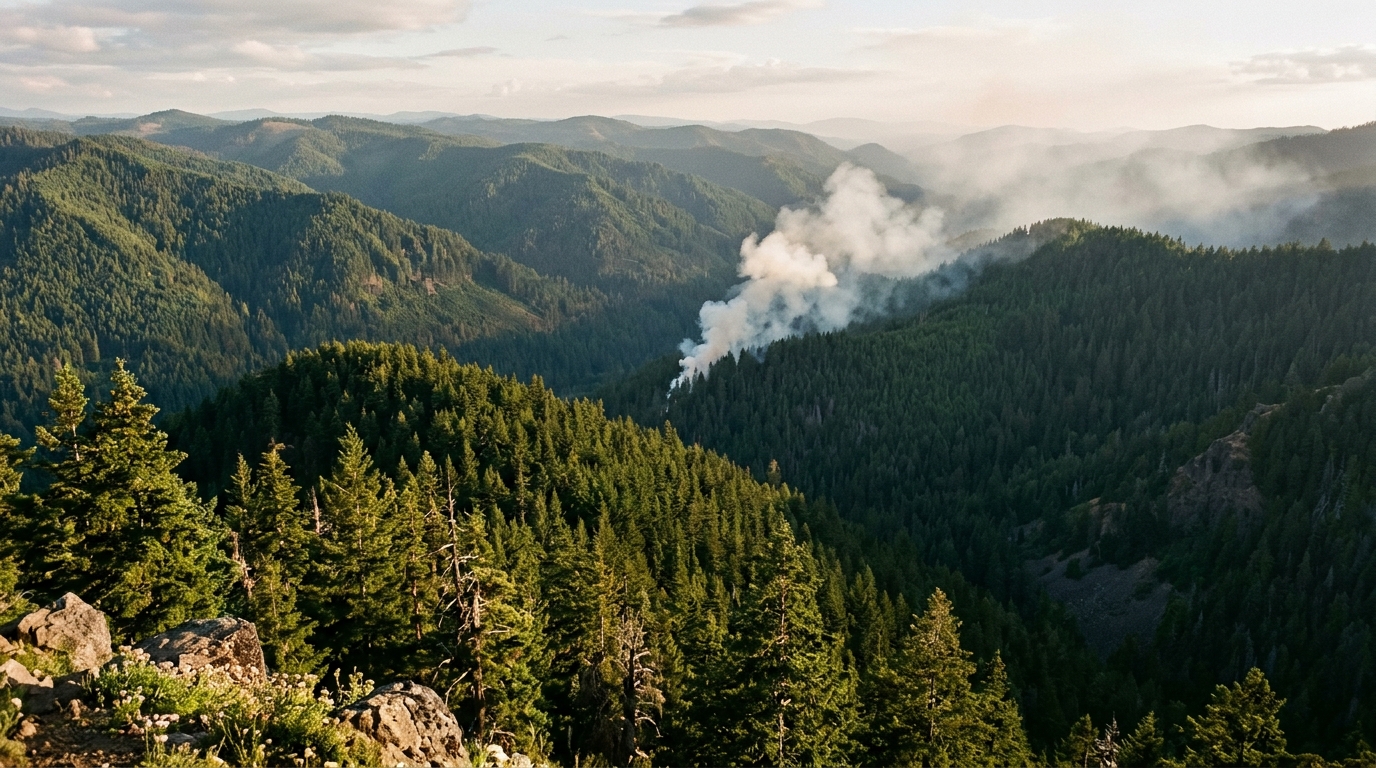
A new lightweight artificial intelligence model can spot flames and smoke in forest fire imagery with higher accuracy than standard detection networks while running fast enough for real-time monitoring. The model, called YOLOv8-CNR, was built by researchers at Shanxi Agricultural University by modifying the popular YOLOv8n object detector at three points: the backbone that extracts features, the neck that fuses multi-scale features, and the loss function that governs how tightly predicted boxes fit their targets. On a synthetic forest wildfire benchmark, the improved model reached 79.8% mAP50 and 39.4% mAP50-95 with only 2.52 million parameters, gains of 7.5 and 2.6 percentage points over a tuned YOLOv8n baseline, while still processing 238.1 frames per second.
The motivation comes from the peculiar visual character of fire itself. Flames appear as locally bright regions with irregular, rapidly shifting edges, so recognizing them depends on high-frequency cues such as salient edges, texture mutations, and intensity jumps. Smoke is nearly the opposite problem: low-contrast, weakly textured, blurred in outline, and spatially diffuse, demanding that a network model large-scale context and continuous weak responses. Forest backgrounds compound both difficulties with canopy shadows, sky, clouds, and vegetation textures that mimic target features. Conventional monitoring tools such as lookout towers, satellite remote sensing, and optical sensors are constrained by manpower, revisit cycles, and cloud or fog interference, which is why the researchers turned to deep learning-based visual detection for real-time perception in high-risk forest areas.
The first modification targets feature extraction. The team introduced a C3_ConvNeXtv2 module into the backbone, replacing the original structure at multi-layer downsampling stages. The module keeps the dual-branch feature aggregation idea of the C3 structure but places ConvNeXtv2 blocks in the main branch to deepen semantic modeling and spatial context awareness, while a lightweight auxiliary branch preserves local details. Each ConvNeXtv2 block uses a 7 by 7 depthwise convolution to expand the receptive field cheaply, then applies tensor rearrangement, layer normalization, channel expansion, GELU activation, and global response normalization before compressing channels back and adding a residual connection. Global response normalization strengthens channels carrying discriminative value and suppresses those dominated by background interference, which the authors say helps the network jointly represent salient flame edges and weakly textured smoke regions.
The second modification addresses the neck, the stage where features from different resolutions must be merged. Small-target smoke information tends to attenuate during multi-scale propagation, so the researchers installed RepNCSPELAN4, a module that combines the CSP split-aggregation concept, the ELAN cascade expansion idea, and a re-parameterized feature extraction mechanism. Input features are split along the channel dimension: one part is retained shallowly and concatenated later, preserving flame edges and early smoke contours, while the other passes through two cascaded sub-modules, each built from a RepNCSP block followed by a 3 by 3 convolution, for progressive semantic enhancement. The four resulting feature paths are concatenated and fused by a 1 by 1 convolution. According to the authors, this split-retention, progressive-enhancement, concatenation-fusion design maximizes small-object recall gains at minimal computational overhead compared with complex structures such as BiFPN and NAS-FPN.
The third change is in the loss function. The original YOLOv8n uses CIoU for bounding box regression, which adds center distance and aspect ratio penalties to IoU but does not explicitly consider directional offset between predicted and ground-truth boxes. For flames that change shape abruptly and smoke that diffuses with the wind, large angular deviations can occur, and CIoU is prone to path oscillation, slow convergence, or local optima. The team adopted the SIoU loss, which introduces an angle cost term alongside distance and shape costs to constrain regression from three dimensions: direction, position, and scale. The angle cost describes the offset direction of the predicted box center relative to the ground-truth center, letting the prediction converge along a more direct path, while the distance and shape terms adaptively penalize positional and dimensional mismatch. The authors report this improves localization of irregular flame boundaries and blurred smoke regions.
Evaluation used M4SFWD, a synthetic forest wildfire remote sensing dataset generated in Unreal Engine 5, containing 3,974 pixel-level annotated images with 17,763 bounding boxes, 9,627 for flame and 8,136 for smoke, spanning mountain lake, snowfield, woodland, and mixed scenes under sunny, foggy, rainy, and snowy weather and day, dusk, and night lighting. The researchers applied a trajectory-level split in which each of the 28 camera runs is assigned exclusively to one subset: 17 runs with 2,803 images for training, 5 runs with 569 images for validation, and 6 runs with 602 images for testing. This prevents near-duplicate frames from the same camera trajectory leaking across subsets. Importantly, the split is scene-disjoint rather than scene-stratified: training runs come from Scenes 1 and 2, validation from Scene 3, and all six test runs from Scene 4, which is completely absent from training and validation. The authors therefore interpret the M4SFWD results as controlled comparisons under a scene-held-out setting, not as evidence of same-distribution generalization.
Ablation experiments, each configuration trained with three random seeds and reported as mean plus or minus standard deviation, show complementary and partially overlapping effects among the three modules. Alone, the C3_ConvNeXtv2 module lifted mAP50-95 by 1.4 percentage points while cutting parameters from 3.01 million to 2.71 million; RepNCSPELAN4 alone added 1.6 points; SIoU alone added 1.8 points, with the highest single-module flame AP at 81.4% but weaker smoke gains. The simple sum of individual gains is 4.8 points, yet the complete model improved mAP50-95 by only 2.6 points, an observed pattern the authors say suggests overlap rather than purely additive contributions, though with three seeds this difference is not statistically distinguishable. A paired t-test on the complete model versus the baseline was significant (t = 19.98, df = 2, p = 0.0025), but that test covers only the overall improvement, not individual module effects. The full model achieved the highest mAP50 of all configurations, smoke AP of 77.3%, the lowest parameter count at 2.52 million, 8.9 GFLOPs, and latency of 4.2 milliseconds.
Comparisons against other detectors under the same split showed the model ahead of YOLOv9c, YOLOv10n, and YOLOv11n in accuracy while carrying the fewest parameters. Smoke AP50 reached 77.3%, beating YOLOv8n by 12.7 points and YOLOv11n by 4.8 points, and flame AP50 reached 82.2%. Two specialized fire detectors fared worse: a-FSDM, with 25 million parameters, managed only 50.3% mAP50, and FireYOLO-Lite, at 7.13 million parameters and 30.4 GFLOPs, reached 69.2% mAP50. Class-wise results from a single seed showed overall precision rising from 72.9 to 80.6% and recall from 65.0 to 71.8%, with smoke precision jumping from 63.4 to 80.1%. The improvement was not uniform: flame recall improved from 70.1 to 79.0%, but flame precision slipped slightly from 82.4 to 81.1%, even as flame mAP50-95 rose from 42.0 to 45.2%. Scale-stratified analysis found the largest AP50 gain, 7.11 points, for small smoke targets, though small-scale fire AP50-95 declined by 2.66 points, and no multiplicity correction was applied to those 18 comparisons.
Transfer to real-world imagery was tested two ways. When retrained on SMOKE_dataset, 737 real outdoor smoke images, and FLAME_dataset, 2,000 real fire images from ground and UAV perspectives, the model reached 90.2% and 90.4% mAP50 respectively, gains of 10.3 and 4.3 points over the retrained baseline. Because both datasets use image-level random splits without scene or trajectory metadata, the authors report these as real-world applicability validation rather than generalization evidence. In zero-shot transfer, the model trained only on M4SFWD scored 78.3% mAP50 on SMOKE_dataset and 82.7% on FLAME_dataset without any fine-tuning, single-run results the authors treat as preliminary cross-domain transfer evidence, with a synthetic-to-real gap of 11.9 and 7.7 percentage points respectively.
The authors are candid about limitations. The real-world datasets are small and single-category, so performance where flames and smoke coexist could not be evaluated; the scene-disjoint split means results characterize one held-out scene group; extreme conditions such as heavy fog, dense smoke occlusion, and very low illumination remain untested; the model uses single frames only, ignoring temporal cues like smoke diffusion trends that could suppress false alarms; and no edge-device deployment measurements have been made, with the 238.1 FPS figure coming from an RTX 4090D desktop GPU under FP16 precision. Future work includes a scene-stratified camera-run split, trajectory metadata and near-duplicate audits for the real-world datasets, larger real-world data collection, video-based detection, Jetson deployment tests, and systematic false-alarm characterization. For now, the study presents a controlled, leakage-free demonstration that joint optimization of feature extraction, feature fusion, and regression loss can make a small detector markedly better at seeing fire and smoke in complex forest scenes.
Subject of Research: A lightweight improved YOLOv8 model for real-time flame and smoke detection in forest fire imagery
Article Title: YOLOv8-CNR: a lightweight fire and smoke detection model for forest fire scenarios based on improved YOLOv8
Article References: Liu, J., Ren, R., Wang, S., Feng, J., He, E., Xue, W., Li, X., & Hu, J. (2026). YOLOv8-CNR: a lightweight fire and smoke detection model for forest fire scenarios based on improved YOLOv8. Frontiers in Forests and Global Change, 9, Article 1906504. https://doi.org/10.3389/ffgc.2026.1906504
Image Credits: AI Generated
DOI: 10.3389/ffgc.2026.1906504
Keywords: YOLOv8-CNR, forest fire detection, flame and smoke detection, lightweight model, SIoU loss, C3_ConvNeXtv2, RepNCSPELAN4, M4SFWD dataset, zero-shot transfer, real-time detection, deep learning, UAV monitoring
News Source: Alan Morgan. (November 8, 2026). Lightweight AI Model Detects Forest Fires Faster With Fewer Parameters. Scienmag.