• HOME
  • NEWS
  • EXPLORE
    • CAREER
      • Companies
      • Jobs
    • EVENTS
    • iGEM
      • News
      • Team
    • PHOTOS
    • VIDEO
    • WIKI
  • BLOG
  • COMMUNITY
    • FACEBOOK
    • INSTAGRAM
    • TWITTER
Saturday, April 11, 2026
BIOENGINEER.ORG
No Result
View All Result
  • Login
  • HOME
  • NEWS
  • EXPLORE
    • CAREER
      • Companies
      • Jobs
        • Lecturer
        • PhD Studentship
        • Postdoc
        • Research Assistant
    • EVENTS
    • iGEM
      • News
      • Team
    • PHOTOS
    • VIDEO
    • WIKI
  • BLOG
  • COMMUNITY
    • FACEBOOK
    • INSTAGRAM
    • TWITTER
  • HOME
  • NEWS
  • EXPLORE
    • CAREER
      • Companies
      • Jobs
        • Lecturer
        • PhD Studentship
        • Postdoc
        • Research Assistant
    • EVENTS
    • iGEM
      • News
      • Team
    • PHOTOS
    • VIDEO
    • WIKI
  • BLOG
  • COMMUNITY
    • FACEBOOK
    • INSTAGRAM
    • TWITTER
No Result
View All Result
Bioengineer.org
No Result
View All Result
Home NEWS Science News Chemistry

Lighting up cells with genetically-encoded X-ray-sensitive probes

Bioengineer by Bioengineer
May 18, 2020
in Chemistry
Reading Time: 2 mins read
0
IMAGE
Share on FacebookShare on TwitterShare on LinkedinShare on RedditShare on Telegram

IMAGE

Credit: ©Science China Press

Microscopic visualization of sub-cellular structures and constituents plays a central role in cell biology. Synchrotron-based X-ray microscopy (XRM) provides a unique approach for direct imaging a whole cell with intrinsic nanoscale resolution. However, existing approaches to label biomolecules rely on the use of exogeneous tags that are multi-step and error-prone (e. g. antibody-based detection). Recently, Chunhai Fan from Shanghai Jiao Tong University, Ying Zhu, Jun Hu and Lihua Wang from the Shanghai Synchrotron Lightsource developed genetically-encoded tags for XRM imaging, which allows nanoscale localization of proteins in cells.

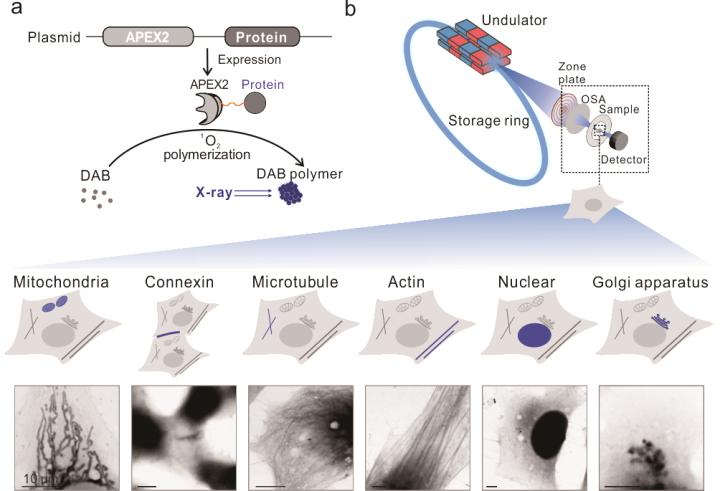
They repurposed peroxidases as genetically-encoded X-ray-sensitive tags for site-specific labeling of protein-of-interest in mammalian cells. They find that polymers that are in-situ catalytically formed by fusion-expressed peroxidases are visible under XRM (Fig. a). The major consequences of using this new tag can be categorized in three aspects: 1) The genetically encoded X-ray tags allow endogenous labeling of diverse molecules and subcellular structures for XRM imaging with an ultrahigh spatial resolution of ~30 nm (Fig. b). 2) The high photostability of X-ray tags enables long-term observation of intracellular and intercellular events. Especially, they visualize the changes of intercellular connections among tumor cells dependent on DNA methylation with XRM. 3) The high energy resolution of XRM provides a direct means to realize multi-colour imaging of cellular structures. This work enlightens the way to nanoscopic imaging for biological studies.

###

This work was supported by the 10ID-1 Soft X-ray Spectromicroscopy beamline of the Canadian Light Source (CLS), the 10A Soft X-ray Nanoscopy beamline of the Pohang Light Source (PLS) II and the BL08U1-A Soft X-ray Spectromicroscopy beamline of the Shanghai Synchrotron Radiation Facility (SSRF).

Genetically encoded X-ray cellular imaging for nanoscale protein
localization

Huating Kong, Jichao Zhang, Jiang Li, Jian Wang, Hyun-Joon Shin,

Renzhong Tai, Qinglong Yan, Kai Xia, Jun Hu, Lihua Wang, Ying Zhu,
Chunhai Fan

https://doi.org/10.1093/nsr/nwaa055

Media Contact
Chunhai Fan
[email protected]

Related Journal Article

http://dx.doi.org/10.1093/nsr/nwaa055

Tags: Chemistry/Physics/Materials Sciences
Share12Tweet8Share2ShareShareShare2

Related Posts

Local Universe Expansion Rate More Precise Than Ever — Yet Still Mysteriously Inconsistent

Local Universe Expansion Rate More Precise Than Ever — Yet Still Mysteriously Inconsistent

April 11, 2026
Breakthrough in Mainz: New Dual-Frequency Paul Trap Achieves Milestone Toward Antihydrogen Creation

Breakthrough in Mainz: New Dual-Frequency Paul Trap Achieves Milestone Toward Antihydrogen Creation

April 10, 2026

Ultra-Low Efficiency Roll-Off and Over 20% Efficiency Achieved in High Color Purity Blue Perovskite QLEDs

April 10, 2026

Bumblebee Bacterium Enables Vitamin B2 Production in Soya Drinks

April 10, 2026
Please login to join discussion

POPULAR NEWS

  • Boosting Breast Cancer Risk Prediction with Genetics

    47 shares
    Share 19 Tweet 12
  • Popular Anti-Aging Compound Linked to Damage in Corpus Callosum, Study Finds

    44 shares
    Share 18 Tweet 11
  • Imagine a Social Media Feed That Challenges Your Views Instead of Reinforcing Them

    1012 shares
    Share 400 Tweet 250
  • Revolutionary Theory Transforms Quantum Perspective on the Big Bang

    41 shares
    Share 16 Tweet 10

About

We bring you the latest biotechnology news from best research centers and universities around the world. Check our website.

Follow us

Recent News

Tumor-Targeted Nanoparticles Boost Glioblastoma Immunotherapy

Biomaterial 3D Cancer Models Tackle Clinical Challenges

Boosting Liver Regrowth via Suv39h1 and HMGB2

Subscribe to Blog via Email

Enter your email address to subscribe to this blog and receive notifications of new posts by email.

Join 78 other subscribers
  • Contact Us

Bioengineer.org © Copyright 2023 All Rights Reserved.

Welcome Back!

Login to your account below

Forgotten Password?

Retrieve your password

Please enter your username or email address to reset your password.

Log In
No Result
View All Result
  • Homepages
    • Home Page 1
    • Home Page 2
  • News
  • National
  • Business
  • Health
  • Lifestyle
  • Science

Bioengineer.org © Copyright 2023 All Rights Reserved.