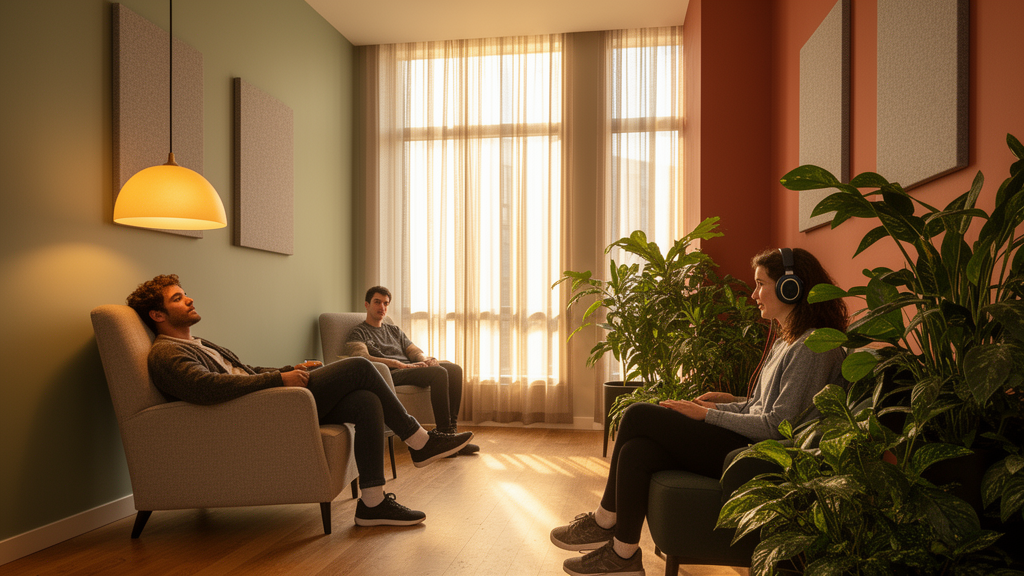
When interior design students were asked to imagine transforming their own studio into a place of mental recovery, they reached first for light. A new study published in Architectural Research on 28 October 2026 reports that lighting was the single most frequently mentioned sensory element in students’ descriptions of an ideal restorative space, accounting for 24.50 percent of all coded sensory references, ahead of sound at 19.13 percent and color at 15.44 percent. The findings come from a theory-guided questionnaire survey of 30 third-year interior design students and offer a detailed map of how future designers talk about the sensory conditions they associate with psychological recovery on campus.
The study, led by Fatama Tuz-Johora, Jannatul Ferdous and Insung Kim, set out to address a gap in restorative design research. While restorative environments have often been studied in outdoor nature and campus greenery, the authors argue that indoor settings can also support restoration when they provide appropriate sensory conditions, environmental comfort, and opportunities for calm withdrawal. Their focus was a dedicated restorative space within a university, conceived not as an extension of the working studio but as a separate setting where students could briefly step back from academic demands before returning to work. This framing is particularly relevant to studio-based design education, where extended workloads, high evaluative pressure and prolonged concentration are common, and where screen-based drawing, modelling and rendering add further digital fatigue.
To structure the inquiry, the researchers drew on their previously developed Restorative Affordances framework, which integrates three environmental psychology traditions: Attention Restoration Theory, the Theory of Supportive Design, and Perceived Sensory Dimensions. From the alignment of these theories, five affordances were derived for the sensory scale of the framework: Retreat, Engage Softly, Spatial Coherence, Express Identity, and Tailored Fit. Retreat combines being away, access to privacy, refuge and serenity, capturing withdrawal in quiet, sheltered settings. Engage Softly describes gentle, low-effort attentional engagement through natural, softly stimulating features. Spatial Coherence refers to environments that are continuous, legible and structured. Express Identity denotes settings that express shared values and belonging, while Tailored Fit concerns the match between user goals and environmental conditions, supported by opportunities to adjust the space.
The survey itself was conducted in a workshop format with 41 third-year students from a Department of Environmental Interior Design. Before responding, students attended an academic briefing on restorative environment theory and the five affordances, and the session was held in the very studio proposed for transformation, allowing participants to connect the questions with a familiar spatial context. Students were given one week to consider their answers, a deliberate choice intended to encourage reflective rather than impulsive responses. Of the 41 attendees, 30 complete responses were included in the analysis; eight non-submissions and three incomplete responses were excluded. The authors note that in qualitative research, sample adequacy depends on the focus of inquiry, participant relevance and richness of data rather than numerical size alone.
Analysis proceeded in two stages. First, the text corpus of 1,145 total words and 415 unique word forms was uploaded to Voyant Tools, which identified recurrent sensory terms such as lighting, color, soft, sound, textures, natural, warm, materials, adjustable, quiet and temperature. Second, the authors conducted manual thematic coding of the same responses, consolidating lexical variants and interpreting recurring expressions in context. This process generated 11 sensory themes, grouped into three broad categories: visual elements comprising lighting, color, pattern and view; ambient elements comprising sound, air, thermal condition and scent; and haptic elements comprising material, texture and tactility. In total, 298 coded sensory references were identified across the 150 affordance-based responses, a figure that represents coded references rather than independent participants, since repeated mentions were counted separately.
The quantitative results reveal a clear hierarchy. Visual elements accounted for 149 of the 298 mentions, or 50.0 percent, making them the dominant category overall. Ambient elements followed with 112 mentions, or 37.6 percent, showing that atmospheric conditions such as sound, air, scent and thermal comfort also played a major role. Haptic elements trailed with only 37 mentions, or 12.4 percent. Tactility was the least mentioned element of all, with just 7 responses, or 2.35 percent, while thermal condition appeared 11 times, and view and texture each appeared 14 times. The authors caution that this lower frequency of haptic responses should not be read as evidence that material and tactile qualities are inherently less important for restoration; rather, such qualities may be less readily verbalized when people imagine a future environment, becoming more apparent through physical occupation. The findings indicate a hierarchy of expressed preference, not a definitive hierarchy of restorative effectiveness.
Perhaps the most striking result is how differently the same sensory elements were configured across the five affordances. In Retreat, students emphasized dim or indirect lighting, soft ambient sound, muted colors and calm air, with lighting recording 26 mentions and sound 22. In Engage Softly, the preferences shifted toward filtered daylight, shifting light, natural sounds and gentle airflow, again led by lighting with 21 mentions and sound with 19, suggesting a preference for gentle sensory movement rather than silence alone. Spatial Coherence showed a distinctly visual-material profile, structured through coordinated colors, consistent materials and controlled textures, with color at 19 mentions and material at 16. Express Identity was conveyed through symbolic colors, culturally meaningful patterns and memory-associated scents, with color, scent and pattern each clustering around 13 to 14 mentions. Tailored Fit centered on adjustable lighting, controllable acoustics, operable airflow and temperature regulation, with lighting at 22 mentions and sound at 12.
This affordance-dependence of sensory meaning is presented as one of the study’s most important contributions. Lighting, for example, was associated with low illumination and withdrawal in Retreat, filtered or changing daylight in Engage Softly, continuity and harmony in Spatial Coherence, culturally meaningful atmosphere in Express Identity, and adjustable brightness or color tone in Tailored Fit. The authors argue that restorative design should therefore not be based on a simple checklist of desirable features such as natural light, quiet sound or warm color, because the same feature may contribute to different restorative outcomes depending on its intensity, configuration, meaning and degree of user control. The more useful design question, they suggest, is not which sensory element to provide, but which restorative function that element is intended to support.
The study also documents what students did not say. Certain elements were absent from particular affordances: pattern, material and tactility were not identified as central to Retreat; thermal condition, texture, material and pattern were not emphasized within Engage Softly; and sound, air and scent were absent from Spatial Coherence responses. The authors interpret these absences cautiously, noting that they indicate where participants did not spontaneously associate an element with a restorative function, not that such elements should be excluded from restorative environments. The excluded elements function as a boundary, showing where empirical associations were weak or absent rather than prescribing design removals.
Several limitations frame the findings. All respondents were interior design students, whose design education and familiarity with spatial and sensory concepts may have influenced how restorative environments were described, so the results represent design-informed student preferences rather than those of the general university population. The theoretical briefing and affordance-specific questionnaire wording may have shaped the frequency and distribution of the identified themes, and the correspondence between responses and the five affordances does not constitute independent validation of the framework. Crucially, no restorative outcomes were measured: attention restoration, stress reduction, affective change, physiological responses and well-being were not assessed, so the preferences should not be interpreted as empirical evidence of restorative effects. The authors position the findings as preliminary, student-informed considerations for designing restorative educational interiors, whose effectiveness requires subsequent evaluation in implemented or simulated environments using validated measures of attention restoration and stress reduction. Future research, they suggest, should include students from non-design disciplines, different universities and diverse cultural contexts to test the consistency of the identified sensory preferences.
Subject of Research: University students' sensory preferences for designing a restorative space on campus
Article Title: An Analysis of University Students’ Sensory Preferences for Designing A Restorative Space
Article References: Tuz-Johora, F., Ferdous, J., & Kim, I. (2026). An Analysis of University Students’ Sensory Preferences for Designing A Restorative Space. Architectural Research, 28(1), Article 27. https://doi.org/10.1007/s44515-026-00028-8
Image Credits: AI Generated
DOI: 10.1007/s44515-026-00028-8
Keywords: restorative environments, sensory design, interior design students, Attention Restoration Theory, lighting, sound, color, university campus, questionnaire survey, Voyant Tools, adaptive reuse, environmental psychology
News Source: Glenn Wilkins. (October 28, 2026). Lighting, Sound and Color Top Students’ Wishlist for a Restorative Campus Space. Scienmag.