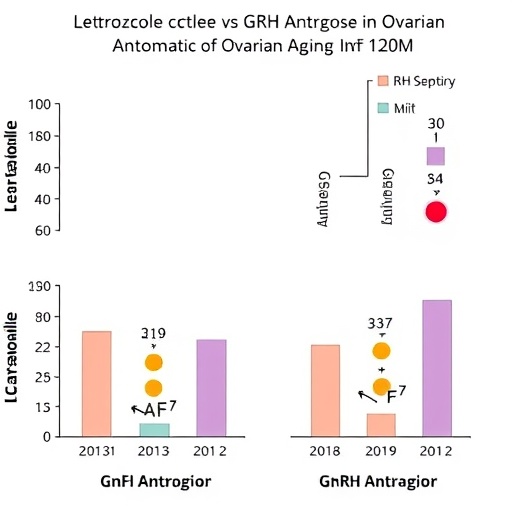
In a groundbreaking development poised to redefine assisted reproductive technology, a recent study published in Nature Communications challenges established protocols in vitro fertilization (IVF) for women grappling with ovarian aging. As global demographics shift, increasing numbers of women seek fertility solutions later in life, often confronting the natural decline in ovarian function that significantly diminishes IVF success rates. This meticulously designed, open-label, multicenter randomized controlled trial spearheaded by Zhao et al. evaluates the efficacy of a modified letrozole protocol compared to the conventional gonadotropin-releasing hormone (GnRH) antagonist approach in enhancing IVF outcomes for this demographic.
The diminishing ovarian reserve and deteriorating oocyte quality accompanying reproductive aging breed significant clinical obstacles. Traditional IVF stimulation regimens, primarily relying on GnRH antagonist protocols, aim to prevent premature luteinizing hormone surges and optimize follicular recruitment. However, in women of advanced reproductive age, these protocols often fall short due to the heterogeneity and diminished responsiveness of ovarian follicles, resulting in fewer retrievable oocytes and compromised embryo quality. Zhao and colleagues rigorously hypothesized that integrating letrozole, an aromatase inhibitor, could modulate the follicular microenvironment and enhance ovarian responsiveness.
Letrozole, well-known for its application in hormone-responsive breast cancer, inhibits the aromatization of androgens to estrogens, thereby elevating intraovarian androgen concentrations. This biochemical shift is theorized to augment folliculogenesis by stimulating early follicular growth, increasing follicle-stimulating hormone (FSH) receptor expression, and enhancing granulosa cell proliferation. While prior small-scale studies hinted at letrozole’s potential to improve IVF outcomes, comprehensive evidence in aging populations remained sparse. The current trial, uniting multiple fertility centers for heightened statistical power and heterogeneity, meticulously compared the clinical outcomes of letrozole-modified protocols to standard GnRH antagonist cycles.
Participants were stratified into two cohorts: those receiving letrozole co-treatment with standard gonadotropin stimulation, versus those undergoing traditional GnRH antagonist protocols without letrozole. Primary endpoints encompassed metrics such as the number of mature oocytes retrieved, fertilization rates, embryo quality graded via standardized morphological criteria, clinical pregnancy rates, and incidence of ovarian hyperstimulation syndrome. Rigorous inclusion criteria ensured enrollment of women with defined ovarian aging parameters, including elevated baseline follicle-stimulating hormone levels and diminished antral follicle counts, thereby focusing the findings on the most clinically challenging subset.
Remarkably, the study reports a statistically significant increase in the yield of mature oocytes among participants receiving the modified letrozole protocol. This augmentation likely arises from letrozole’s endocrine modulation that mitigates supraphysiological estrogen levels, thus preserving follicular sensitivity to exogenous gonadotropins. Moreover, the letrozole cohort demonstrated superior fertilization rates, suggesting enhanced oocyte competence. Embryo quality assessments corroborated these findings, with a greater proportion reaching the blastocyst stage and exhibiting optimal morphological features predictive of implantation potential.
Clinical pregnancy rates—a pivotal outcome—were also markedly improved in the letrozole group. The enhanced embryo quality and increased oocyte yield synergistically translate into higher implantation successes, a critical consideration for women whose ovarian aging severely curtails reproductive opportunities. Additionally, modified letrozole protocols were associated with a reduced total gonadotropin dose requirement, implying a cost-effective and patient-friendly approach minimizing injection burden and side effects.
Safety parameters intellectually underpinning clinical acceptance revealed no increased risk of ovarian hyperstimulation syndrome or adverse events with letrozole co-treatment, underscoring its favorable risk-benefit profile. This is particularly salient given the delicate endocrine balance in older IVF patients, who are predisposed to diminished ovarian responsiveness but potentially vulnerable to stimulation-induced complications. The subtle endocrine recalibration afforded by letrozole may circumvent such risks while optimizing follicular dynamics.
Beyond immediate clinical efficacy, the trial provides valuable mechanistic insights into ovarian aging biology. By elucidating how aromatase inhibition reprograms intraovarian androgen-estrogen balance, the research lends credence to the concept that stimulating androgenic pathways can rejuvenate follicular milieu, potentially reversing aspects of ovarian senescence. This paradigm shift aligns with emerging endocrinological theories positing androgens as crucial mediators in follicle development and oocyte maturation, particularly in aging ovaries.
The multicenter randomized controlled design lends robustness and external validity to the findings, accounting for geographic and ethnic variability in ovarian aging patterns and treatment responses. Such rigor enhances the confidence with which reproductive endocrinologists may translate these insights into practice, fostering personalized approaches tailored to the nuanced endocrine profiles of aging women.
Notably, the open-label nature of the trial introduces some limitations, including potential bias. However, objective endpoints like oocyte counts, embryo morphology, and biochemical pregnancy confirmation mitigate subjective influence. The authors advocate for subsequent double-blind investigations with larger populations to corroborate data and explore long-term outcomes including live birth rates and neonatal health metrics.
This innovative protocol arrives in an era marked by unprecedented demand for IVF due to global trends of delayed childbearing. Empowering women with ovarian aging—a demographic historically burdened by suboptimal IVF success rates—with more efficacious stimulation protocols fundamentally addresses a pressing unmet need in reproductive medicine. Improved access to effective interventions may also have socioeconomic ripple effects by reducing cycle cancellations, emotional distress, and treatment expenditures.
The interplay between clinical practice and molecular insights exemplified in this study exemplifies the bench-to-bedside translation imperative for advancing fertility care. Zhao et al.’s pioneering work recalibrates the treatment algorithm for women with compromised ovarian function, heralding a new frontier where hormonal manipulation is strategically harnessed to optimize reproductive outcomes despite biological adversities.
Future research trajectories inspired by these findings include deeper exploration of androgen receptor signaling pathways, transcriptomic profiling of granulosa cells under letrozole influence, and integration with adjunctive therapies targeting mitochondrial function or oxidative stress reduction in oocytes. Coupling pharmacological innovation with precision diagnostics stands to revolutionize reproductive aging interventions.
As this evidence disseminates across clinical networks, it paves the way for updated guidelines and consensus statements endorsing letrozole co-treatment as a frontline strategy in select IVF candidates. The clinical community eagerly anticipates integration of this approach into routine care pathways, potentially transforming the reproductive landscape for millions of women worldwide.
In essence, this study transcends conventional fertility paradigms by reaffirming that ovarian aging, once considered an insurmountable barrier, can be mitigated through intelligent hormonal modulation. The fusion of established endocrinology with innovative protocol design defines a seminal advancement in assisted reproduction, embodying hope and tangible progress for those yearning to conceive under challenging physiological conditions.
This landmark trial not only validates letrozole’s therapeutic promise but also invigorates the broader scientific dialogue on ovarian biology, opening avenues for multi-disciplinary collaboration encompassing endocrinology, molecular biology, and clinical reproductive medicine. The ramifications extend beyond IVF, potentially informing interventions for diverse ovarian dysfunction disorders rooted in hormonal imbalances.
In sum, Zhao et al.’s robust investigation meticulously demonstrates that a modified letrozole protocol offers a superior alternative to standard GnRH antagonist regimens in aging women undergoing IVF, improving oocyte yield, embryo quality, and pregnancy outcomes without compromising safety. This breakthrough encourages a reimagining of fertility treatment frameworks and invigorates hope for enhanced reproductive autonomy in the face of ovarian decline.
Subject of Research:
Comparison of modified letrozole protocols versus standard GnRH antagonist protocols in women with ovarian aging undergoing in vitro fertilization (IVF).
Article Title:
Modified letrozole vs GnRH antagonist protocols in ovarian aging women for IVF: an open-label, multicenter, randomized controlled trial.
Article References:
Zhao, Y., Zhao, S., Xu, J. et al. Modified letrozole vs GnRH antagonist protocols in ovarian aging women for IVF: an open-label, multicenter, randomized controlled trial. Nat Commun (2026). https://doi.org/10.1038/s41467-026-70964-5
Image Credits: AI Generated
Tags: advanced maternal age fertility solutionsaromatase inhibitors in ovarian stimulationenhancing ovarian responsiveness in IVFfertility protocols for diminished ovarian reservefollicular microenvironment modulation in IVFGnRH antagonist protocol in assisted reproductionimpact of androgen modulation on oocyte qualityimproving embryo quality in older womenletrozole in IVF for ovarian agingletrozole vs GnRH antagonist IVF outcomesovarian aging and fertility treatmentrandomized controlled trial in reproductive medicine