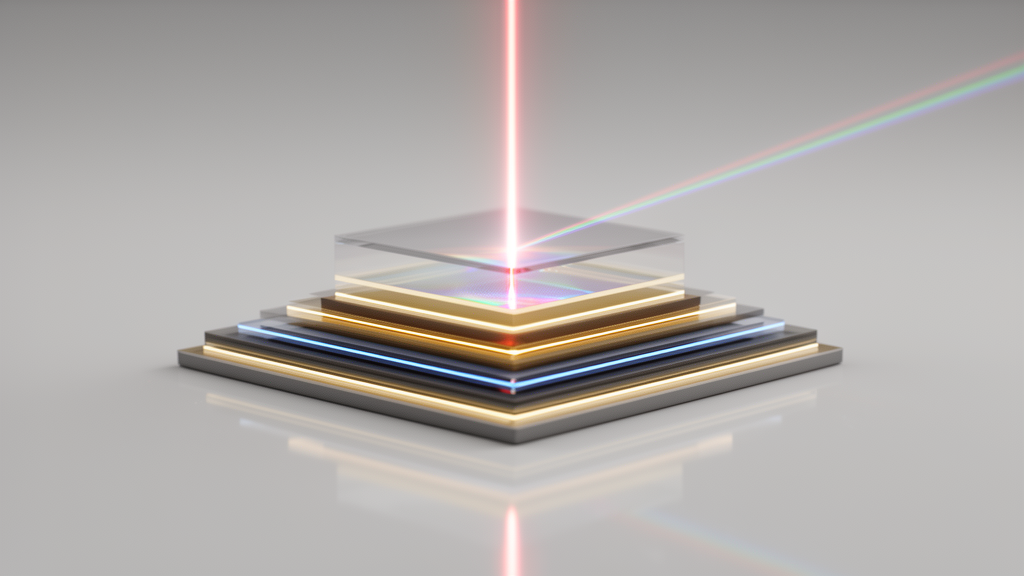
Researchers have theoretically and numerically demonstrated that a layered structure possessing a reflection zero enables the optical computation of the second-order mixed derivative of a linearly polarized light beam. The mathematical operation is carried out at normal incidence, with the resulting spatial derivative manifesting directly in the cross-polarized component of the reflected optical beam.
Photonic structures designed for analog optical computing have attracted widespread research attention because they perform mathematical computations at the speed of light. Such systems are viewed as promising complements to conventional electronic computing architectures, offering the potential to enhance overall operational performance by executing spatial transformations without digital processing overhead.
While prior research in analog optical processing has successfully implemented differential operators such as the Laplace and gradient operators for edge detection, optical evaluation of the spatial second-order mixed derivative remained underexplored. The second mixed derivative is critical for image filtering, contour highlighting, corner detection, and calculating Hessian matrices in broader computational frameworks.
Previous attempts to compute the spatial second-order mixed derivative from a beam profile relied on nonparaxial beam propagation, which suffered from system bulkiness due to requiring light to travel across substantial propagation distances. In contrast, the newly proposed approach utilizes a compact layered medium operating under normal incidence geometry, avoiding bulky propagation setups.
To describe light diffraction on the layered architecture, the authors represented the electromagnetic field of a monochromatic incident beam within the basis of plane waves possessing transverse magnetic and transverse electric polarizations. By analyzing an incident beam linearly polarized along the horizontal transverse axis, the spectral distribution of the incident field is decomposed into corresponding polarization amplitudes.
Upon reflection from the layered medium, the plane-wave amplitudes are modulated by polarization-dependent reflection coefficients, while the transverse components of the wave vectors remain unchanged. Under the condition that the central reflection coefficient vanishes at normal incidence, a Taylor series expansion reveals that the copolarized reflected field yields a weighted sum of second derivatives, whereas the cross-polarized component yields the pure second-order mixed spatial derivative.
The authors illustrated this mathematical transformation using a metal-dielectric-metal configuration composed of an upper gold layer, an intermediate silicon dioxide dielectric layer, and an opaque gold substrate. Within this Fabry-Pérot resonant geometry, the structure achieves zero reflection at an operating wavelength of 633 nanometers when the gold layer thickness is set to 32.4 nanometers and the silicon dioxide thickness is set to 156.5 nanometers.
Rigorous numerical solutions of Maxwell’s equations confirmed the predictive accuracy of the theoretical model. Comparing the strictly calculated transfer function against the analytical quadratic model function demonstrated an extremely close match, exhibiting a normalized standard deviation of only 0.04 percent across the transfer function moduli.
To evaluate performance in visual processing tasks, the researchers simulated the response of the structure to incident square beam profiles oriented along the coordinate axes and rotated at an angle of 45 degrees. The numerically calculated cross-polarized reflected fields showed excellent agreement with analytical predictions, maintaining normalized standard deviations below 5 percent while clearly highlighting image corners and contours.
The authors noted practical fabrication considerations, explaining that manufacturing errors in layer thicknesses would introduce a non-zero normal-incidence reflection coefficient, causing an undifferentiated background field to appear alongside the derivative. However, the researchers concluded that this residual background can be readily compensated during subsequent computer processing, confirming the viability of layered differentiators for optical image processing systems.
In developing their mathematical formulation, the researchers analyzed the diffraction of a monochromatic optical beam incident normally on a layered structure by decomposing the electromagnetic field into plane waves possessing transverse magnetic and transverse electric polarizations. Applying Maxwell’s equations, plane waves defined by a spatial wave vector are expressed through polarized amplitude vectors multiplied by exponential spatial phase factors. The wave vector components satisfy the dispersion equation, where the sum of the squared transverse wave vector magnitude and the squared longitudinal wave vector component equals the product of the squared free-space wavenumber and the dielectric constant of the medium. The wavenumber is defined as two pi divided by the optical wavelength. The longitudinal wave vector component is determined by the transverse components, taking either a positive or negative root depending on whether the wave propagates in the positive or negative direction along the longitudinal axis.
The vector amplitudes for transverse magnetic and transverse electric polarized waves are defined purely as functions of the transverse wave vector components. Each amplitude vector is normalized by the transverse wave vector magnitude, equal to the square root of the sum of the squared transverse coordinates. For transverse magnetic polarization, the vector amplitude contains components equal to the negative product of the horizontal transverse coordinate and the longitudinal component, the negative product of the vertical transverse coordinate and the longitudinal component, and the sum of the squared transverse coordinates. For transverse electric polarization, the amplitude vector comprises the negative product of the wavenumber and the vertical transverse coordinate, the product of the wavenumber and the horizontal transverse coordinate, and zero along the longitudinal direction. Because the incoming beam propagates against the longitudinal axis, the longitudinal wave vector component takes a negative sign in the transverse magnetic amplitude vector.
The incident light beam propagating in the negative longitudinal direction is expressed as a double integral over transverse wave vector space, superposing transverse magnetic and transverse electric plane waves weighted by their spectral distributions. Under linear polarization in the interface plane, the cross-polarized vertical electric field component is identically zero. Consequently, the horizontal transverse field is defined by a fixed spatial frequency spectrum. The transverse magnetic and transverse electric spectra are linked to this fixed spectrum by auxiliary spectral weighting functions. The transverse magnetic spectral weighting function equals the negative horizontal transverse wave vector coordinate divided by the product of the longitudinal wave vector component and the transverse wave vector magnitude. Meanwhile, the transverse electric spectral weighting function equals the negative vertical transverse wave vector coordinate divided by the product of the wavenumber and the transverse wave vector magnitude.
When the optical beam reflects from the layered structure, transverse wave vector components remain invariant, while the longitudinal component reverses sign to a positive value, indicating propagation along the positive longitudinal axis. Reflection multiplies the transverse magnetic and transverse electric plane waves by their polarization reflection coefficients. At the interface, the reflected electric field is described by a linear transformation governed by a vector transfer function. This transfer function represents the superposition of the transverse magnetic and transverse electric amplitude vectors, each scaled by spectral weighting functions and reflection coefficients. Assuming the incident beam spectrum is concentrated near normal incidence, where transverse components vanish, the vector transfer function is approximated by a Taylor series expansion up to quadratic terms. Because reflection coefficients are even functions around normal incidence, they take a quadratic form governed by a normal-incidence constant and curvature coefficients proportional to second partial derivatives.
Under operating conditions where the structure exhibits zero reflection at normal incidence, the constant reflection term vanishes. Zero reflection occurs specifically for the central plane wave with zero transverse wave vector components. However, a non-zero reflected beam still emerges because plane waves incident at oblique angles encounter non-zero reflection coefficients. In this quadratic regime, transverse components of the reflected field execute spatial differentiation on the incident profile. The horizontal field component produces a weighted sum of second partial derivatives along both transverse axes, scaled by second-order expansion coefficients for transverse magnetic and transverse electric polarizations. In contrast, the cross-polarized vertical component computes the pure second-order mixed derivative of the incident profile with respect to both transverse coordinates, scaled by the difference between transverse magnetic and transverse electric curvature coefficients. This mathematical transformation represents a manifestation of the higher-order optical spin Hall effect.
The physical realization of this differentiator utilizes a metal-dielectric-metal configuration wherein zero reflection is established through a Fabry-Pérot resonance. This resonance can be tailored to achieve reflection cancellation at any chosen operating wavelength by calculating appropriate layer thicknesses for the upper metal layer and underlying dielectric spacer supported on an opaque metal substrate. In the studied gold-silicon dioxide-gold stack, layer thicknesses of 32.4 nanometers for gold and 156.5 nanometers for silicon dioxide were selected for an operating wavelength of 633 nanometers. At this wavelength, gold exhibits a complex refractive index comprising a real part of 0.18 and an imaginary part of 3.43, while silicon dioxide has a refractive index of 1.46. Rigorous numerical solutions of Maxwell’s equations demonstrated that the cross-polarized transfer function module matches the analytical quadratic model with high precision, showing a normalized standard deviation of only 0.04 percent.
In image filtering simulations, an incident square beam oriented parallel to the coordinate axes highlighted object corners, whereas rotating the square by 45 degrees revealed image contours and dual contour views. This contour enhancement arises because the second mixed derivative corresponds to the difference between second partial derivatives in a coordinate system rotated by 45 degrees. Numerically simulated fields showed excellent agreement with analytical predictions, maintaining normalized standard deviations under 5 percent. Additionally, manufacturing errors in layer thicknesses will yield a non-zero normal reflection coefficient proportional to the thickness error, causing an undifferentiated background field to appear alongside the derivative. The authors concluded that this background component can be readily compensated during subsequent computer processing of the recorded beam.
Subject of Research: Optical computation of spatial second-order mixed derivatives using a layered structure
Article Title: Optical Computation of a Second-Order Mixed Derivative Using a Layered Structure
Article References: Kashapov, A. I., Bezus, E. A., Bykov, D. A., & Doskolovich, L. L. (2026). Optical Computation of a Second-Order Mixed Derivative Using a Layered Structure. Bulletin of the Russian Academy of Sciences: Physics, 90(1), 1-6. https://doi.org/10.1134/s1062873825714126
Image Credits: AI Generated
DOI: 10.1134/S1062873825714126
Keywords: analog optical computing, optical differentiation, second-order mixed derivative, layered structure, reflection zero, normal incidence, cross-polarized component, metal-dielectric structure, Fabry-Pérot resonance, gold-silicon dioxide structure, image processing, corner detection, edge detection, spatial differentiation, transfer function, transverse magnetic polarization, transverse electric polarization, optical spin Hall effect
News Source: Denise Maddox. (November 23, 2026). Layered Optical Structure Computes Spatial Second-Order Mixed Derivatives at Normal Incidence. Scienmag.