• HOME
  • NEWS
  • EXPLORE
    • CAREER
      • Companies
      • Jobs
    • EVENTS
    • iGEM
      • News
      • Team
    • PHOTOS
    • VIDEO
    • WIKI
  • BLOG
  • COMMUNITY
    • FACEBOOK
    • INSTAGRAM
    • TWITTER
Tuesday, January 20, 2026
BIOENGINEER.ORG
No Result
View All Result
  • Login
  • HOME
  • NEWS
  • EXPLORE
    • CAREER
      • Companies
      • Jobs
        • Lecturer
        • PhD Studentship
        • Postdoc
        • Research Assistant
    • EVENTS
    • iGEM
      • News
      • Team
    • PHOTOS
    • VIDEO
    • WIKI
  • BLOG
  • COMMUNITY
    • FACEBOOK
    • INSTAGRAM
    • TWITTER
  • HOME
  • NEWS
  • EXPLORE
    • CAREER
      • Companies
      • Jobs
        • Lecturer
        • PhD Studentship
        • Postdoc
        • Research Assistant
    • EVENTS
    • iGEM
      • News
      • Team
    • PHOTOS
    • VIDEO
    • WIKI
  • BLOG
  • COMMUNITY
    • FACEBOOK
    • INSTAGRAM
    • TWITTER
No Result
View All Result
Bioengineer.org
No Result
View All Result
Home NEWS Science News Chemistry

Laser writing enables practical flat optics and data storage in glass

Bioengineer by Bioengineer
February 20, 2020
in Chemistry
Reading Time: 2 mins read
0
IMAGE
Share on FacebookShare on TwitterShare on LinkedinShare on RedditShare on Telegram

IMAGE

Credit: by Masaaki Sakakura, Yuhao Lei, Lei Wang, Yan-Hao Yu, and Peter G. Kazansky


Conventional optics (e.g. lenses or mirrors) manipulate the phase via optical path difference by controlling thickness or refractive index of material. Recently, researchers reported that arbitrary wavefront of light can be achieved with flat optics by spatially varying anisotropy, using geometric or Pancharatnam-Berry phase. However, despite various methods employed for anisotropy patterning, producing spatially varying birefringence with low loss, high damage threshold and durability remains a challenge.

In addition, the technologies of birefringence patterning have been also used for generating light beams with spatially variant polarization known as vector beams, in particular with radial or azimuthal polarization. Radially polarized vector beams are especially interesting due to the non-vanishing longitudinal electric field component when tightly focused, allowing superresolution imaging. Radial polarization is also the optimal choice for material processing. On the other hand, azimuthal vector beams can induce longitudinal magnetic fields with potential applications in spectroscopy and microscopy. Nonetheless, generating such beams with high efficiency is not a trivial matter.

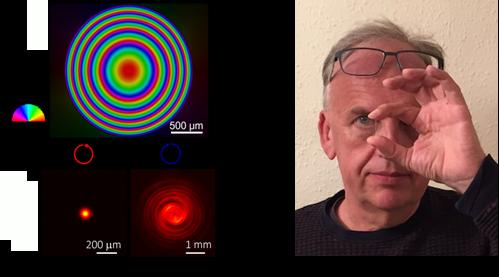
In an article published in Light Science & Applications, scientists from the Optoelectronics Research Centre, University of Southampton, UK, demonstrated a new type of birefringent modification with ultra-low loss by ultrafast laser direct writing in silica glass. The discovered birefringent modificati which is completely different from the conventional one originating from nanogratings or nanoplatelets, contains randomly distributed nanopores with elongated anisotropic shapes, aligned perpendicular to the writing polarization, which are responsible for the high transparency and controllable birefringence. The birefringent modification enabled fabrication of ultra-low loss spatially variant birefringent optical elements including geometrical phase flat prism and lens, vector beam converters and zero-order retarders, which can be used for high power lasers. The high transmittance from UV to near-infrared and high durability of the demonstrated birefringent optical elements in silica glass overcome the limitations of geometrical phase and polarization shaping using conventional materials and fabrication methods including photo-aligned liquid crystals and meta-surfaces.

“We observed ultrafast laser induced modification in silica glass with the evidence of anisotropic nanopore formation representing a new type of nanoporous material.”

“The technology of low loss polarization and geometrical phase patterning widens the applications of geometrical phase optical elements and vector beam convertors for high power lasers and visible and UV light sources.”

“The space-selective birefringent modification with high transparency also enables high capacity multiplexed data storage in silica glass.”

###

Media Contact
Masaaki Sakakura
[email protected]

Related Journal Article

http://dx.doi.org/10.1038/s41377-020-0250-y

Tags: Chemistry/Physics/Materials SciencesOptics
Share12Tweet8Share2ShareShareShare2

Related Posts

Creating Synthetic Protein-Binding DNA Systems in Cells

January 17, 2026
blank

Chiral Catalysis Powers Rotary Molecular Motors

January 16, 2026

Selective GlcNAc to GalNAc Epimerization via Kinetic Control

January 15, 2026

Thermal [2+2] Cycloaddition Builds Gem-Difluoro Bicycloalkanes

January 13, 2026
Please login to join discussion

POPULAR NEWS

  • Enhancing Spiritual Care Education in Nursing Programs

    155 shares
    Share 62 Tweet 39
  • PTSD, Depression, Anxiety in Childhood Cancer Survivors, Parents

    148 shares
    Share 59 Tweet 37
  • Robotic Ureteral Reconstruction: A Novel Approach

    78 shares
    Share 31 Tweet 20
  • Study Reveals Lipid Accumulation in ME/CFS Cells

    55 shares
    Share 22 Tweet 14

About

We bring you the latest biotechnology news from best research centers and universities around the world. Check our website.

Follow us

Recent News

Evaluating Patient-Reported Outcomes for Opioid Recovery

Testosterone’s Impact on Aggression and Mating Behavior

Revolutionary 3D Printed Collars Aid Dropped Head Syndrome

Subscribe to Blog via Email

Enter your email address to subscribe to this blog and receive notifications of new posts by email.

Join 71 other subscribers
  • Contact Us

Bioengineer.org © Copyright 2023 All Rights Reserved.

Welcome Back!

Login to your account below

Forgotten Password?

Retrieve your password

Please enter your username or email address to reset your password.

Log In
No Result
View All Result
  • Homepages
    • Home Page 1
    • Home Page 2
  • News
  • National
  • Business
  • Health
  • Lifestyle
  • Science

Bioengineer.org © Copyright 2023 All Rights Reserved.