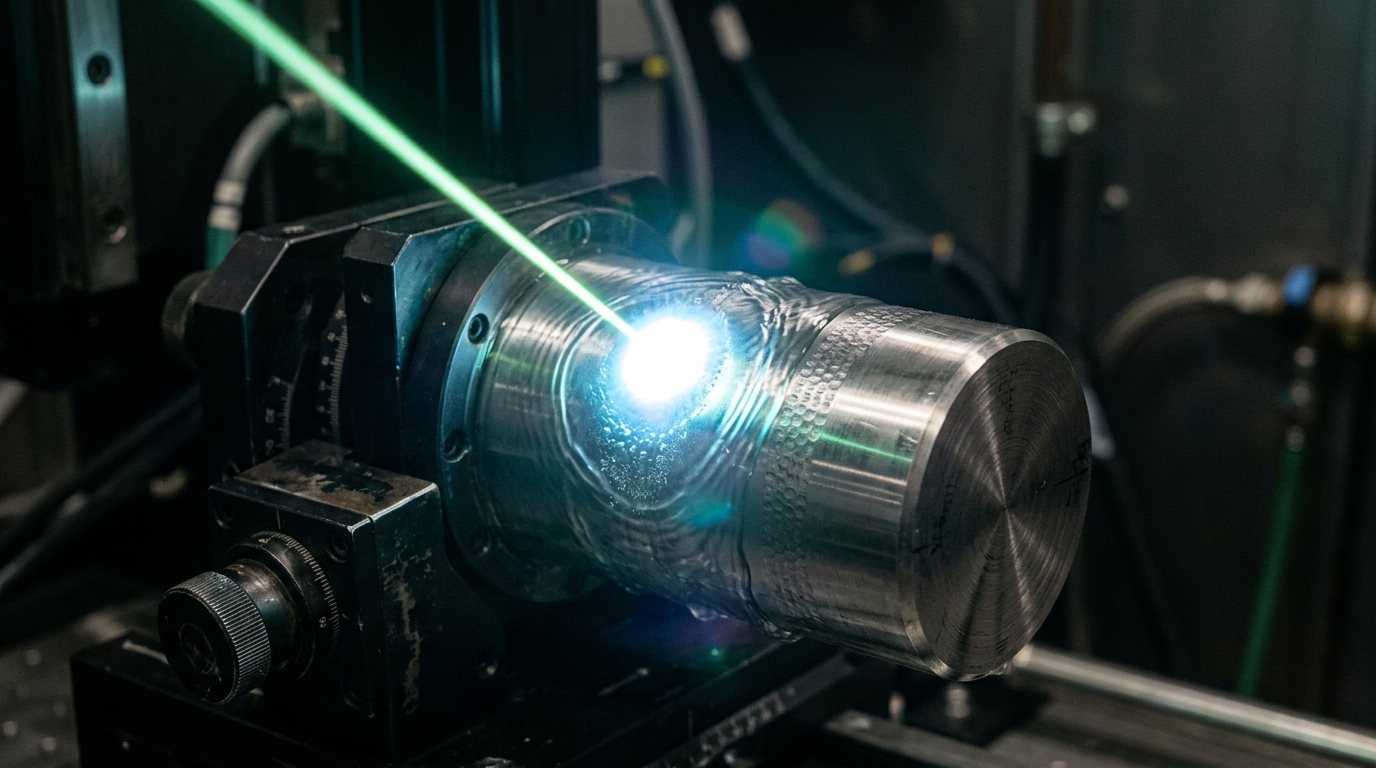
A systematic investigation into Cronidur 30 steel shows that laser shock peening effectively enhances the mechanical properties of the alloy while significantly modifying its microstructure.
Topographical evaluations demonstrated that laser shock peening led to a substantial increase in surface roughness, with higher processing energy levels producing progressively rougher surfaces. The surface roughness parameter Sa rose from an untreated baseline of 0.013 micrometers to 0.41 micrometers under higher laser energy. In phase analyses conducted via X-ray diffraction, researchers detected no newly formed metallurgical phases.
Electron backscatter diffraction analysis revealed significant structural changes, marked by a reduction in average grain size from 0.56 micrometers in the original material down to 0.492 micrometers after treatment. This grain refinement was accompanied by a measurable increase in the proportion of high-angle grain boundaries across the sampled regions. In addition, the kernel average misorientation value rose from 0.642 degrees to 0.765 degrees, pointing to an accumulation of dislocation density within the grains. Transmission electron microscopy further validated this structural refinement, as the electron diffraction pattern transformed from discrete single-crystal diffraction spots into continuous diffraction rings.
Microhardness testing showed pronounced surface hardening alongside a substantial deepening of the affected subsurface zone. The untreated Cronidur 30 steel started with a surface hardness of 750 HV, which rose to 810 HV following treatment at an energy level of 2 joules and reached 830 HV after treatment at 4 joules. Alongside these surface-level increases, the overall depth of the hardened layer expanded significantly, increasing from 900 micrometers in thickness to 1600 micrometers as laser processing reinforced the material.
The peening process also introduced high levels of residual compressive stress into the near-surface layer of the high-nitrogen steel. Experimental measurements recorded a maximum residual compressive stress of minus 306 megapascals under the 2-joule laser treatment, which strengthened substantially to minus 632 megapascals when the energy was raised to 4 joules.
Compared with the original untreated specimens, tensile strength increased by 12.49 percent after a 2-joule treatment and climbed by 16.65 percent after a 4-joule treatment. Yield strength exhibited even larger proportional gains, rising by 18.4 percent at 2 joules and by 23.41 percent at 4 joules. However, these strength improvements were accompanied by a reduction in ductility, as the measured elongation decreased with higher laser shock peening energy levels.
Subject of Research: Effects of laser shock peening on Cronidur 30 steel microstructure and mechanical properties
Article Title: Effect of laser shock peening on the microstructure and mechanical performance of Cronidur 30 steel
Article References: Chen, W., He, T., Liu, Z., Cao, Y., Liang, Y., Du, S., Yue, Y., Zheng, X., & Zhang, Y. (2026). Effect of laser shock peening on the microstructure and mechanical performance of Cronidur 30 steel. Journal of Materials Science. https://doi.org/10.1007/s10853-026-14057-0
Image Credits: AI Generated
DOI: 10.1007/s10853-026-14057-0
Keywords: laser shock peening, Cronidur 30 steel, high-nitrogen bearing steel, surface roughness, X-ray diffraction, electron backscatter diffraction, transmission electron microscopy, grain refinement, high-angle grain boundaries, kernel average misorientation, dislocation density, surface hardness, hardened layer depth, residual compressive stress, tensile strength, yield strength, elongation
News Source: Denise Maddox. (November 27, 2026). Laser Shock Peening Strengthens Cronidur 30 Steel While Refining Surface Microstructure. Scienmag.