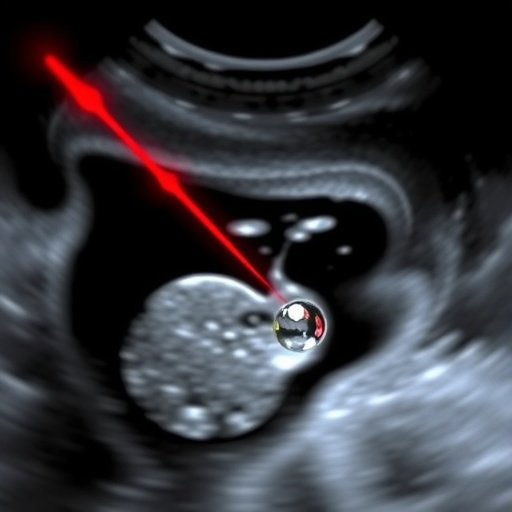
In a groundbreaking advancement poised to redefine the frontiers of diagnostic imaging, researchers have unveiled a novel technology called photo-activated ultrasound localization imaging (PAULI), which utilizes laser-activated nanodroplets to achieve unprecedented imaging resolution. This innovative approach, presented by Zhao, Yi, Qiu, and colleagues, combines the precision of laser activation with the deep tissue penetration of ultrasound, promising to overcome longstanding limitations in medical imaging and diagnostics.
Traditional ultrasound imaging, widely used in clinical practice for its non-invasive nature and real-time capabilities, often suffers from limited resolution and contrast when imaging deep tissue structures. These limitations largely stem from the inherent physical properties of ultrasound waves and the scattering behaviors in complex biological environments. Seeking to overcome these hurdles, the research team harnessed the concept of photo-activation: the use of laser pulses to trigger nanoscale agents that can significantly enhance ultrasound signals at targeted locations.
Central to this technology are nanodroplets—tiny, engineered particles designed to respond to specific light frequencies. Unlike conventional ultrasound contrast agents, these nanodroplets remain inert under regular imaging, only transitioning to highly echogenic microbubbles upon laser stimulation. When exposed to finely tuned laser pulses, the nanodroplets rapidly vaporize, expanding into microbubbles that scatter ultrasound waves with much greater intensity. This transformation dramatically amplifies the ultrasonic signal, thereby allowing for precise localization of these agents in the body.
What makes this technique revolutionary is its ability to provide spatial resolution beyond what was previously achievable by ultrasound alone. By synchronizing laser activation and ultrasound detection, the researchers were able to capture the exact moments when nanodroplets convert to microbubbles, effectively creating a map of targeted structures with micrometer-scale precision. The heightened contrast and resolution make it possible to visualize minute biological features, including cellular-level vessel structures and microenvironmental changes, which were previously undetectable using standard ultrasound methods.
The photo-activation process is not only highly sensitive but also tunable. By adjusting parameters such as laser wavelength, pulse duration, and energy intensity, researchers can control the activation depth and selectivity of nanodroplet vaporization. This flexibility ensures that imaging can be tailored to specific clinical needs and anatomical sites, while minimizing inadvertent activation or tissue damage. The versatility of this method opens doors to a wide range of applications, from cancer imaging and targeted drug delivery monitoring to vascular health assessments and beyond.
One of the most compelling aspects of PAULI is its non-invasiveness combined with high spatial resolution. Conventional imaging techniques that approach similar resolutions—like MRI or CT scans—are often expensive, require ionizing radiation, or involve contrast agents with potential side effects. Photo-activated ultrasound localization imaging, by contrast, relies on biocompatible nanodroplets that can be engineered for safety and biodegradability, and it uses laser and ultrasound devices which are increasingly accessible in clinical environments.
In experimental validations, the researchers demonstrated the efficacy of PAULI in imaging complex tissue phantoms and in vivo models with striking results. The images obtained exhibited markedly enhanced contrast-to-noise ratios and spatial detail compared to conventional ultrasound methods. This advance suggests potential for early disease detection, such as identifying microtumors or vascular abnormalities long before they manifest symptomatically or become visible through standard imaging modalities.
Moreover, the temporal resolution of this technique is remarkably fast. Because laser pulses and ultrasound detection can occur within milliseconds, PAULI allows for real-time dynamic imaging of physiological processes. This feature is vitally important for functional imaging, where understanding the behavior of tissues over time—such as blood flow, oxygenation changes, or metabolic activity—can provide critical insights into disease mechanisms and therapeutic responses.
The integration of nanotechnology with optical and acoustic physics exemplifies a broader trend in medical imaging innovation. By exploiting the unique properties of nanoparticles and harnessing the power of multi-modal energy sources, researchers are steadily pushing the boundaries of what is possible in diagnostics. PAULI stands as a prime testament to the potential of this multidisciplinary fusion, combining engineering ingenuity and medical need.
Further development efforts are focusing on optimizing nanodroplet composition and laser parameters to maximize safety, specificity, and relative ease of clinical translation. The prospect of combining PAULI with other imaging modalities, such as photoacoustic imaging or molecular imaging techniques, is also being explored to create comprehensive diagnostic platforms. Achieving this could provide clinicians with a multidimensional view of disease at the molecular, cellular, and tissue levels simultaneously.
Importantly, the design of these laser-activated nanodroplets incorporates advances in material science to ensure stability in circulation and targeted activation only at intended sites. This targeted activation capability raises the possibility of using PAULI not only for imaging but also for therapeutic interventions, such as localized drug release triggered by laser pulses, thereby bridging diagnostics and therapeutics in a single platform.
The implications of this research extend beyond human medicine. With its ability to deliver detailed structural and functional information non-invasively, PAULI can be adapted for veterinary medicine, biological research, and environmental monitoring where high-resolution imaging in complex media is required. This adaptability underscores the transformative impact of the technology across scientific and medical disciplines.
Looking ahead, clinical trials will be vital to verify the safety and efficacy of photo-activated ultrasound localization imaging in diverse patient populations. The combination of minimally invasive techniques with heightened diagnostic accuracy aligns with the ongoing healthcare emphasis on patient comfort, cost-effectiveness, and precision medicine. If successfully translated, PAULI could become a routine component of diagnostic workflows, enabling earlier interventions and improved patient outcomes across a spectrum of diseases.
This pioneering work by Zhao, Yi, Qiu, and their team, published in Communications Engineering, represents a paradigm shift. It illustrates how light-driven nanotechnologies can synergistically augment existing imaging infrastructures, offering a clear pathway toward harmonizing advanced physics with clinical realities. The future of ultrasound imaging, once limited by resolution and contrast, is now illuminated by the promise of photo-activated localization and nanomedicine.
Photo-activated ultrasound localization imaging introduces a new era in which the invisible becomes visible, where cellular and sub-cellular landscapes are delineated with remarkable clarity, and where diagnostic precision is no longer a compromise but a standard. This exciting intersection of photonics, acoustics, and nanotechnology is poised to transform medical diagnostics and beyond, heralding a new chapter in how we visualize health and disease.
As technology progresses, the convergence of laser activation mechanisms with ultrasound and nanotechnology stands to inspire further innovations. This could involve customized nanodroplet formulations responsive to specific biological markers or the development of portable PAULI devices for point-of-care diagnostics. Such advancements carry the potential to democratize access to high-quality imaging worldwide, especially in resource-limited settings.
In summary, the advent of laser-activated nanodroplet technology for photo-activated ultrasound localization imaging represents a remarkable leap forward. The synthesis of optical control and acoustic detection in a single, minimally invasive approach not only addresses critical challenges in current imaging modalities but also unlocks new possibilities for early diagnosis, treatment monitoring, and biomedical research. It is a striking example of how multidisciplinary innovation can drive the future of healthcare into sharper, more illuminating focus.
Subject of Research:
Photo-activated ultrasound localization imaging using laser-activated nanodroplets for enhanced diagnostic imaging.
Article Title:
Photo-activated ultrasound localization imaging with laser-activated nanodroplets.
Article References:
Zhao, S., Yi, J., Qiu, Y. et al. Photo-activated ultrasound localization imaging with laser-activated nanodroplets. Commun Eng (2026). https://doi.org/10.1038/s44172-026-00592-w
Image Credits:
AI Generated
Tags: deep tissue ultrasound penetrationinnovative diagnostic imaging techniqueslaser-activated imaging technologymicrobubbles for ultrasoundnanodroplets in medical diagnosticsnanoscale agents in diagnosticsnon-invasive imaging advancementsovercoming ultrasound imaging limitationsphoto-activated ultrasound imagingtargeted ultrasound signal amplificationultrasound contrast agentsultrasound imaging resolution enhancement