Geotechnical engineers designing highway infrastructure over compressible soils have long confronted a persistent discrepancy between laboratory predictions and field performance when utilizing lightweight expanded polystyrene blocks. A comprehensive three-dimensional numerical investigation by Andre Matoso Resende, Jose Orlando Avesani Neto, and Adrian Torrico Siacara demonstrates that standard elastic parameters derived from small-scale laboratory specimens fail to represent the mechanical behavior of full-scale geofoam embankments. By calibrating advanced finite element simulations against physical instrumentation installed in a full-scale experimental road embankment in Brazil, the researchers established that elastic stiffness values obtained from large-scale specimens reproduce field observations with remarkable precision. The findings resolve critical technical uncertainties regarding how expanded polystyrene responds to heavy vehicular loading, revealing that relying on diminutive laboratory specimens significantly underestimates field stiffness and miscalculates vertical stress distribution throughout pavement layers.
Standard characterization protocols typically rely on 50-millimeter cubic laboratory specimens, yet preceding empirical evidence indicated that these small test specimens regularly overestimate actual field settlements and underestimate the mobilized stiffness exhibited by full-sized blocks under operating conditions.
To investigate these scale effects under controlled conditions, the research team analyzed an instrumented experimental road embankment previously constructed over soft organic soil in Ribeirão Pires, located within the state of São Paulo, Brazil. The full-scale test structure measured 31.4 meters in total length, 10.8 meters in base width, and reached an overall height of 1.8 meters. Laboratory testing of undisturbed subgrade samples classified the deposit as an organic clayey silt with a 90 percent fines fraction passing the 75-micrometer sieve, displaying a natural moisture content of 42 percent, an in situ unit weight of 15.3 kilonewtons per cubic meter, and a liquid limit of 55 alongside a plastic limit of 32.
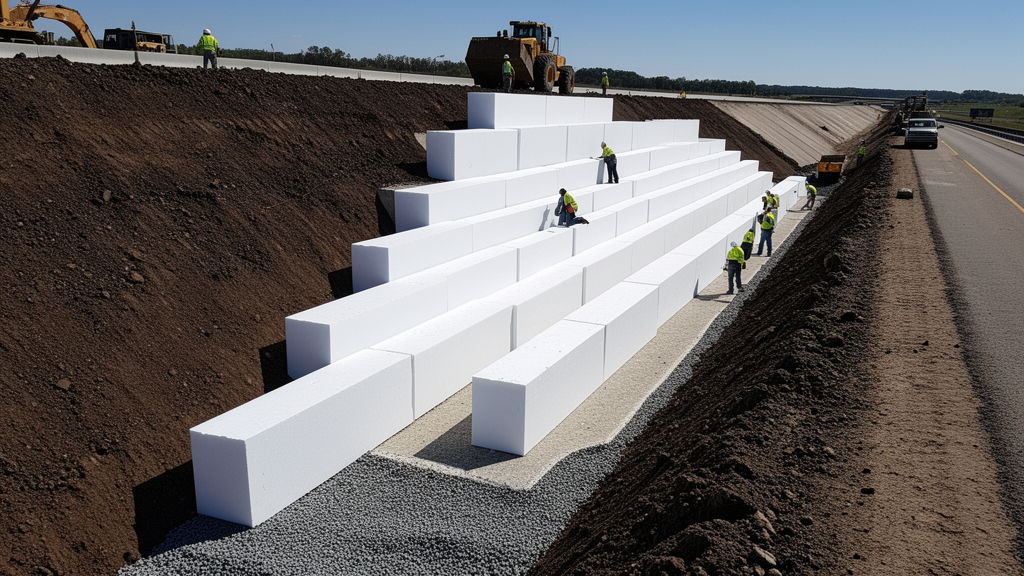
The assembly commenced with a 200-millimeter gravel drainage layer enclosed within a 180 gram per square meter nonwoven polypropylene geotextile resting directly upon the natural soft ground. Over this basal working platform, workers placed standard commercial blocks of EPS22 geofoam having an in situ unit weight of 0.22 kilonewtons per cubic meter, manufactured in dimensions of 4.0 by 1.0 by 0.4 meters and 2.0 by 1.0 by 0.4 meters, to erect a 1.2-meter-high pyramidal embankment structure. A 200-micrometer continuous polyethylene sheet was spread across the uppermost foam surface to protect the blocks, followed by a 300-millimeter cement-treated base and a 100-millimeter surface layer composed of dense hot mix asphalt.
Field performance evaluation incorporated two distinct physical testing regimes: a controlled Load Test and standardized Benkelman Beam Tests. Dynamic vertical stresses were tracked through Total Pressure Cells positioned at four distinct layer boundaries: between the cement-treated base and the upper geofoam layer, at the upper geofoam-to-geofoam block interface, along the lower geofoam-to-geofoam boundary, and at the bottom interface between the lowest geofoam block and the underlying gravel drainage layer. Complementing these buried stress measurements, Benkelman Beam surface deflection testing was executed across twelve longitudinal positions under an 80-kilonewton standardized axle load, registering a mean structural deflection of 0.90 millimeters with a standard deviation of 0.20 millimeters.
The authors developed a comprehensive numerical modeling framework using Plaxis 3D finite element software alongside Layered Elastic Theory calculations executed through the specialized MNLayer computational program. Across 30 distinct simulation runs, the researchers modeled the full three-dimensional geometry of the embankment using ten-node tetrahedral finite elements, applying refined mesh discretizations to capture high local stress gradients beneath vehicle wheel footprints. Material behavior was simulated using linear elastic constitutive models governed by Young’s modulus and Poisson’s ratio, an assumption justified by the fact that working stresses within the geofoam remained strictly within the initial linear elastic zone.
To evaluate the direct implications of specimen size during parameter selection, the numerical investigation incorporated two distinct elastic parameter regimes for the EPS22 geofoam blocks. The small-sample parameter set represented values typically obtained from conventional 50-millimeter laboratory specimens, adopting an elastic modulus of 4 megapascals and a Poisson’s ratio of 0.10. Conversely, the large-sample parameter set adopted an elastic modulus of 14 megapascals accompanied by a Poisson’s ratio of 0.25, derived from large 600-millimeter block laboratory specimens and back-analyzed full-scale geotechnical structures documented in published technical literature. Concurrently, the simulations evaluated three vehicle load geometries: the complete multi-axle vehicle assembly incorporating all truck tires, a single entire transverse axle configuration representing the loaded axle group, and a half-axle loading configuration isolating the wheel pairs on only one side of the vehicle.
The finite element simulations revealed striking contrasts between the two geofoam parameter sets when compared against the physical Total Pressure Cell records collected during truck loading. Numerical models employing the small-sample elastic properties substantially underestimated the magnitude of vertical stresses transmitted through the embankment interfaces. Under tandem axle loading, the small-sample models diverged from field stress readings by an average of nearly 70 percent, reaching maximum discrepancies of 100 percent, while tridem axle simulations exhibited average and peak errors of 57 percent and 72 percent respectively. In sharp contrast, finite element runs utilizing the large-sample elastic parameters demonstrated exceptional fidelity to field measurements, yielding an average error of merely 1 percent for the tandem axle and 8 percent for the tridem axle, with maximum discrepancies capped at 16 percent and 20 percent across all monitored depths.
The modeling also highlighted the profound role of vehicle load representation in calculating internal pavement stresses and surface displacements. When comparing vertical stress distributions, simulations representing the entire vehicle and those modeling only the full axle produced remarkably consistent vertical stress profiles, with average differences of only 3 percent and a maximum variance of 13 percent between them. The half-axle representation failed completely, underestimating transmitted stresses by 20 to 40 percent relative to full-axle simulations and diverging significantly from instrumented cell observations.
Surface deflection analyses modeled for the Benkelman Beam Test yielded equally decisive conclusions regarding parameter scaling and geometric vehicle boundaries. Finite element models configured with the small-sample geofoam parameters predicted surface deflections roughly 70 percent larger than those calculated using large-sample properties, confirming that small laboratory specimens erroneously exaggerate structural flexibility. However, unlike vertical stress calculations where a single axle proved sufficient, surface deflection calculations showed strong sensitivity to the presence of adjacent vehicle axles. The finite element simulation modeling the entire vehicle with large-sample parameters produced a calculated deflection of 0.93 millimeters, matching the measured field average of 0.90 millimeters within an error margin of approximately 3 percent, whereas the isolated single-axle simulation predicted a deflection of 0.69 millimeters, underestimating the field average by 23 percent.
Direct comparisons between three-dimensional finite element modeling and simplified Layered Elastic Theory highlighted specific engineering scenarios where each analytical tool is most appropriately applied. Under the common full-axle loading condition with large-sample material inputs, Layered Elastic Theory predicted transmitted vertical stresses that matched finite element results within an average margin of 4 percent for tandem axles and 1 percent for tridem configurations. While Layered Elastic Theory offers an efficient, rapid tool for preliminary design assessments, the authors note that three-dimensional finite element software remains indispensable for evaluating complex geometries, boundary restraints, and discontinuous load placements.
The authors emphasize that these conclusions are inherently bound to the specific material grades, pyramidal embankment configuration, and linear elastic constitutive assumptions evaluated in the Ribeirão Pires field trial. Because both Young’s modulus and Poisson’s ratio were varied concurrently between the small-sample and large-sample test matrices, the mathematical formulation did not independently isolate the separate mechanical contribution of each elastic constant. Additionally, localized contact irregularities observed between the basal geofoam blocks and the underlying coarse gravel drainage layer generated localized stress spikes at the lowest sensor elevation that fell outside idealized continuum predictions.
Subject of Research: Three-dimensional finite element and layered elastic modeling of expanded polystyrene geofoam embankments under vehicle loading
Article Title: Three-dimensional evaluation of EPS geofoam elastic parameter sets and vehicle load configurations using large-scale field tests
Article References: Resende, A. M., Avesani Neto, J. O., & Siacara, A. T. (2026). Three-dimensional evaluation of EPS geofoam elastic parameter sets and vehicle load configurations using large-scale field tests. Discover Civil Engineering, 3(1), Article 242. https://doi.org/10.1007/s44290-026-00638-0
Image Credits: AI Generated
DOI: 10.1007/s44290-026-00638-0
Keywords: Expanded Polystyrene, EPS Geofoam, Finite Element Method, Layered Elastic Theory, Road Embankments, Soft Soil Subgrade, Benkelman Beam Test, Load Test, Elastic Modulus, Pavement Deflection, Total Pressure Cells, Axle Load Configurations, Geotechnical Engineering, Pavement Mechanics, Scale Effects, Cement-Treated Base, Hot Mix Asphalt
News Source: Denise Maddox. (November 13, 2026). Large-Scale Geofoam Parameters Better Match Field Embankment Behavior Than Small Samples. Scienmag.