In a retrospective multicenter investigation spanning three tertiary medical institutions, artificial intelligence demonstrated strong agreement with expert radiologists in evaluating complex kidney lesions from narrative diagnostic text. The study evaluated whether four state-of-the-art large language models could automatically interpret unstructured magnetic resonance imaging reports and assign standardized risk categories using the clear cell likelihood score version 2.0. Across an internal cohort of 802 patient records and an external validation cohort of 246 records, the leading model achieved an overall assignment accuracy of 85.2 percent and 85.8 percent, respectively, when compared directly against expert radiologist consensus. Researchers emphasized that these findings establish agreement in executing complex standardized scoring workflows from clinical narrative text rather than direct diagnostic accuracy from underlying medical images.
The clinical motivation for automating risk assessment stems from the increasing frequency of incidentally detected renal masses resulting from the widespread deployment of abdominal cross-sectional imaging. Solid renal lesions exhibit profound biological heterogeneity, ranging from entirely benign neoplasms and indolent lesions to aggressive, potentially fatal malignancies. Among malignant kidney tumors, renal cell carcinoma represents the overwhelming majority, with clear cell renal cell carcinoma constituting approximately 70 percent to 80 percent of all diagnoses. This specific subtype exhibits distinct biological aggressiveness, characterized by greater metastatic potential and a less favorable prognosis compared to non-clear cell subtypes. Consequently, accurate preoperative differentiation of clear cell renal cell carcinoma from other solid renal masses is vital for risk stratification, active surveillance decisions, and tailored surgical planning.
To standardize the evaluation of renal tumors, clinical oncology has increasingly relied on the clear cell likelihood score, a structured multiparametric magnetic resonance imaging assessment algorithm. The system categorizes renal masses along a five-point Likert scale to predict the probability that a suspicious lesion represents clear cell renal cell carcinoma, boasting a particularly high negative predictive value that safely spares patients from unnecessary invasive biopsies. Despite its clinical efficacy, implementing version 2.0 of the scoring system in routine hospital practice presents major operational bottlenecks. The underlying decision tree requires rigorous simultaneous appraisal of numerous sequential imaging features. Compounding this challenge, the vast majority of historical and ongoing radiology archives consist of unstructured, free-text reports that exhibit descriptive inconsistencies and subjective phrasing, which substantially amplifies cognitive burden and inter-observer variability.
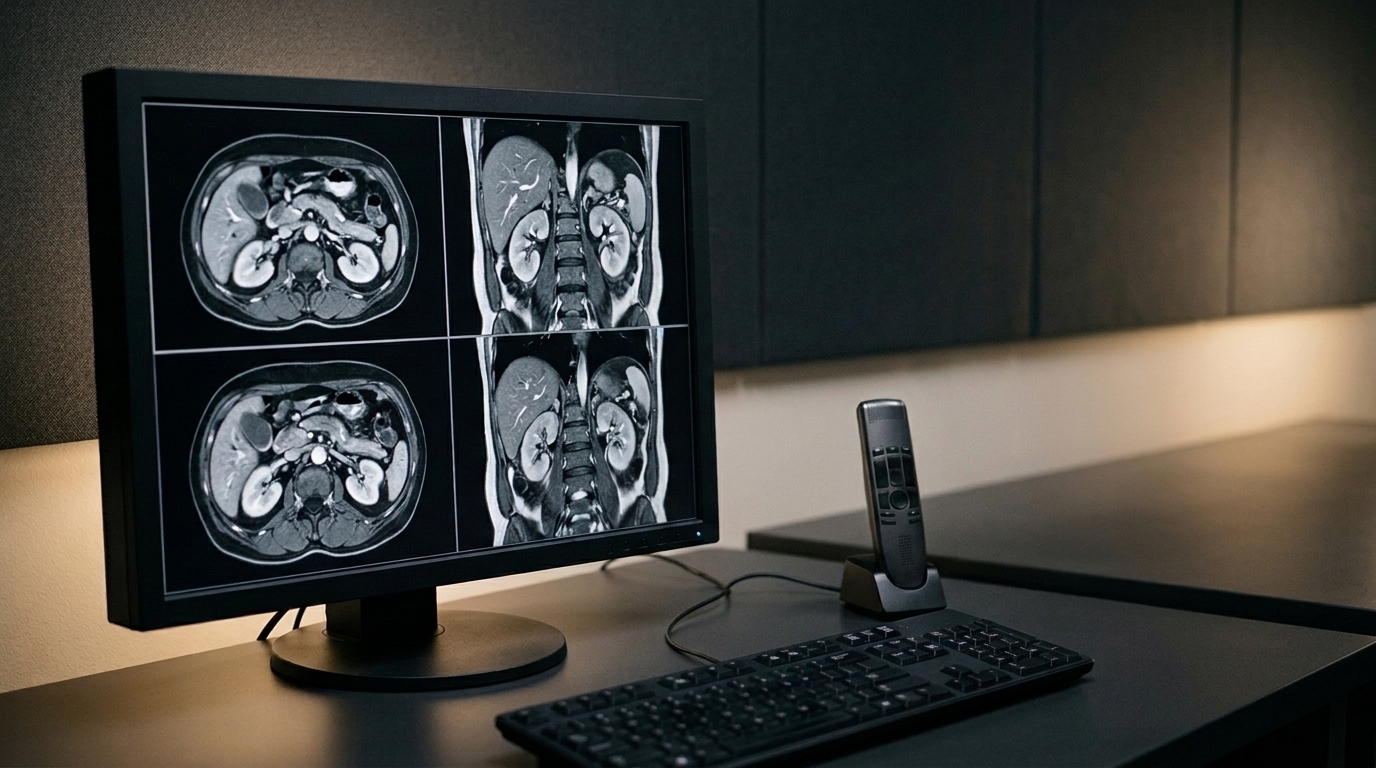
To investigate whether natural language processing could resolve this administrative and cognitive bottleneck, investigators from three tertiary institutions screened 1,156 consecutive Chinese-language renal magnetic resonance imaging reports acquired between January 2020 and January 2026. The participating centers included the Beilun Branch of the First Affiliated Hospital of Zhejiang University School of Medicine, the First Affiliated Hospital of Zhejiang University School of Medicine, and the First Affiliated Hospital of Wannan Medical University. After excluding 108 examinations involving patients who had previously undergone renal biopsy, surgical resection, ablation, or targeted pharmacological therapy, the research team finalized an analytic sample of 1,048 abdominal reports. Examinations had been acquired on standard 1.5-Tesla and 3.0-Tesla scanners utilizing standardized abdominal imaging protocols.
The overall dataset was partitioned into an internal development cohort of 802 reports from a single primary facility and an external validation cohort of 246 reports gathered across the two independent secondary facilities. Demographic and imaging profiles remained consistent across both groups, with patient ages averaging approximately 55 years and renal lesion sizes averaging 29.2 millimeters in the internal cohort and 23.9 millimeters in the external cohort. Lesion representation spanned the full five-point scale, encompassing clear cell likelihood categories one through five in both groups. For examinations documenting multiple renal lesions, the primary lesion specified in the impression section was designated as the index lesion to ensure human readers and automated systems appraised identical findings.
The human reference standard was established through rigorous double review by two dedicated abdominal radiologists possessing 15 and 18 years of specialized subspecialty experience in renal magnetic resonance interpretation and standardized likelihood scoring. Working strictly from original free-text narratives without access to underlying imaging files or clinical records, the radiologists independently graded all 1,048 cases. Initial inter-reader concordance was reached in 930 cases, representing 88.7 percent of the cohort. Consensus discussions resolved 102 cases, while the remaining 16 unresolved cases were formally adjudicated by a third senior abdominal radiologist with three decades of abdominal imaging experience. In accordance with the study protocol, imaging features that were not explicitly mentioned in the original report narrative were systematically coded as absent.
The authors evaluated four large language models: DeepSeek-V3.2 in its standard configuration, Qwen 3.5 Flash, GPT-5.3 in standard non-reasoning mode, and Gemini 3.0 Flash. To ensure procedural fidelity with clinical diagnostic logic, the research team developed a multi-step guided prompting framework enriched with few-shot examples that decomposed the evaluation into three distinct stages. In the initial stage, models performed automated extraction of six cardinal imaging characteristics: signal intensity on T2-weighted imaging, corticomedullary phase enhancement, microscopic intravoxel fat, segmental enhancement inversion, arterial-to-delayed enhancement ratio, and diffusion restriction. The subsequent stages guided the models through conditional rule matching against standardized scoring criteria before finalizing an ordinal score ranging from one to five.
All model evaluations were executed between March 20 and May 1, 2026, through official web-based graphical user interfaces rather than automated programmatic application programming interfaces or offline software deployments. This experimental environment was intentionally selected to mimic real-world interactions available to healthcare workers on standard hospital workstations, although it precluded direct fine-tuning of internal inference parameters such as sampling temperature. The prompts prohibited real-time web browsing, retrieval-augmented database connections, and external tool execution, ensuring that each case was evaluated within an independent transient session without conversational history. Data extractions and finalized category outputs were independently audited and cross-checked by two clinical researchers to verify computational recording fidelity.
In the primary internal evaluation of 802 reports, Gemini 3.0 achieved the highest overall accuracy across the five categories at 85.2 percent, correctly classifying 683 reports. Statistical comparisons utilizing Cochran Q tests with Bonferroni corrections confirmed that Gemini 3.0 and GPT-5.3 achieved significantly higher assignment accuracy than DeepSeek-V3.2 and Qwen 3.5. When stratified into clinical risk tiers, all four language models maintained accuracies exceeding 80 percent within the high-risk subgroup representing scores four and five, where Gemini 3.0 and GPT-5.3 reached 90.8 percent and 91.0 percent accuracy, respectively. For low-risk lesions scoring one or two, Gemini 3.0 attained 77.1 percent accuracy, outperforming DeepSeek-V3.2 and GPT-5.3, while for intermediate-risk score three lesions, Gemini 3.0 and GPT-5.3 tied at 80.3 percent accuracy.
External validation across 246 multicenter reports confirmed the stability of these automated scoring pipelines across disparate clinical environments. Gemini 3.0 maintained the top performance tier, accurately categorizing 211 of 246 cases for an overall accuracy of 85.8 percent, significantly exceeding Qwen 3.5. Within the external risk strata, models scored between 86.8 percent and 90.9 percent accuracy for high-risk lesions, with no statistically significant differences emerging among the four architectures. Agreement metrics using linear-weighted Cohen kappa demonstrated strong concordance between Gemini 3.0 and the expert consensus standard, yielding a kappa coefficient of 0.839 in the internal cohort, while GPT-5.3 reached 0.821, DeepSeek-V3.2 reached 0.754, and Qwen 3.5 reached 0.721.
Analysis of feature-level extraction revealed substantial differences depending on semantic complexity and vocabulary standardization within the free-text narratives. All four language models achieved high extraction precision, recall, and F1 scores exceeding 0.80 for explicit, unambiguous descriptors including marked corticomedullary enhancement, diffusion restriction on diffusion-weighted sequences, and clear T2 hyperintensity. In contrast, extraction performance declined substantially when models encountered nuanced or linguistically variable characteristics, such as subtle signal drops reflecting microscopic fat or subjective descriptions of mild-to-moderate enhancement. The models experienced their greatest difficulties parsing segmental enhancement inversion and calculating the arterial-to-delayed enhancement ratio, where colloquial clinical descriptions like fast-in and fast-out enhancement were required as surrogate textual proxies.
To determine how report-derived scores correlated with definitive tissue histology, the authors conducted a subgroup analysis among 237 internal patients with confirmed histopathologic diagnoses, comprising 133 clear cell renal cell carcinomas and 104 non-clear cell lesions. Applying a diagnostic cutoff of clear cell likelihood score four or higher, expert report-based categorizations achieved an area under the receiver operating characteristic curve of 0.799. Language model scores yielded areas under the curve ranging from 0.768 to 0.791, with negligible statistical differences ranging between negative 0.008 and negative 0.031 compared to the human experts. The authors concluded that while current natural language models cannot independently replace expert radiologic review, structured multi-step prompting offers practical utility as a first-pass clinical decision-support tool within supervised radiology workflows.
Subject of Research: Evaluation of large language models for automated clear cell likelihood scoring from free-text renal MRI reports
Article Title: Application of large language models for assigning clear cell likelihood score v2.0 from free–text MRI reports: a feasibility study
Article References: Duan, Y., Zhao, Y., He, M., Li, T., Yang, L., Hu, Z., Wang, M., & Feng, Z. (2026). Application of large language models for assigning clear cell likelihood score v2.0 from free–text MRI reports: a feasibility study. Abdominal Radiology. https://doi.org/10.1007/s00261-026-05818-1
Image Credits: AI Generated
DOI: 10.1007/s00261-026-05818-1
Keywords: clear cell likelihood score, ccLS v2.0, large language models, renal cell carcinoma, magnetic resonance imaging, free-text reports, radiology report parsing, feature extraction, Gemini 3.0, GPT-5.3, DeepSeek-V3.2, Qwen 3.5, corticomedullary enhancement, diffusion restriction, arterial-to-delayed enhancement ratio, decision-support tools, retrospective multicenter study
News Source: Ophelia Keating. (November 24, 2026). Large Language Models Accurately Classify Renal Masses From Free-Text MRI Reports. Scienmag.