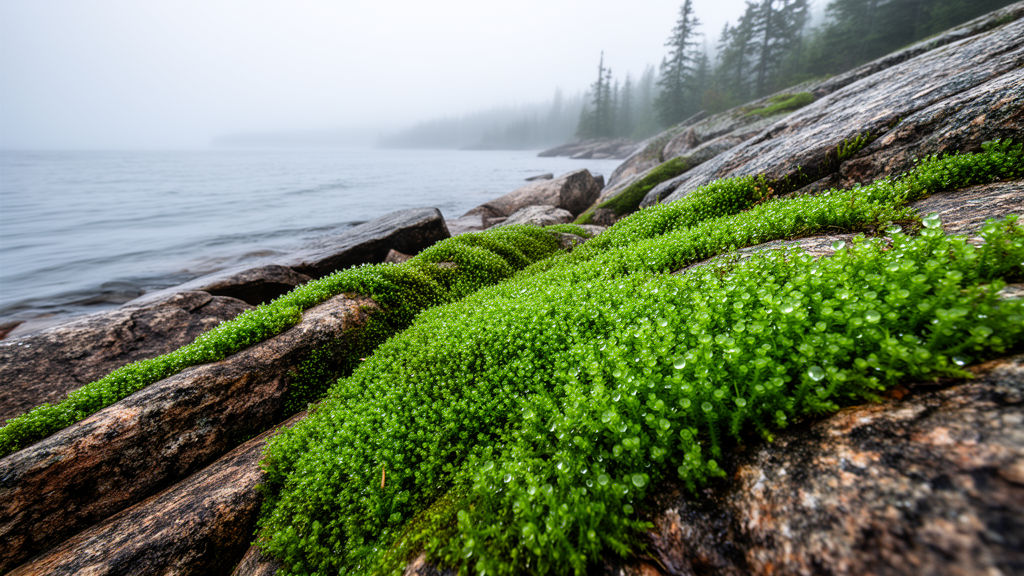
New research conducted along the northern and eastern shores of Lake Superior reveals that the massive freshwater body exerts a powerful influence on bryophyte communities, effectively restructuring their composition across various spatial scales. While large lakes are known to modify regional climates—a phenomenon often referred to as the “lake effect”—the specific impacts of this climatic heterogeneity on biodiversity have remained poorly documented until now. By investigating how these environmental gradients affect mosses and liverworts at micro, meso, and macro levels, the research team found that Lake Superior induces biotically important conditions that help define which species occupy specific forest habitats. This study provides crucial insight into how large waterbodies might serve as important thermal and hydrologic refugia for sensitive bryophyte species in an era of global climate change.
The study, which spanned approximately 400 kilometers of the northern and eastern shoreline, utilized 54 sampling sites across eight transects to collect detailed data on bryophyte communities and local forest characteristics. Researchers examined communities on three distinct substrates—rocks, live trees, and fallen logs—to capture a comprehensive picture of how these organisms respond to the environment. The team integrated this field data with bioclimatic information to evaluate the relative influence of three spatial scales: the microscale, which encompasses forest structure and composition; the mesoscale, which includes the lake-induced climatic effects; and the macroscale, defined by regional climatic norms. This multi-scale approach was essential for disentangling the complex, overlapping factors that influence where these poikilohydric organisms—which cannot regulate their internal hydration status—are able to persist.
Results from the analysis indicated that the lake effect mesoscale gradients exhibited the strongest impact on bryophyte community composition. The researchers divided the lake effect into three orthogonal axes, each reflecting a distinct component of the moisture environment: precipitation, relative humidity, and vapour pressure deficit. Each of these components appeared to influence bryophyte communities in divergent ways. For example, a strong directional moisture gradient was identified on the eastern, leeward shore of the lake, where winter, spring, and autumn precipitation levels are elevated significantly above expectations for the region. This localized high-precipitation zone, resulting from the interaction between cold air masses and the relatively warmer lake surface, strongly shaped the community composition of species found in the southeastern portion of the study area.
Interestingly, while the lake effect and other environmental gradients had a pronounced influence on the composition of these plant communities, they had no statistically significant influence on species richness. The team recorded a total of 145 bryophyte species, including 101 mosses and 44 liverworts, with site richness ranging from 18 to 54 species. The lack of an observable trend in richness suggests that under the relatively low-stress conditions mediated by the lake, other ecological processes—such as biological competition for space or resources—may become the dominant factors shaping the number of species present. Furthermore, the findings highlight that while environmental filtering is vital, standardized sampling suggests that local microhabitat availability and diversity might play a larger role in determining total species counts than the broader climatic shifts caused by the lake.
The study also revealed that the strength of the coupling between bryophyte communities and their environment varies significantly by substrate type. Epiphytic communities—those living on trees—showed the strongest response to environmental gradients, likely because they are more directly exposed to atmospheric conditions and lack the moisture-buffering capacity of other substrates like decaying logs. Conversely, epilithic communities on rocks displayed the lowest variation explained by the models. Rocks offer a vast array of micro-niches through variations in texture, pH, and microtopography, which may partially decouple these communities from the broader forest and lake-induced climatic drivers. These findings illustrate the nuanced ways in which the structural properties of different substrates modulate the effects of regional and local climate on the organisms they support.
The influence of the macroclimate was also evident in the study, with latitude and regional vapour pressure deficit serving as key factors. These macroscale influences interacted with the forest canopy, which acts as a secondary buffer, moderating the microclimate experienced by bryophytes on the forest floor and on trees. The team noted that the forest itself influences these communities through two primary pathways: the physical and chemical nature of the substrate, such as bark or decaying wood, and the moderation of understorey light and humidity levels through canopy closure. These pathways highlight a complex interplay where the forest acts as both a habitat and a mediator of environmental stress, with the most sensitive species relying on the stability provided by these moderating factors.
The findings have significant implications for the conservation of bryophyte diversity in the face of ongoing environmental change. Climate models generally predict not only higher average temperatures but also increased vapour pressure deficits and decreased relative humidity, factors which together will likely increase moisture and thermal stress for many plant groups. Because bryophytes are notoriously sensitive to moisture, these changes could lead to the thermophilisation of communities—a transition toward species adapted to warmer conditions—and potential declines in particularly sensitive groups like liverworts. Lake Superior may serve as an essential thermal and hydrologic refuge, preserving regional diversity that might otherwise be lost without the lake’s buffering effect on local temperature and moisture.
While the study demonstrates that the lake’s influence is widespread, the team emphasized that the refugial characteristics are not uniform. The directional high-precipitation effect is largely unique to the leeward shore, meaning that different parts of the lake’s perimeter offer different types of protection for bryophyte communities. This regional variability suggests that the response to climate change will be similarly heterogeneous, with some areas retaining more favorable conditions for moisture-loving bryophytes than others. The researchers suggest that further investigations at even larger spatial scales could provide a deeper understanding of how these divergent moisture gradients interact with regional climate change, helping to refine predictions for biodiversity in boreal forest ecosystems across North America.
Lake Superior’s physical scale underpins these dynamics, possessing an exceptional surface area of 82,000 square kilometers and depths reaching 400 meters. These dimensions generate a tempered shoreline microclimate characterized by cooler summers, warmer winters, and reduced diurnal temperature swings, capable of sustaining disjunct communities of Arctic-alpine plant species. To evaluate these gradients systematically, the researchers established eight 100-kilometer transects extending inland perpendicular to the lake shoreline. Sites were mapped at predetermined distances ranging from the shoreline up to 100 kilometers inland across mixedwood forest stands with a minimum age of 80 years. To isolate the lake’s influence from confounding environmental stressors, all locations were placed at least one kilometer away from roads or railways to minimize aerial pollution deposition, and at least one kilometer from any other inland waterbody. Accessibility constraints and these stringent criteria yielded 54 suitable survey sites.
Within each site, field crews evaluated bryophyte colonies within a circular plot 24 meters in diameter across four distinct substrate categories. Sampling targeted live white birch and live spruce trees with a diameter at breast height of at least seven centimeters, partitioning tree trunks into basal zones below one meter and trunk zones above one meter. On the forest floor, teams inventoried decaying logs categorized specifically at decay stages three and four, alongside rock boulders or rock walls measuring at least one square meter where present. Across all substrates, the survey documented 101 moss species, comprising 45 acrocarps, 55 pleurocarps, and one Sphagnum species, alongside 44 liverwort species. Notably, the inventory revealed 25 provincially rare species with subnational conservation ranks between S1 and S3. Three of these taxa, Frullania selwyniana, Homomallium adnatum, and Pseudotaxiphyllum distichaceum, also hold national conservation designations as nationally rare species.
To analyze environmental drivers without confounding collinearity, the authors condensed bioclimatic rasters from the Chelsa database and local stand measurements using principal components analysis. Generalized linear models revealed contrasting drivers of species richness among substrate guilds, even though overall community richness remained unaffected by mesoscale lake variables. For epilithic bryophytes dwelling on rocks, negative binomial models showed that species richness was significantly higher in southern survey sites experiencing higher mean vapour pressure deficit. In contrast, epixylic richness peaked in northern sites characterized by lower vapour pressure deficit and was positively associated with stands containing larger trees and a greater proportion of deciduous canopy cover. For tree-dwelling epiphytes, Poisson regression models demonstrated that species richness increased significantly with higher canopy closure, which helps elevate understorey humidity and mitigate moisture stress on exposed bark.
Distance-based redundancy analyses and variance partitioning further quantified how substrate properties govern community assembly. The models accounted for varying proportions of compositional variation across substrates, explaining 26 percent of the variation in epiphytic communities, 13 percent in epixylic communities, and 11 percent in epilithic assemblages. Epiphytic communities exhibited the tightest coupling to macroclimate and mesoscale lake gradients because tree bark dries rapidly, leaving tree-dwelling bryophytes dependent on atmospheric moisture. Conversely, decaying logs possess substantially greater water retention capacity, which dampens microclimatic fluctuations. Moreover, because fallen logs reflect the forest structure and chemistry present at the time of treefall rather than current stand conditions, progressive wood decay introduces a temporal lag that partially uncouples wood-inhabiting communities from contemporary forest canopies.
Subject of Research: Landscape Ecology
Article Title: Complex lake effects structure bryophyte communities across spatial scales around Lake Superior, Canada
Article References: Crisfield, V. E., Holt-Schmitt, D., Buttò, V., & Fenton, N. J. (2026). Complex lake effects structure bryophyte communities across spatial scales around Lake Superior, Canada. Landscape Ecology, 41(12), Article 230. https://doi.org/10.1007/s10980-026-02488-8
Image Credits: AI Generated
DOI: 10.1007/s10980-026-02488-8
Keywords: Bryophytes, Lake Superior, Lake Effect, Climate Refugia, Community Composition, Boreal Forest, Moisture Gradients, Environmental Heterogeneity, Landscape Ecology, Species Richness, Epiphytes, Epixylics, Epilithics, Climate Change Adaptation, Spatial Scaling, Forest Microclimates
News Source: Gavin Prescott. (November 16, 2026). Lake Superior’s Climate Moderation Shapes Regional Bryophyte Community Composition. Scienmag.