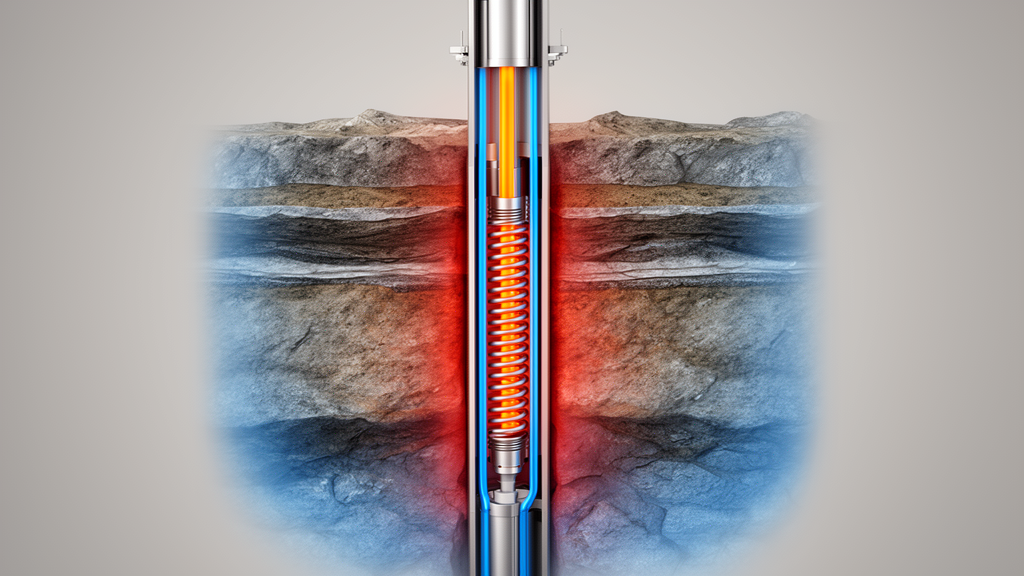
Published in the journal Geothermal Energy in February 2026, the study aims to address the limitations of traditional deep borehole heat exchangers, which often suffer from low heat extraction rates due to the poor thermal conductivity of surrounding rock. By modifying the well structure to include an engineered reservoir, the SEGS concept seeks to enhance heat transfer through convective mechanisms rather than relying solely on conduction. The team, led by Ma Bo and colleagues, conducted a series of controlled experiments to identify the key operational parameters that maximize heat extraction while maintaining stable production temperatures.
The experimental apparatus was designed to simulate the subsurface conditions of a fractured geothermal reservoir using a large sandbox filled with glass beads. The sandbox, measuring 1.5 meters in height and 1 meter in diameter, was constructed from stainless steel and insulated to approximate adiabatic boundary conditions. The glass beads, with particle sizes ranging from 0.8 to 1.2 millimeters, served as a homogeneous porous medium to mimic the rock matrix. This setup allowed the researchers to control the injection of water through an annular space and its production through an inner pipe, replicating the flow dynamics of a real-world SEGS configuration.
To ensure the reliability of their findings, the study included a rigorous uncertainty analysis and model validation. The temperature was measured at 44 distinct points using calibrated PT100 thermal resistors, while the mass flow rate was monitored with an electromagnetic flowmeter. The relative uncertainties for temperature, temperature difference, and flow rate were all kept below 5%, confirming the precision of the data. Furthermore, numerical simulations were conducted to corroborate the experimental results, showing a close agreement between the simulated and observed production temperature histories, with a maximum variance of approximately 8% occurring at the beginning of the tests.
The investigation focused on several critical variables, including injection flow rate, injection temperature, the initial temperature of the sandbox, and the spacing between the injection and production zones. The team found that the injection flow rate significantly influences the duration of stable heat production. At a flow rate of 0.3 cubic meters per hour, the system maintained a stable production temperature for approximately 50 minutes, whereas at 0.6 cubic meters per hour, this plateau was reduced to just 25 minutes. Although higher flow rates increased the average heat flow rate from 8.9 to 22.3 kilowatts, they also led to more rapid temperature decay in the later stages of operation.
The initial temperature of the reservoir also played a crucial role in determining the system’s thermal output. Experiments conducted with initial sandbox temperatures of 50, 60, and 70 degrees Celsius revealed that higher temperatures resulted in greater average heat flow rates, reaching 24.76 kilowatts at the highest temperature tested. However, this increased thermal driving force also led to more pronounced thermal depletion over time, with the total reduction in production temperature reaching 33.43% after 60 minutes of operation at 70 degrees Celsius, compared to 20% at 50 degrees Celsius.
Injection temperature presented a distinct trade-off between thermal stability and power output. When the injection temperature was increased from 21 to 41 degrees Celsius, the average production temperature rose by 2.3 degrees Celsius, but the average heat flow rate decreased by 10.33 kilowatts. This suggests that while higher injection temperatures can mitigate the adverse effects of thermal breakthrough and extend the system’s operational lifetime, they come at the cost of reduced short-term thermal power. The optimal choice for injection temperature therefore depends on the specific design of the surface heat-exchange equipment and the intended heat-utilization strategy.
The spacing between the injection and production zones emerged as a particularly effective lever for improving system performance. By increasing the axial distance between the upper injection screen and the lower production screen from 90 to 120 centimeters, the researchers observed a significant delay in the onset of thermal breakthrough. This wider interval allowed the injected fluid to exchange heat more fully with the surrounding rock, raising the average production temperature by 4.4 degrees Celsius and the average heat flow rate by 2.6 kilowatts. Notably, the total temperature decay over the test period dropped from 31.5% to just 8.0% with the larger spacing.
Based on the observed trade-offs within the tested parameter range, the study identified a specific combination of conditions that provided the best compromise between high heat extraction and stable production. A flow rate of 0.4 cubic meters per hour, an injection temperature of 31 degrees Celsius, and an injection-production spacing of 120 centimeters yielded the most favorable balance. These findings offer a foundational understanding of SEGS thermal behavior and provide a basis for optimizing system design in practical applications.
The study highlights the potential of the SEGS to sustain efficient heat extraction in the early stages of operation, with production temperatures initially matching the reservoir temperature. However, the researchers noted that a discernible decline in temperature and heat flow rate occurs during the mid-stage of operation as thermal breakthrough progresses. This geometric model of the thermal front, which expands longitudinally and radially from the injection zone, helps explain the observed delay in production temperature decline and the subsequent decay.
Despite the promising results, the authors acknowledge several limitations of their work. The conclusions are based on a controlled laboratory analog using a homogeneous porous medium, which may not fully capture the complexities of real-world geological heterogeneity. Scale effects and long-term operational factors were not investigated in this study. The team emphasizes that field-scale pilot studies are necessary for comprehensive validation and suggests that future research should expand the parameter range and explore long-term performance to address these gaps.
This research contributes to the broader objective of optimizing energy supply diversification and reducing reliance on fossil fuels, aligning with China’s dual carbon goals and global climate commitments.
The experimental setup relied on a specific physical model to simulate the subsurface environment. The sandbox was filled with glass beads having a density of 1500 kg/m³, a specific heat capacity of 800 J/(kg·K), and a thermal conductivity of 2.5 W/(m·K). The average porosity of this packed medium was determined to be 0.35. Using the Kozeny–Carman equation, the researchers calculated the permeability of the porous medium to be 8.92 × 10⁻¹⁰ m². These physical properties allowed the team to treat the fractured reservoir as a homogeneous porous medium, facilitating the analysis of fluid flow and heat transfer under controlled conditions.
Temperature distribution within the sandbox was mapped using a dense array of sensors. Forty-two PT100 thermal resistors were placed inside the sandbox, with additional sensors at the inlets and outlets of the screen pipes. The internal sensors were arranged along two longitudinal lines, designated H1 and H2, and one transverse line, L1. The H1 line was positioned 10 cm from the cylinder wall, while H2 was located 30 cm from the wall. The L1 line was arranged radially at a distance of 55 cm from the base of the box. This spatial arrangement enabled the researchers to track the propagation of the thermal front in both longitudinal and radial directions.
The propagation of the cooling front was quantified during the typical working condition tests. The cooling front, defined as the depth where the temperature dropped by 5 °C from the initial value, propagated downward at an average velocity of approximately 1.0 cm/min between 30 and 60 minutes. In contrast, the radial propagation velocity of the 20 °C isotherm was calculated to be roughly 0.75 cm/min. This difference in velocity resulted in a distinct, elongated shape for the thermal front. The most pronounced cooling occurred between depths of 50 and 80 cm, where the depth-averaged cooling rate reached about 0.42 °C/min. Temperatures at the top and bottom of the sandbox remained stable, confirming that heat extraction was initially confined to the mid-section.
Numerical simulations were employed to validate the experimental findings. The physical model was constructed based on the experimental design, assuming that fluid flow obeys Darcy’s law and that local thermal equilibrium is maintained. The simulation results showed excellent concordance with the experimental data across various injection flow rates. The maximum variance between the numerical model and experimental data was about 8%, occurring at the beginning of the tests. This variance decreased over time, with decay rates converging beyond the 40-minute mark. The observed discrepancies were attributed to minor experimental heat losses and slight heterogeneities in the bead packing, which were not fully captured by the homogeneous medium assumption in the model.
The study also examined the influence of injection flow rate on the temperature distribution along the H2 line. As the injection flow rate increased, the temperature difference between the initial sandbox temperature and the final temperature at the same depth position also increased. For an injection mass flow rate of 0.2 m³/h, the temperature differences remained negligible across the monitored depth. However, when the flow rate exceeded 0.3 m³/h, a clear advancing front was observed. This indicates that increasing the flow rate enables heat extraction from a larger area of the sandbox, although it accelerates the thermal depletion in the later stages of operation.
Subject of Research: Experimental analysis of heat transfer parameters in single-well enhanced geothermal systems.
Article Title: Experimental investigation on heat transfer characteristics of single-well enhanced geothermal system
Article References: Bo, M., Anfan, L., Wei, C., Xujun, G., Wenbin, H., Yongzhi, L., & Lingbao, W. (2026). Experimental investigation on heat transfer characteristics of single-well enhanced geothermal system. Geothermal Energy, 14(1), Article 9. https://doi.org/10.1186/s40517-026-00379-4
Image Credits: AI Generated
DOI: 10.1186/s40517-026-00379-4
Keywords: geothermal energy, heat transfer, single-well system, enhanced geothermal system, laboratory experiment, thermal performance, injection flow rate, production temperature, reservoir simulation, renewable energy, Experimental, investigation
News Source: Violet Maxwell. (November 8, 2026). Lab Study Reveals Optimal Settings for Single-Well Geothermal Heat Extraction. Scienmag.