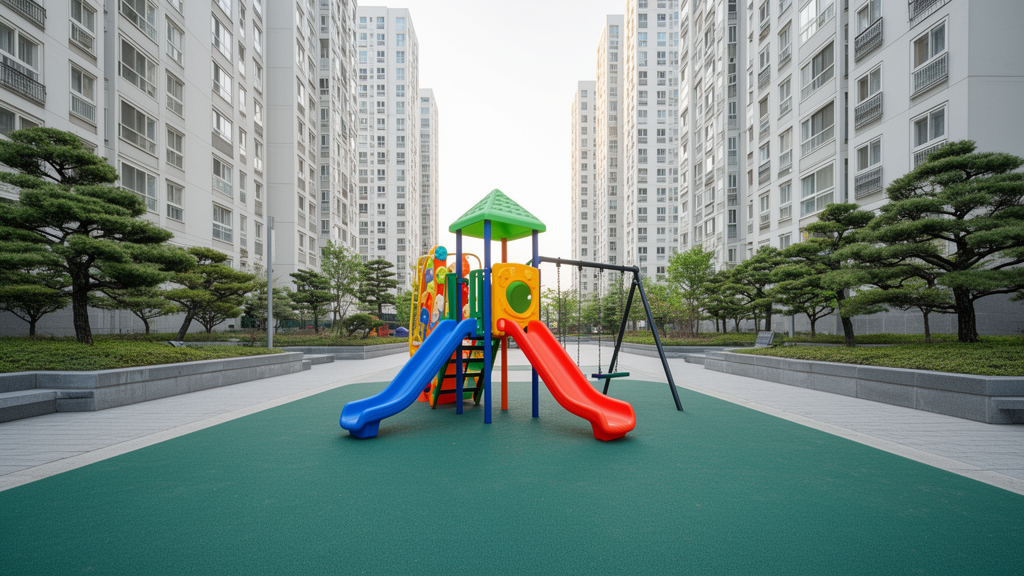
A new study published in Architectural Research investigates the transformation of children’s playgrounds in South Korea through the theoretical lens of Aldo van Eyck’s concept of the “in-between space.” The research, conducted by Dong Keum Hong, Eun Joo Park, and Keunhye Lee, posits that playgrounds are not merely recreational facilities but dynamic urban environments that mediate intergenerational relationships and reflect the evolving nature of public space. By framing these areas as urban mediators between the private and public realms, the authors identify three key spatial dimensions—publicness, multifunctionality, and locality—that define the social and spatial significance of contemporary play spaces in Seoul and its surrounding urban areas.
The study addresses a critical shift in the urban landscape of South Korea, where the number of playgrounds has been decreasing due to legal revisions and urban development. This decline has weakened the spatial and social value inherent in these spaces, restricting children’s play environments within cities. Historically, early playgrounds were designed solely around children’s play, but today’s environments have evolved to encompass complex values including intergenerational exchange and social solidarity. The research traces this evolution from informal alley-based spaces in the early 20th century to the highly formalized and themed environments of the present, highlighting how the future evolution of playgrounds provides important implications for urban spatial planning and design.
To analyze this transformation, the researchers developed an analytical framework that integrates Aldo van Eyck’s notion of in-between space with three specific criteria: publicness, multifunctionality, and locality. Publicness is defined as a space open to everyone, characterized by unrestricted access and spontaneous use by diverse people. Multifunctionality refers to the capacity of a space to accommodate diverse activities based on a flexible structure, allowing for the coexistence of multiple behaviors rather than being fixed to a single purpose. Locality is defined by the embedding of history, social currents, and identity within the space, creating a unique sense of place specific to that locality. These criteria were derived from a comparison of van Eyck’s theoretical concepts with the spatial characteristics of traditional Korean alleyways.
The study selected six representative case sites in Seoul and the metropolitan area, categorized into three types: park-type, play-type, and experience-type. These cases were chosen based on distinct user demographics, spatial configurations, and operational methods that reflect the characteristics of in-between spaces. The park-type includes Seoul Forest Park and Yeouido Han-river Park, which exemplify large-scale publicness. The play-type includes Seoul Children’s Grand Park and Sanmaru Playground, focusing on multifunctionality and locality. The experience-type includes Eungbong Park Children’s Forest Experience Center and Seoul Boramae Park, which integrate learning and sensory experiences with local identity. This typological framework allows for a comparative analysis of how different design approaches influence the social and spatial performance of playgrounds.
The comparative analysis reveals that publicness remains the most consistently expressed attribute across all case studies. Large-scale sites such as Seoul Forest and Yeouido Han-river Park achieve this through physical openness, accessibility, and universal design principles. These sites embody democratic ideals by accommodating diverse users and activities, similar to the communal hubs of historical alleyways. However, the study notes that these large-scale sites risk homogenization, as design standardization and institutional oversight can limit the organic social dynamics once found in informal play spaces. In modern contexts, publicness often prioritizes accessibility over intimacy and safety over spontaneity, potentially diminishing the shared community use that characterized earlier forms of play.
Unlike publicness, multifunctionality demonstrates uneven integration in modern playgrounds. Historically, Korean alleyways were multi-layered spaces that served as marketplaces, gathering spots, play areas, and resting places, with their purpose shifting depending on the time or situation. In contrast, contemporary playgrounds often exhibit programmatic rigidity, separating activities into designated zones. The analysis highlights that multifunctionality is most successful when physical structure, program, and social use are aligned to encourage overlap rather than separation. Sites like Seoul Children’s Grand Park effectively incorporate layered spaces that allow simultaneous play, observation, and rest, reinforcing intergenerational interaction. However, other sites lack this adaptive quality, indicating a loss of the flexible use that defined traditional interstitial spaces.
Locality plays a crucial role in reestablishing the identity of playgrounds within their communities, yet it remains underrepresented in many large-scale institutional playgrounds. Cases such as Sanmaru Playground and Seoul Boramae Park demonstrate strong place-based design, integrating local topography, history, and culture into spatial form. Sanmaru Playground, developed through an urban regeneration project, utilizes the area’s hilly topography and dense residential context to create a unique spatial experience, reinforcing regional identity. Similarly, Boramae Park incorporates the area’s history as a former air force base into its play facilities, offering an educational experience linked to local identity. These examples show how contemporary play spaces can express local character by combining topographical features with social and cultural values, restoring the symbolic and emotional connection between residents and space.
The study quantifies these observations by converting qualitative assessments into numerical scores, revealing distinct patterns of performance across the three dimensions. The findings confirm that while contemporary playgrounds partially inherit the mediating characteristics of traditional in-between spaces, they have diverged in critical aspects. The transition from organic alleyway play to institutionalized playgrounds reflects a shift from lived spontaneity to managed experience. Under the pressures of safety regulation, design standardization, and commercialization, the layers of multifunctionality and contextual resonance have weakened. This divergence suggests that modern playgrounds, while safer and more accessible, may have lost the flexibility and contextual embeddedness that made traditional alleyways vital social hubs.
The research emphasizes that the three dimensions of publicness, multifunctionality, and locality are not mutually exclusive but dynamically interdependent. Playgrounds with high publicness often facilitate multifunctional activities, while those emphasizing locality foster community engagement. However, contemporary design tends to prioritize safety and management efficiency, which inadvertently restricts the spontaneity central to traditional interstitial spaces. The authors argue that for playgrounds to function effectively as in-between spaces, they must move beyond their utilitarian purpose as recreational facilities. Instead, they should evolve into civic spaces of encounter, learning, and coexistence, integrating the openness of publicness, the adaptability of multifunctionality, and the rootedness of locality.
The study concludes by suggesting strategies for future playground design to recover their role as inclusive urban in-between spaces. It proposes that designers and policymakers view playgrounds as catalysts for urban vitality and social connection, rather than merely as child-centered recreational facilities. By embracing participatory planning and adaptive, modular systems, playgrounds can allow spontaneous reconfiguration based on user behavior and community input. This approach would help reconstitute the in-between realm within contemporary urbanism, transforming age-specific spaces into inclusive urban realms shared by multiple generations. The research ultimately highlights the potential for playgrounds to contribute to urban vitality by redefining the role of public space within contemporary city environments.
The historical evolution detailed in the study outlines how play spaces shifted across distinct eras of Korean urban development. Western-style public parks and basic play apparatus such as swings and seesaws first appeared during the Japanese colonial period, emphasizing civic order alongside physical development. Following national liberation, informal play areas spontaneously emerged within urban ruins and vacant lots, operating as organic interstitial zones between residential quarters and adjacent buildings. Rapid apartment-driven development from the 1960s through the 1980s subsequently institutionalized playgrounds through formal regulations and standardized equipment. Since the 2000s, specialized municipal themes, cultural programming, and educational objectives have further formalized these sites, moving urban play further from spontaneous street interaction into programmed facilities.
To evaluate the physical and programmatic performance of modern sites, the researchers constructed an analytical model combining Aldo van Eyck’s three principles of mediation—relational mediation, sense of play, and overlapping quality—with the three alleyway attributes of publicness, multifunctionality, and locality. Relational mediation examines how space bridges physical boundaries and psychological distance to connect users across generations. Sense of play assesses how localized spatial characteristics foster community memory and place identity, while overlapping quality captures how diverse recreational, social, and educational functions occur concurrently rather than within segregated zones. By juxtaposing these mediation components against alleyway traits, the framework clarifies how contemporary playground architecture mediates everyday urban encounters.
The investigation applied a structured scoring method to convert qualitative site observations into standardized metrics. The authors evaluated spatial drawings, analytical diagrams, and on-site field observations across each location, rating criteria on a four-tier scale: highly suitable, suitable, partially suitable, or unsuitable. These categorical determinations were converted into numerical scores from zero to three and expressed as percentage ratios to quantify spatial suitability. A rating of highly suitable required concrete, verifiable physical evidence, while unsuitable indicated the complete absence of observable features. Specific site designs illustrated these evaluations; for instance, the Eungbong Park Children’s Forest Experience Center in Yongsan-gu integrated sensory engagement and nature learning into play routines, whereas airplane-themed installations at Seoul Boramae Park anchored play equipment to the park’s history as a former air force installation.
In addressing whether modern playgrounds maintain continuity with historical alleyways, the authors concluded that spatial traces remain partially preserved, although the deliberate positioning of playgrounds as structured educational facilities has inadvertently contributed to reduced flexibility. Field evaluations verified that van Eyck’s mediating, locational, and overlapping attributes remain applicable to contemporary urban play environments. The study positions playgrounds not simply as child-oriented recreational infrastructure, but as critical intermediate spaces capable of reintroducing intergenerational social interaction into denser modern cities.
Subject of Research: Spatial analysis of playgrounds in South Korea as in-between spaces
Article Title: Reframing the Playground as an In-Between Space: Exploring Publicness, Multifunctionality, and Locality in Contemporary S. Korea
Article References: Hong, D. K., Park, E. J., & Lee, K. (2026). Reframing the Playground as an In-Between Space: Exploring Publicness, Multifunctionality, and Locality in Contemporary S. Korea. Architectural Research, 28(1), Article 3. https://doi.org/10.1007/s44515-026-00003-3
Image Credits: AI Generated
DOI: 10.1007/s44515-026-00003-3
Keywords: Architectural Research, Aldo van Eyck, In-between space, South Korea, Urban planning, Public space, Multifunctionality, Locality, Playground design, Intergenerational interaction, Seoul, Urban regeneration, Spatial analysis, Community cohesion, Korean alleyways, Urban vitality, Social solidarity, Civic space, Environmental education, Urban form
News Source: Denise Maddox. (November 14, 2026). Korean Playgrounds Lose Multifunctionality and Local Depth. Scienmag.