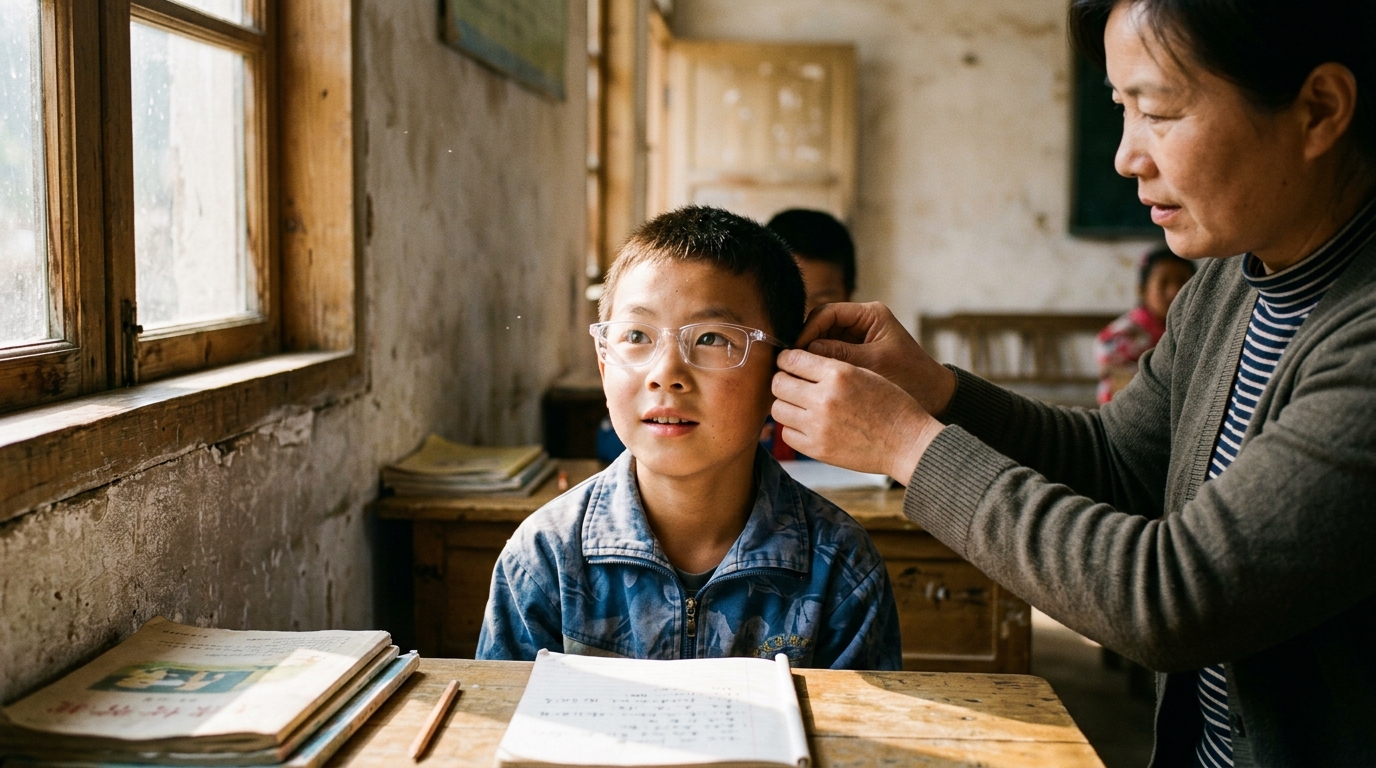
A cross-sectional study published in BMC Public Health examined subjective correlates of vision correction among rural primary school children in China. The research, led by Hongyu Guan and colleagues, focused on students in Q County, Gansu Province, where uncorrected myopia is highly prevalent. The study aimed to determine whether vision health knowledge, benefit expectation of correction, and intertemporal preference were associated with willingness to correct vision and actual corrective behaviors, such as eye examinations and spectacle use.
The researchers utilized data from 1,889 students in grades 4 through 6 across 21 schools. A positive screening result was defined as uncorrected visual acuity of 6/12 or worse in either eye, a condition that affected 989 students, or 52.4 percent of the total sample. After excluding students with missing information, the analytic subsample consisted of 981 screening-positive students. The primary outcome for the full sample was willingness to correct vision, while the outcomes for the screening-positive subsample included undergoing an eye examination, owning spectacles, and wearing them regularly.
The study estimated ordered logit and logit models with school fixed effects and adjustment for individual and household covariates. Among the 981 screening-positive students, 67.9 percent had undergone an eye examination, 50.9 percent owned spectacles, and 35.6 percent wore spectacles regularly. These figures highlight a significant gap between the need for correction and the actual uptake of corrective measures, suggesting that access limitations are not the only barrier to proper vision care in these rural communities.
The results indicated that vision health knowledge was significantly associated with both willingness and behavior. Specifically, a one-standard-deviation increase in knowledge was associated with a 6.0-percentage-point higher probability of being very willing to wear spectacles. Furthermore, this increase in knowledge was linked to 4.8 to 7.2-point higher probabilities of engaging in the three corrective behaviors: eye examination, spectacle ownership, and regular wear. This suggests that a lack of understanding regarding the importance of vision correction may be a key factor in under-correction among these children.
A one-standard-deviation increase in benefit expectation was associated with 3.9 to 5.1-point higher probabilities of the three corrective behaviors. However, when entered alone, benefit expectation was associated with willingness, but this association disappeared after adjusting for knowledge.
In contrast, present bias, a measure of intertemporal preference, was not significantly associated with willingness to correct vision or any of the specific corrective behaviors. This suggests that general measures of time preference may be less informative for explaining childhood spectacle-related decisions, which are likely embedded in complex household and school contexts. The study’s findings emphasize that interventions aimed at improving spectacle uptake may need to combine misconception correction with messages that make the practical benefits of correction more salient.
The study has several limitations, including its cross-sectional design, which prevents causal inferences. The data were collected from a single county in Gansu Province, which may limit the generalizability of the findings to other rural areas in China. Despite these limitations, the study provides valuable insights into the subjective correlates of vision correction, highlighting the importance of knowledge and benefit expectation in addressing the high prevalence of uncorrected myopia among rural school-aged children.
By identifying specific subjective factors associated with corrective behaviors, the study offers a framework for developing targeted interventions that go beyond simply improving access to eye care services.
Subject of Research: Beyond access: subjective correlates of vision correction among rural primary school children in China
Article Title: Beyond access: subjective correlates of vision correction among rural primary school children in China
Article References: Guan, H., Li, S., Zhong, Y., Liu, W., Zhou, L., & Liu, J. (2026). Beyond access: subjective correlates of vision correction among rural primary school children in China. BMC Public Health. https://doi.org/10.1186/s12889-026-30329-5
Image Credits: AI Generated
DOI: 10.1186/s12889-026-30329-5
Keywords: Beyond, access, subjective, correlates, vision, correction, rural, primary, school, children, China, scientific research
News Source: Ophelia Keating. (November 8, 2026). Knowledge and Benefit Expectation Linked to Vision Correction in Rural China. Scienmag.