Both elegant and fierce, killer whales are some of the oceans’ top predators, but even they can be exposed to environmental pollution. Now, in the largest study to date on North Atlantic killer whales, researchers in ACS’ Environmental Science & Technology report the levels of legacy and emerging pollutants in 162 individuals’ blubber. The animals’ diet, rather than location, greatly impacted contaminant levels and potential health risks — information that’s helpful to conservation efforts.
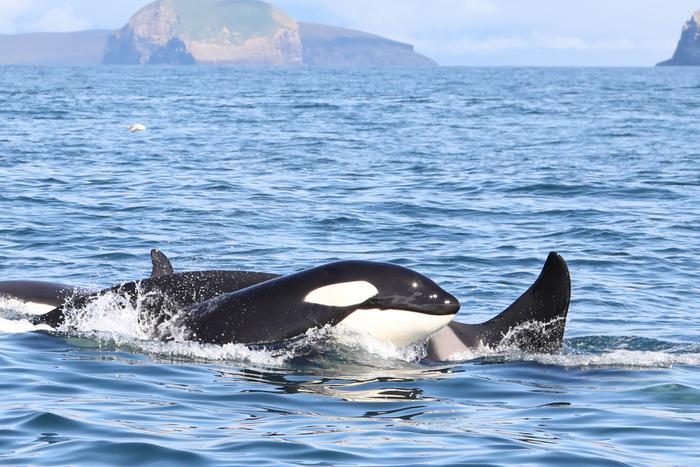
Credit: Anaïs Remili / The Icelandic Orca Project
Both elegant and fierce, killer whales are some of the oceans’ top predators, but even they can be exposed to environmental pollution. Now, in the largest study to date on North Atlantic killer whales, researchers in ACS’ Environmental Science & Technology report the levels of legacy and emerging pollutants in 162 individuals’ blubber. The animals’ diet, rather than location, greatly impacted contaminant levels and potential health risks — information that’s helpful to conservation efforts.
As the largest member of the dolphin family, killer whales, also known as orcas, are found worldwide. Marine vessel traffic can disturb the hunting and communication of these black-and-white marine mammals. But they face another type of human threat — legacy and emerging persistent organic pollutants (POPs) in their environments. POPs include chlorinated hydrocarbons and flame retardants, and can accumulate in animals’ fat stores as the contaminants move up the food chain though a process called biomagnification.
Previous studies have shown that some Pacific orca populations can carry POP loads in their blubber that pose potential health risks, including reduced immunity, hormonal imbalances and reproductive issues. But information on orcas living in the North Atlantic are lacking. So, Anaïs Remili, Melissa McKinney and colleagues wanted to assess the contaminants present in animals spanning from Eastern Canada to Norway.
The researchers collected skin and blubber biopsies from over a hundred free-ranging killer whales, across the North Atlantic Ocean from Canada, Greenland, Iceland to Norway. They analyzed half of each tissue sample for five classes of POPs, including polychlorinated biphenyls (PCBs). The other portion was used to evaluate the animals’ diets. Multiple features stood out in the data:
- Specimens from orcas in the western North Atlantic contained substantially higher contaminant loads than ones from orcas on the eastern side — a pattern that contrasts with previously reported POP levels in other Arctic marine organisms.
- The pattern could be attributed to individuals’ diet rather than location. Specifically, killer whales foraging on fish had the lowest POP levels, and animals consuming marine mammals, such as seals or other whales, had the highest.
- PCB-associated health risks were highest for killer whales that ate primarily marine mammals, with most animals’ levels exceeding the threshold for a higher risk of female reproductive failure.
- The levels of one POP, known as α-HBCDD, were the highest reported for any marine mammal to date, despite the fact that this brominated flame retardant was banned a decade ago.
The researchers say the findings support the need for proper waste disposal to prevent contaminants from entering the oceans’ food chains and reaching the top predators. They explain that the findings of their study underscore the need for action to protect North Atlantic killer whales and their ecosystems.
The authors acknowledge funding from the Canada Research Chairs Program, the Natural Sciences and Engineering Research Council of Canada Discovery Grants Program, a Canada Foundation for Innovation Grant, The Danish Cooperation for Environment in the Arctic Programme, the Fonds de Recherche du Québec Nature et Technologies Doctoral Scholarship, the Quebec Strategic Cluster “EcotoQ”, the Quebec Center for Biodiversity Science, the Office Français de la Biodiversité, an Icelandic Research Fund START Postdoctoral Fellowship, an Icelandic Research Fund Project Grant, the Fisheries and Oceans Canada Nunavut Implementation Fund and Species at Risk Act, the Nunavut General Monitoring Plan, and the Nunavut Wildlife Management Board.
The paper’s abstract will be available on Oct. 11 at 8 a.m. Eastern time here: http://pubs.acs.org/doi/abs/10.1021/acs.est.3c05516
The American Chemical Society (ACS) is a nonprofit organization chartered by the U.S. Congress. ACS’ mission is to advance the broader chemistry enterprise and its practitioners for the benefit of Earth and all its people. The Society is a global leader in promoting excellence in science education and providing access to chemistry-related information and research through its multiple research solutions, peer-reviewed journals, scientific conferences, eBooks and weekly news periodical Chemical & Engineering News. ACS journals are among the most cited, most trusted and most read within the scientific literature; however, ACS itself does not conduct chemical research. As a leader in scientific information solutions, its CAS division partners with global innovators to accelerate breakthroughs by curating, connecting and analyzing the world’s scientific knowledge. ACS’ main offices are in Washington, D.C., and Columbus, Ohio.
To automatically receive news releases from the American Chemical Society, contact [email protected].
Follow us: Twitter | Facebook | LinkedIn | Instagram
Journal
Environmental Science & Technology
DOI
10.1021/acs.est.3c05516
Article Title
Varying Diet Composition Causes Striking Differences in Legacy and Emerging Contaminant Concentrations in Killer Whales across the North Atlantic
Article Publication Date
11-Oct-2023