Geotechnical engineers seeking reliable predictions of shear strength in serrated jointed rock masses have demonstrated that integrating Extreme Gradient Boosting with the Kepler Optimization Algorithm achieves superior predictive performance over alternative data-driven frameworks. Rock formations crossed by irregular structural discontinuities dictate the mechanical stability of natural slopes, foundational works, and deep underground excavations, where failure along joint interfaces can precipitate catastrophic landslides or rock collapses. Serrated joints present complex interlocking geometries and non-linear mechanical responses that frequently elude traditional analytical formulation. The newly developed computational framework combines machine learning algorithms with swarm intelligence optimization techniques, successfully mapping complex multi-parameter interactions to forecast shear resistance with notable precision while maintaining systematic physical interpretability through game-theoretic feature analysis.
Assessing the shear behavior of serrated rock joints has historically depended on simplified analytical and empirical criteria. Classic formulations, including Patton’s bilinear model, Barton and Choubey’s joint roughness coefficient approach, and subsequent extensions examining three-dimensional surface morphology, established theoretical foundations by linking surface asperities and compressive strength to shear resistance. Nevertheless, these classical formulations rely on foundational simplifications that struggle to capture the complex, non-linear mechanical responses inherent in natural joint systems under diverse stress states. When applied to serrated jointed rocks whose irregular geometries generate pronounced interlocking, empirical models often fail to capture multivariate relationships, whereas unoptimized artificial intelligence models can suffer from suboptimal parameter settings or opacity that restricts practical engineering deployment.
To overcome these computational and mechanical hurdles, the investigation established an integrated predictive structure incorporating four foundational machine learning models: Support Vector Regression, Backpropagation Neural Networks, Random Forest, and Extreme Gradient Boosting. Support Vector Regression projects non-linear geotechnical data into high-dimensional feature spaces using specialized kernel transformations to manage small datasets with high generalization ability. The Backpropagation Neural Network approximates non-linear geological mechanisms through a three-layer architecture of input, hidden, and output units, iteratively updating network weights via gradient descent and momentum factors. Random Forest aggregates predictions across multiple independently trained decision trees by averaging individual outputs to suppress variance. Extreme Gradient Boosting iteratively constructs an ensemble of decision trees by computing first-order and second-order gradients of a loss function while applying explicit regularization terms to suppress model overfitting.
Because the performance of complex data-driven models hinges upon hyperparameter configurations, the researchers deployed four nature-inspired metaheuristic search techniques to optimize model tuning: the Sparrow Search Algorithm, the Chameleon Optimization Algorithm, the Snake Optimization Algorithm, and the Kepler Optimization Algorithm. The Sparrow Search Algorithm simulates the foraging and anti-predation vigilance behavior of sparrow flocks by partitioning individuals into discoverers, followers, and vigilantes. The Chameleon Optimization Algorithm models how chameleons track, rotate their eyes, and extend their tongues to capture prey across search dimensions. The Snake Optimization Algorithm simulates mating and foraging patterns across dedicated exploration and exploitation phases, switching search behavior according to predefined environmental thresholds to refine candidate solutions.
The Kepler Optimization Algorithm applies principles derived from planetary motion around a star to navigate complex hyperparameter search domains. Candidate solutions represent planets tracing elliptical orbits around an optimal solution designated as the central star, with their velocities and orbital positions governed by gravitational forces, orbital eccentricities, and Euclidean distances. The algorithm structures hyperparameter discovery through distinct exploration and exploitation stages, updating planetary positions via velocity vectors and applying an elitism strategy that retains the best-performing parameter configurations. In optimizing the Extreme Gradient Boosting model, the algorithm searched specified continuous and discrete bounds, such as learning rates from 0.01 to 0.40, tree depths between 3 and 20, and tree quantities spanning 50 to 200, terminating once the root mean square error fitness fell below 0.5 without improvement across 500 consecutive iterations.
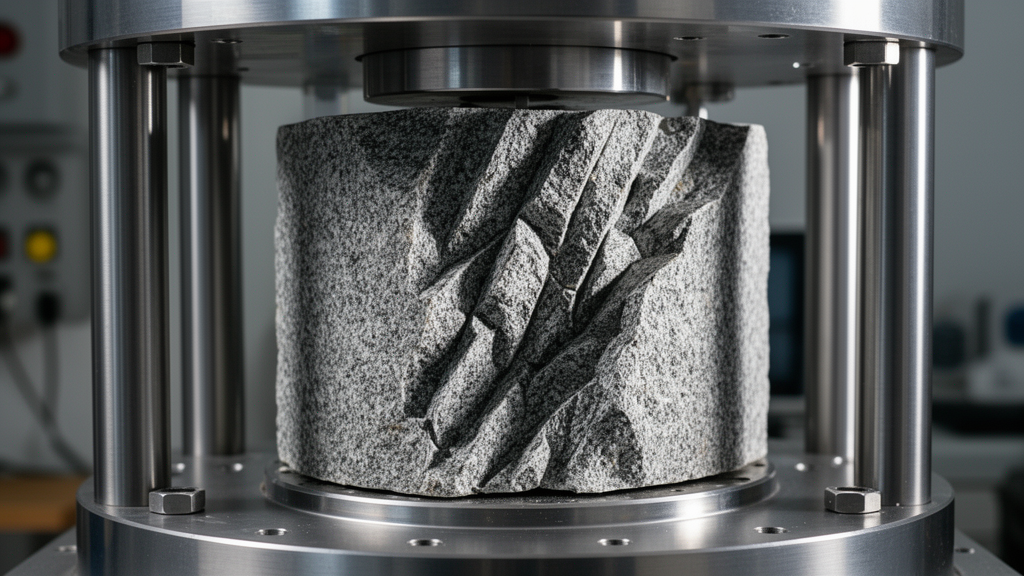
The experimental database supporting this predictive pipeline was constructed from 50 sets of direct shear tests performed on artificial serrated jointed rock specimens. Obtaining intact, geometrically consistent serrated joint samples from in-situ formations is difficult due to variable natural conditions and limited accessibility. Consequently, the researchers compiled experimental data using rock-like specimens manufactured from a controlled cement, sand, and plaster mixture mixed in a 1 to 1 to 0.5 weight ratio. These fabricated specimens featured basic friction angles ranging between 36.1 degrees and 42 degrees, consistent with typical friction angles of 30 to 40 degrees observed in natural jointed formations, and joint inclination angles from 10 to 40 degrees. The dataset was split into an 80 percent training subset to establish model weights and a 20 percent testing subset to evaluate generalization to unseen observations.
The dataset incorporated five critical parameters governing rock joint mechanics: basic internal friction angle, joint inclination angle, joint normal stress, the ratio of joint normal stress to intact rock tensile strength, and target shear strength. Prior to model training, min-max normalization was applied to map every input feature into a uniform interval between 0 and 1, preventing variables with larger numerical magnitudes from distorting the optimization process. Pearson correlation evaluations revealed distinct linear and non-linear patterns within the raw data: joint normal stress and the normalized stress ratio exhibited strong positive correlations with shear strength, both registering coefficients of 0.93, consistent with established normal-stress friction relationships. Conversely, joint inclination showed a weaker correlation coefficient of 0.27, and the basic friction angle exhibited a minor negative correlation coefficient of 0.01 across the sampled range.
Quantitative evaluations across both training and testing datasets demonstrated that the Kepler Optimization Algorithm paired with Extreme Gradient Boosting outperformed all other evaluated combinations across standard statistical metrics. On the training dataset, this optimized model yielded a coefficient of determination of 0.992, an adjusted coefficient of determination of 0.991, a root mean square error of 0.197, a mean absolute error of 0.153, and a variance accounted for of 99.20 percent. When validated against the testing subset, the model preserved high precision, recording a coefficient of determination of 0.992, an adjusted coefficient of determination of 0.991, a root mean square error of 0.239, a mean absolute error of 0.205, and a variance accounted for of 99.146 percent. Scatter evaluations showed predictions aligning closely along the ideal equality line with minimal dispersion.
Comparative evaluations against unoptimized baselines and alternate swarm-optimized configurations confirmed the advantages of the Kepler-guided gradient boosting approach. Unoptimized baseline models—including raw Extreme Gradient Boosting, Random Forest, Support Vector Regression, and Backpropagation Neural Networks—exhibited acceptable predictive capacity with coefficients of determination spanning from 0.895 to 0.927 on the test set. Among the metaheuristic variations, the Snake Optimization variant reached the second-highest accuracy, while the Chameleon and Sparrow Search models showed closely aligned performance, with the Chameleon model securing a test determination coefficient of 0.952, a root mean square error of 0.611, and a mean absolute error of 0.454. The Kepler variant consistently generated the lowest error metrics across the cohort, confirmed by geometric triangle plots and Wilson score confidence interval analyses.
To overcome the black-box opacity typical of ensemble tree architectures, the researchers applied TreeSHAP analysis to quantify the mechanical contributions of each input parameter to the predicted shear strength. Rooted in cooperative game theory, TreeSHAP computes the Shapley value of each parameter across decision trees using conditional expectations. The analysis established that joint normal stress was the most influential parameter, yielding an importance score of 0.360, followed by joint inclination at 0.255, the ratio of normal stress to tensile strength at 0.240, and basic friction angle at 0.145. Together, joint normal stress and joint inclination produced a cumulative importance score exceeding 0.6, establishing their primary control over serrated joint failure mechanisms.
These calculated parameter contributions reflect classical geomechanical principles governing discontinuous rock masses. Higher normal stress increases asperity confinement and frictional contact area, directly amplifying resistance according to the Mohr-Coulomb shear strength criterion. Joint inclination governs the geometric orientation of asperities relative to applied loads, dictating whether failure proceeds primarily via sliding along asperity surfaces or through tensile and shearing degradation of the intact asperities. The ratio of normal stress to tensile strength characterizes relative confinement, controlling the initiation of tensile cracking and transitions between failure modes. Meanwhile, the narrower relative variation of friction angles in the test specimens explains its smaller statistical contribution, as basic frictional resistance operates as a baseline parameter rather than the primary driver of variance.
For practical engineering deployment, the researchers proposed an iterative workflow integrating field mapping, automated prediction, targeted laboratory verification, and model refinement into routine slope stability and excavation design calculations. However, the authors noted key limitations in the current study: the dataset remains confined to 50 laboratory-derived specimens, and external validation against independent field datasets has not yet been conducted. Future investigations must expand testing across wider lithologies, varying joint surface geometries, and complex field stress environments, while exploring hybrid modeling frameworks that integrate explicit physical constitutive laws with machine learning architectures to ensure consistency across broader engineering scenarios.
Subject of Research: Predictive machine learning framework for the shear strength of serrated jointed rock masses
Article Title: Application of swarm intelligence optimization techniques and explainable data-driven methods in predicting the shear strength of serrated jointed rock masses
Article References: Ma, T., Ni, H., Luo, X., Zhang, M., Shen, L., Chen, C., Luo, K., Xie, S., Yang, Z., Lin, Y., Lin, H., Peng, K., Fu, X., & Jiang, Z. (2026). Application of swarm intelligence optimization techniques and explainable data-driven methods in predicting the shear strength of serrated jointed rock masses. International Journal of Geo-Engineering, 17(1), Article 9. https://doi.org/10.1186/s40703-026-00264-w
Image Credits: AI Generated
DOI: 10.1186/s40703-026-00264-w
Keywords: shear strength, jointed rock masses, Kepler Optimization Algorithm, Extreme Gradient Boosting, TreeSHAP, rock mechanics, geotechnical engineering, support vector regression, backpropagation neural network, random forest, sparrow search algorithm, chameleon optimization algorithm, snake optimization algorithm, direct shear tests, joint inclination, normal stress, geohazard prevention, machine learning
News Source: Denise Maddox. (November 21, 2026). Kepler Optimized XGBoost Accurately Predicts Serrated Jointed Rock Shear Strength. Scienmag.