

• HOME
  • NEWS
  • EXPLORE
    • CAREER
      • Companies
      • Jobs
    • EVENTS
    • iGEM
      • News
      • Team
    • PHOTOS
    • VIDEO
    • WIKI
  • BLOG
  • COMMUNITY
    • FACEBOOK
    • INSTAGRAM
    • TWITTER
Monday, January 12, 2026
BIOENGINEER.ORG
No Result
View All Result
  • Login
  • HOME
  • NEWS
  • EXPLORE
    • CAREER
      • Companies
      • Jobs
        • Lecturer
        • PhD Studentship
        • Postdoc
        • Research Assistant
    • EVENTS
    • iGEM
      • News
      • Team
    • PHOTOS
    • VIDEO
    • WIKI
  • BLOG
  • COMMUNITY
    • FACEBOOK
    • INSTAGRAM
    • TWITTER
  • HOME
  • NEWS
  • EXPLORE
    • CAREER
      • Companies
      • Jobs
        • Lecturer
        • PhD Studentship
        • Postdoc
        • Research Assistant
    • EVENTS
    • iGEM
      • News
      • Team
    • PHOTOS
    • VIDEO
    • WIKI
  • BLOG
  • COMMUNITY
    • FACEBOOK
    • INSTAGRAM
    • TWITTER
No Result
View All Result
Bioengineer.org
No Result
View All Result
Home Headlines

KAIST team identifies the novel molecular signal for triggering septic…

Bioengineer.org by Bioengineer.org
January 28, 2018
in Headlines, Health, Science News
Reading Time: 2 mins read
0
Share on FacebookShare on TwitterShare on LinkedinShare on RedditShare on Telegram
IMAGE

Credit: KAIST

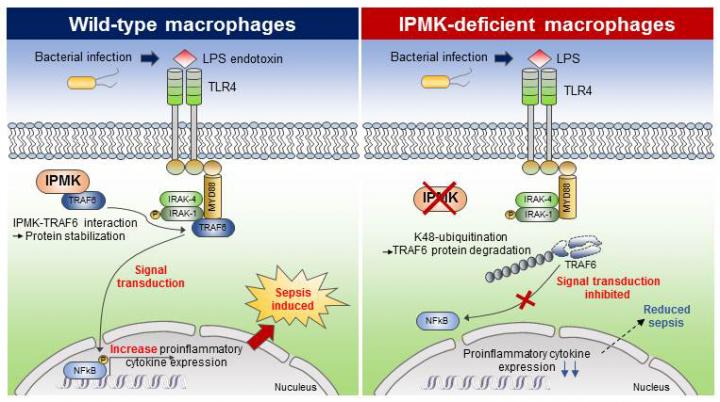
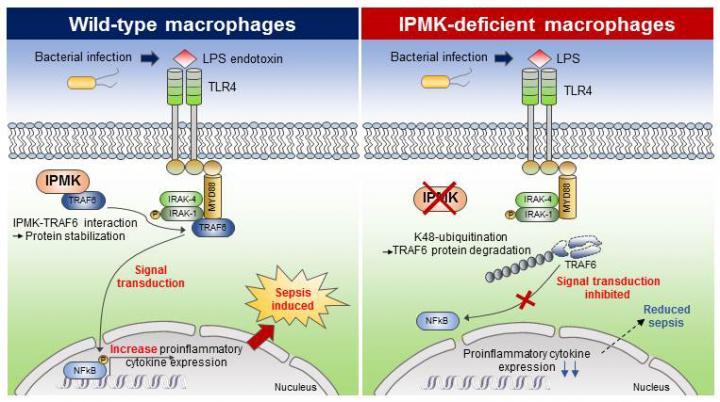
Professor Seyun Kim's team from KAIST reported the mechanism by which cellular signaling transduction network is exquisitely controlled in mediating innate immune response such as sepsis by the enzyme IPMK (Inositol polyphosphate multikinase) essential for inositol biosynthesis metabolism.

In collaboration with Professor Rho Hyun Seong at Seoul National University, the study's first author, Eunha Kim, a Ph.D. candidate in Department of Biological Sciences, performed a series of cellular, biochemical, and physiological experiments searching for the new function of IPMK enzyme in macrophages. The research findings were published in Science Advances on April 21.

Professor Kim's team has been investigating various inositol metabolites and their biosynthesis metabolism for several years and has multilaterally identified signaling actions of IPMK (Inositol polyphosphate multikinase) in the control of cellular growth and energy homeostasis.

This research showed that specific deletion of IPMK enzyme in macrophages could significantly reduce levels of inflammation and increase survival rates in mice when they were challenged by microbial septic shock as well as endotoxins. This suggests a role for IPMK enzyme in mediating innate inflammatory responses that are directly related to host defense against pathogenic bacterial infection.

The team further discovered that IPMK enzyme directly binds to TRAF6 protein, a key player in immune signaling, thus protecting TRAF6 protein from ubiquitination reactions that are involved in protein degradation. In addition, Kim and colleagues successfully verified this IPMK-dependent immune control by employing short peptides which can specifically interfere with the binding between IPMK enzyme and TRAF6 protein in macrophage cells.

This research revealed a novel function of IPMK enzyme in the fine tuning of innate immune signaling networks, suggesting a new direction for developing therapeutics targeting serious medical conditions such as neuroinflammation, type 2 diabetes, as well as polymicrobial sepsis that are developed from uncontrolled host immune responses. This research was funded by the Ministry of Science, ICT and Future Planning.

###

Media Contact

Younghye Cho
[email protected]
82-423-502-294
@KAISTPR

http://www.kaist.edu/english/

Original Source

http://www.kaist.ac.kr/_prog/_board/?code=ed_news&mode=V&no=63821&upr_ntt_no=63821&site_dvs_cd=en&menu_dvs_cd=060101 http://dx.doi.org/10.1126/sciadv.1602296


Share13Tweet8Share2ShareShareShare2

Related Posts

Deep Learning Revolutionizes Personalized Entrepreneurship Education

Deep Learning Revolutionizes Personalized Entrepreneurship Education

January 12, 2026

Senior Nursing Students Encounter End-of-Life Experiences

January 11, 2026

Kawasaki Disease Linked to Hepatitis and Torque Teno Virus

January 11, 2026

Developing Efficient Protocols for Respiratory Virus Biobank

January 11, 2026
Please login to join discussion

POPULAR NEWS

  • Enhancing Spiritual Care Education in Nursing Programs

    154 shares
    Share 62 Tweet 39
  • PTSD, Depression, Anxiety in Childhood Cancer Survivors, Parents

    146 shares
    Share 58 Tweet 37
  • Robotic Ureteral Reconstruction: A Novel Approach

    67 shares
    Share 27 Tweet 17
  • Impact of Vegan Diet and Resistance Exercise on Muscle Volume

    47 shares
    Share 19 Tweet 12

About

We bring you the latest biotechnology news from best research centers and universities around the world. Check our website.

Follow us

Recent News

Deep Learning Revolutionizes Personalized Entrepreneurship Education

Senior Nursing Students Encounter End-of-Life Experiences

Kawasaki Disease Linked to Hepatitis and Torque Teno Virus

Subscribe to Blog via Email

Enter your email address to subscribe to this blog and receive notifications of new posts by email.

Join 71 other subscribers
  • Contact Us

Bioengineer.org © Copyright 2023 All Rights Reserved.

Welcome Back!

Login to your account below

Forgotten Password?

Retrieve your password

Please enter your username or email address to reset your password.

Log In
No Result
View All Result
  • Homepages
    • Home Page 1
    • Home Page 2
  • News
  • National
  • Business
  • Health
  • Lifestyle
  • Science

Bioengineer.org © Copyright 2023 All Rights Reserved.
