Cartilaginous fish have changed much more in the course of their evolutionary history than previously believed. Evidence for this thesis has been provided by new fossils of a ray-like shark, Protospinax annectans, which demonstrate that sharks were already highly evolved in the Late Jurassic. This is the result of a recent study by an international research group led by palaeobiologist Patrick L. Jambura from the Department of Palaeontology at the University of Vienna, which was recently published in the journal Diversity.
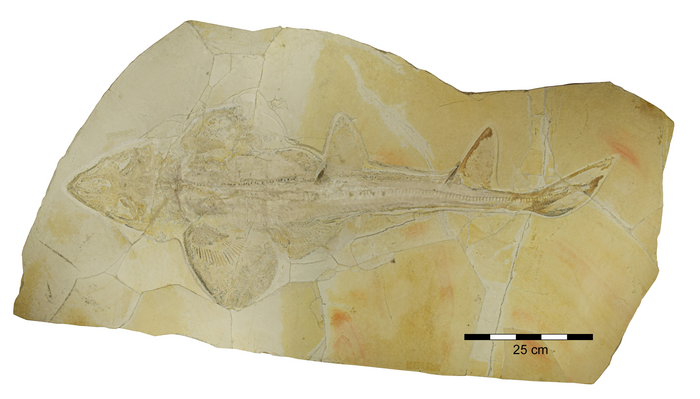
Credit: C: Sebastian Stumpf
Cartilaginous fish have changed much more in the course of their evolutionary history than previously believed. Evidence for this thesis has been provided by new fossils of a ray-like shark, Protospinax annectans, which demonstrate that sharks were already highly evolved in the Late Jurassic. This is the result of a recent study by an international research group led by palaeobiologist Patrick L. Jambura from the Department of Palaeontology at the University of Vienna, which was recently published in the journal Diversity.
Cartilaginous fishes (sharks, rays, and ratfish) are an evolutionarily very old group of animals that already lived on earth before the dinosaurs more than 400 million years ago and have survived all five mass extinctions. Their fossil remains can be found in large numbers all over the world – however, usually only the teeth remain, while the cartilaginous skeleton decays together with the rest of the body and does not fossilize.
A unique window into the past
In the Solnhofen archipelago, a so-called “Konservat Lagerstätte” in Bavaria, Germany, skeletal remains and even imprints of skin and muscles of Late Jurassic vertebrates (including cartilaginous fishes) have been preserved due to special preservation conditions. The research team used this circumstance to take a closer look at the previously unclear role of the already extinct species Protospinax annectans in the evolution of sharks and rays, also with the help of modern genetic evidence.
“Protospinax carried features that are found in both sharks and rays today,” explains study author Patrick L. Jambura. Protospinax lived some 150 million years ago and was a 1.5-m-long, dorso-ventrally flattened cartilaginous fish with expanded pectoral fins and a prominent fin spine in front of each dorsal fin. Although known from well preserved fossils, the phylogenetic position of Protospinax has puzzled researchers ever since it was first described in 1918. “Of particular interest,” Jambura continued, “is whether Protospinax represents a transition between sharks and rays as a ‘missing link’ – a hypothesis that has gained considerable appeal among experts over the past 25 years.” Alternatively, Protospinax could have been a very primitive shark, an ancestor of rays and sharks, or an ancestor of a certain group of sharks, the Galeomorphii, which includes the great white shark today – all of which are exciting ideas whose plausibility has now been clarified by scientists.
One mystery solved, another one remains
Incorporating the latest fossil finds, Jambura and his international team reconstructed the family tree of extant sharks and rays using genetic data (mitochondrial DNA) and embedded fossil groups – including Protospinax annectans – using morphological data. The results of the analysis were startling: Protospinax was neither a “missing link” nor a ray nor a primitive shark – but a highly evolved shark.
“We tend to think of evolution like a hierarchical, ladder-like system, in which older groups are at the base, while humans, as a very young species in Earth history, are at the top. In truth, however, evolution has never stopped even for these primitive representatives, but they continue to evolve day by day via changes in their DNA, just as we do. This is the only way they have been able to adapt to constantly changing environments and survive to this day,” says Jambura.
Even though cartilaginous fishes as a group have survived to this day, most species disappeared during its evolution, including Protospinax. Why Protospinax became extinct at the Jurassic-Cretaceous boundary some 145 million years ago and why there is no comparable shark species today, while the ecologically similarly adapted rays exist relatively unchanged to this day, remains a mystery at this point.
Journal
Diversity
DOI
10.3390/d15030311
Article Title
Systematics and Phylogenetic Interrelationships of the Enigmatic Late Jurassic Shark Protospinax annectans Woodward, 1918 with Comments on the Shark-Ray Sister Group Relationship.
Article Publication Date
21-Feb-2023