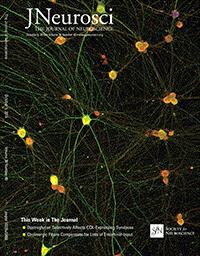
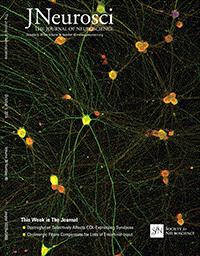
Credit: Kramer et al.
Check out these newsworthy studies from the October 5, 2016, issue of JNeurosci. Media interested in obtaining the full text of the studies should contact [email protected]
Genetic Mutation on Opioid Receptor Blocks Tolerance and Increases Vulnerability to Addiction
Opioids, the most potent pain-relieving drugs, have a high potential for abuse, but it's not clear why some people are more vulnerable to opioid tolerance and addiction than others. In a new study in mice, researchers identify a genetic mutation that contributes to tolerance and addiction. Mice with the single-nucleotide mutation on a gene coding for a specific opioid receptor don't develop opioid tolerance and increase self-administration of intravenous opioids. The findings may offer a new drug target for therapies to prevent opioid addiction, as well as a potential biomarker to identify people vulnerable to addiction.
Corresponding author: Zheng-Xiong Xi, [email protected]
Hormone Replacement Therapy Improves Cognition in Older Female Monkeys
During menopause, estrogen levels plummet. Some studies in people link this sharp decline to cognitive problems. While hormone replacement therapy can ameliorate some symptoms of menopause, like hot flashes and osteoporosis, its effects on cognition are not clear. In a new study, researchers find long-term administration of estradiol boosts cognitive performance in aged female rhesus monkeys over a one-year period of testing.
Corresponding author: Steven Kohama, [email protected]
Alzheimer's Gene May Impair Brain's Ability to Compensate for Neuron Loss
In the early stages of Alzheimer's disease, neurons in an area of the brain called the entorhinal cortex (EC) die. Studies in mice and people indicate the hippocampus — an area of the brain crucial for learning and memory — sprouts new neural connections when EC cells die. In a new study in mice, researchers find hippocampal sprouting helps compensate for the death of EC cells and preserve memory function, but mice possessing the genetic variation linked to Alzheimer's have less sprouting and poor memory. The results may help explain why individuals with the Alzheimer's genetic variation experience faster cognitive decline.
Corresponding author: Chantal Mathis, [email protected]
New Insights Into How Babies Learn
A defining feature of human cognition is our ability to learn sets of rules and group them into hierarchies. We then select the best rule set to use depending on the context. For example, bilingual individuals select which language (rule set) to use depending on who they're speaking with (context). Hierarchical rule learning depends on dopamine signaling in the prefrontal cortex, an area of the brain involved in complex cognitive processes that isn't fully developed until young adulthood. In a new study, researchers find 8-month-old infants use this same brain area in a simple rule-learning task, suggesting this brain circuitry is involved in learning and behavior much earlier in life than previously thought.
Corresponding author: Denise Werchan, [email protected]
Thyroid Hormone Boosts Neurogenesis in Developing Tadpole Brain
Thyroid hormone helps shape the developing brain, and abnormal thyroid hormone signaling in pregnancy is linked to cognitive deficits in offspring. But investigating the role of thyroid hormone in the early stages of mammalian brain development remains a challenge because the fetal brain is not accessible. Studying tadpoles, which develop externally, circumvents this challenge. In a new study in tadpoles, researchers find thyroid hormone regulates the birth of new neurons at key developmental stages by affecting the proliferation and differentiation of immature precursor cells and by enhancing dendritic branching in neurons.
Corresponding author: Hollis Cline, [email protected]
###
The Journal of Neuroscience is published by the Society for Neuroscience, an organization of nearly 38,000 basic scientists and clinicians who study the brain and nervous system.
Media Contact
Emily Ortman
[email protected]
202-962-4000
@sfntweets
http://www.sfn.org