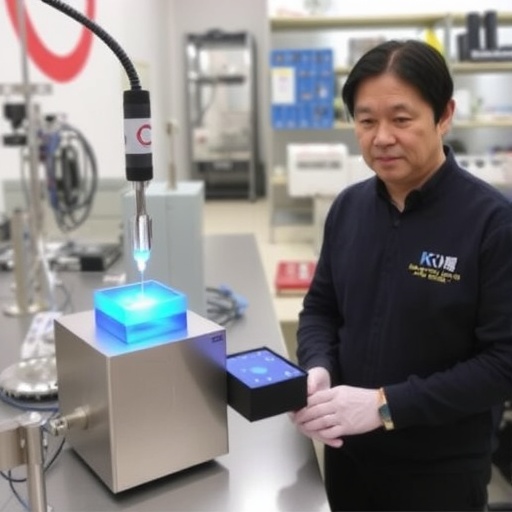
In the continuous quest to mitigate environmental hazards posed by radioactive contaminants, recent advances from the laboratories of Jeonbuk National University in South Korea have unveiled a transformative approach to cesium ion removal from nuclear wastewater. Radioactive cesium-137 (^137Cs), notorious for its high solubility and pervasive environmental diffusion, represents a critical challenge for nuclear waste management worldwide. The dynamic team led by Professor Jum Suk Jang has pioneered an innovative electrode system that leverages the exceptional adsorption characteristics of Prussian blue (PB) integrated onto a thermochemically functionalized carbon cloth substrate. This development promises a leap forward in the precision, efficiency, and sustainability of radioactive cesium remediation processes.
While nuclear fission remains a cornerstone of low-carbon energy generation, it concomitantly produces radioactive byproducts that necessitate scrupulous containment strategies. The presence of ^137Cs ions in wastewater resulting from nuclear reactors, radiological laboratories, and research installations poses insidious health and ecological risks due to the ion’s tendency to disperse through aquatic environments. Existing remediation methods such as adsorption and ion-exchange have found favor for their cost-effective and straightforward operational profiles. However, these techniques often face limitations in scalability, selectivity, and long-term stability, particularly when applied with conventional adsorbent forms like powder-based Prussian blue.
Prussian blue, known chemically as ferric hexacyanoferrate, has long intrigued material scientists for its exceptional affinity toward cesium ions. Its unique lattice structure selectively traps cesium via ion-exchange mechanisms, presenting a chemically stable and non-toxic choice for radiocesium sequestration. Yet, the conventional powder form of PB requires cumbersome immobilization steps for practical applications, increasing operational complexity and cost, while often suffering from poor electrochemical responsiveness.
Addressing these challenges head-on, the Jeonbuk research team devised a novel method to fabricate PB-based electrodes by electrodepositing the compound directly onto a conductive carbon cloth (CC) substrate. Carbon cloth is widely appreciated for its flexibility, conductivity, and mechanical robustness, making it an ideal platform for such applications. However, the native hydrophobicity of untreated CC surfaces impedes effective electrolyte interaction during deposition, leading to inconsistent PB layering and detrimental performance impacts.
To optimize the substrate’s physicochemical properties, the group employed a controlled acid treatment protocol at 60 °C, which effectively removes graphitic carbon layers and enriches the CC surface with oxygen-containing functional groups. This thermochemical functionalization process markedly enhances the hydrophilicity of the carbon cloth, denoted here as acid-treated carbon cloth (ACC), facilitating homogeneous and adherent Prussian blue electrodeposition. The functionalized surface thereby promotes uniform PB layer formation crucial for maximizing active sites for cesium adsorption.
Electrochemical characterizations reveal that the PB-ACC electrode exhibits superior activity and reduced ion diffusion resistance compared to both untreated carbon cloth and the acid-treated substrate without PB. These traits correlate directly with the composite electrode’s enhanced cesium ion adsorption capacities. Notably, experimental adsorption assays demonstrated a record high uptake value of 1173 milligrams of Cs^+ per gram of electrode material within a mere three-hour exposure, surpassing previous benchmarks for PB-based adsorbents. This heightened performance underscores the synergistic effects of electrochemical assistance and substrate functionalization.
An equally important attribute of any remediation technology lies in its operational durability and reusability. Repeated adsorption-desorption cycling tests confirmed that the PB-ACC electrodes maintained approximately 97% efficiency over multiple iterations. This resilience not only affirms material stability under electrochemical cycling but also highlights practical feasibility for extended use in industrial wastewater treatment settings, where cost-efficiency and sustainability dictate adoption.
Furthermore, the PB-ACC electrodes showcase remarkable selectivity for cesium ions amidst a milieu of competing ionic species typically present in nuclear wastewater. This selectivity is crucial for realistic deployment scenarios where complex ion matrices could otherwise impair adsorbent specificity and reduce treatment effectiveness. The electrochemically driven adsorption-desorption mechanism empowers precise ion recovery and regeneration of active sites, significantly simplifying post-treatment material handling and cesium sequestration.
This pioneering work, published in the Chemical Engineering Journal in early 2026, not only sets a new standard for cesium removal efficiency but also offers an elegant, scalable platform for radiological waste treatment. The facile acid treatment of commercially available carbon cloth, combined with straightforward PB electrodeposition, presents a manufacturable pathway for widespread deployment in nuclear industry effluents remediation. By enhancing cesium ion recovery via electrochemical assistance, this technology holds promise for directly mitigating public health risks while advancing environmental stewardship in nuclear waste management.
Professor Jum Suk Jang emphasizes the broader implications of these findings, stating that this electrochemical adsorption system embodies a significant step toward faster, more effective, and environmentally responsible cesium removal. As nuclear power continues to play a pivotal role in global energy portfolios, innovations like these address an urgent need to safeguard ecosystems and human populations from the insidious dangers of radiocesium contamination. These developments underscore the potent intersection of materials science, electrochemistry, and environmental engineering in crafting solutions for complex nuclear wastewater challenges.
The results achieved here are a testament to interdisciplinary collaboration and forward-thinking research, highlighting Jeonbuk National University’s role as a leader in environmental biotechnology and sustainable materials development. With its rich academic heritage and commitment to advancing technological frontiers, the institution continues to champion innovations that translate fundamental science into actionable environmental protections. As the global community grapples with the dual demands of energy needs and environmental safety, such advances provide critical tools for a cleaner, safer future.
In sum, the functionalized PB-carbon cloth electrode represents a major stride in radioactive cesium ion remediation efforts, combining cutting-edge nanomaterial engineering with practical electrochemical applications. Future research avenues are poised to explore scale-up possibilities, probe long-term operational performance under varied wastewater conditions, and integrate this technology within comprehensive nuclear waste treatment systems. The compelling synergy of affordability, efficiency, and durability positions this innovation as a prospective standard bearer in the evolving field of radioactive wastewater treatment.
Subject of Research:
Not applicable
Article Title:
Facial deposition of Prussian blue on thermochemically functionalized carbon cloth: An efficient cesium recovery via electrochemically assisted ions adsorption–desorption process
News Publication Date:
1-Jan-2026
Web References:
https://www.sciencedirect.com/science/article/abs/pii/S1385894725126429?via%3Dihub
http://dx.doi.org/10.1016/j.cej.2025.171795
Image Credits:
Professor Jum Suk Jang from Jeonbuk National University
Keywords
Physical sciences, Materials science, Chemistry, Material properties, Materials, Materials engineering, Electrodes, Chemical engineering, Waste management, Environmental engineering
Tags: advanced radioactive cesium remediationcesium-137 removal from nuclear wastewaterenvironmental impact of nuclear fission wastehigh-efficiency cesium adsorption materialsJeonbuk National University nuclear researchlow-carbon energy byproduct treatmentnuclear waste management innovationsPrussian blue electrode technologyscalable radioactive contaminant removalselective cesium ion adsorptionsustainable radioactive ion decontaminationthermochemically functionalized carbon cloth substrate