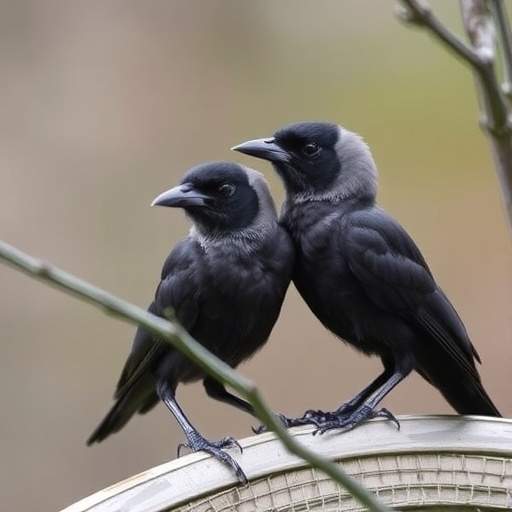
Jackdaw Nestlings Acquire Predator Recognition Through Adult Vocal Social Learning
In a groundbreaking study shedding light on avian cognition, researchers have demonstrated that jackdaw (Corvus monedula) nestlings develop predator awareness by eavesdropping on adult vocal communications. The investigation, conducted by the University of Exeter’s Centre for Ecology and Conservation, underscored the remarkable capacity for social learning in birds even before fledging—a period during which these young birds are physically sheltered but neurologically primed for environmental education.
Utilizing an experimental paradigm involving playback of auditory stimuli, the scientists exposed nestlings to predator-associated calls. The stimuli comprised Eurasian goshawk (Accipiter gentilis) vocalizations, a natural predator of jackdaws, paired alternately with either alarm calls made by adult jackdaws or contact calls, which convey no threat. By monitoring subsequent behavioral vigilance, notably characterized by head-raising beyond the shoulder level, the researchers demonstrated that nestlings exposed to the predator calls in conjunction with alarm signals exhibited significantly elevated vigilance. In contrast, those hearing the same calls combined with innocuous contact calls did not demonstrate increased alertness, highlighting the critical role of adult cues in imparting relevant threat information.
This sophisticated auditory conditioning suggests that jackdaw chicks are not indiscriminately associating any simultaneous sounds; rather, their learning appears selective and biologically calibrated. When the team introduced a non-predatory bird call, specifically from the American golden plover—a species not naturally encountered in the study region—nestlings failed to form any aversive association, even when these calls were paired with alarm signals. This selective learning implies evolved neural mechanisms that prevent energy expenditure on false alarms, which could otherwise compromise survival by diluting responses to genuine threats.
The experimental design took place in Cornwall, UK, a region where native jackdaws have had minimal exposure to goshawks or the American golden plovers, ensuring that any learned predator recognition was recently acquired rather than innate or previously conditioned. This careful environmental context lends weight to the theory that social learning mechanisms operate to expand threat recognition beyond genetically hardwired responses, enabling adaptability in changing ecological landscapes.
Lead researcher Hannah Broad, during her Master’s by Research at Exeter’s Penryn Campus, emphasized the significance of such early-life social learning. Jackdaws nest inside cavities offering relative safety, potentially limiting exposure to environmental dangers during developmental stages. However, direct encounters with predators following fledging expose juveniles to life-threatening risks. The ability to learn about predators acoustically before leaving the nest provides a crucial fitness advantage by reducing the trial-and-error risks otherwise encountered.
Professor Alex Thornton, a senior author on the paper, elaborated on the adaptive nature of this learning process. He cautioned against the dangers of associative over-generalization, where animals might improperly link alarm calls to irrelevant stimuli, leading to maladaptive fear responses. The observed specificity in nestling learning suggests evolutionary pressures have fine-tuned cognitive processes, promoting efficient and accurate social transmission of information concerning genuine threats while filtering out non-threatening environmental noise.
This study bears further significance given current shifts in species ranges prompted by environmental change. The ongoing expansion of goshawk populations within the UK poses new predation threats to local jackdaws in Cornwall. The observed capacity for social learning may afford these corvids a mechanism to adapt dynamically to emerging risks, enhancing survival prospects in novel ecological contexts.
Methodologically, data were collected from 39 individual nests with nestlings aged between 20 and 30 days—an age range considered critical for cognitive development. Sound levels for playback experiments were calibrated to naturalistic volumes of approximately 39 decibels at the nest entrance, ensuring ecological validity. Behavioral recordings analyzed changes in scanning and posture reflective of predator vigilance following exposure to experimental auditory cues.
Funding for this research was provided by the Leverhulme Trust, contributing to the broader Cornish Jackdaw Project that investigates cognitive ecology in wild bird populations. Hannah Broad’s work not only provided the scientific insights but also garnered recognition through the Vic Simpson Award for Student Research on Birds in Cornwall, highlighting the study’s impact both academically and in conservation biology.
The findings were published in the journal Biology Letters under the title “Socially learnt predator recognition in nestling jackdaws” on March 3, 2026. This study paves the way for future research into the neural and evolutionary mechanisms underpinning selective social learning in wild animals, offering new perspectives on how species persist and adapt in rapidly changing environments.
Subject of Research: Social learning and predator recognition in nestling jackdaws
Article Title: Socially learnt predator recognition in nestling jackdaws
News Publication Date: 3-Mar-2026
Web References: https://ecologyconservation.exeter.ac.uk/, https://www.wildcognitionresearch.com/cornish-jackdaw-project
References: DOI 10.1098/rsbl.2025.0770
Image Credits: University of Exeter
Keywords: Birds, Ecology, Ethology, Predator recognition, Social learning, Jackdaws, Corvid cognition, Vocal communication, Behavioral ecology
Tags: animal behavior learning mechanismsavian cognitive developmentavian social learningbird auditory conditioningCorvus monedula behaviorecological conservation studiesEurasian goshawk threatsjackdaw predator recognitionjuvenile bird vigilancenestling vocal communicationpredator alarm callspredator-prey interaction birds