• HOME
  • NEWS
  • EXPLORE
    • CAREER
      • Companies
      • Jobs
    • EVENTS
    • iGEM
      • News
      • Team
    • PHOTOS
    • VIDEO
    • WIKI
  • BLOG
  • COMMUNITY
    • FACEBOOK
    • INSTAGRAM
    • TWITTER
Wednesday, November 11, 2026
BIOENGINEER.ORG
No Result
View All Result
  • Login
  • HOME
  • NEWS
  • EXPLORE
    • CAREER
      • Companies
      • Jobs
        • Lecturer
        • PhD Studentship
        • Postdoc
        • Research Assistant
    • EVENTS
    • iGEM
      • News
      • Team
    • PHOTOS
    • VIDEO
    • WIKI
  • BLOG
  • COMMUNITY
    • FACEBOOK
    • INSTAGRAM
    • TWITTER
No Result
View All Result
Bioengineer.org
No Result
View All Result
Home NEWS Science News Health

It takes a village

Bioengineer by Bioengineer
May 29, 2018
in Health
Reading Time: 2 mins read
0
Share on FacebookShare on TwitterShare on LinkedinShare on RedditShare on Telegram
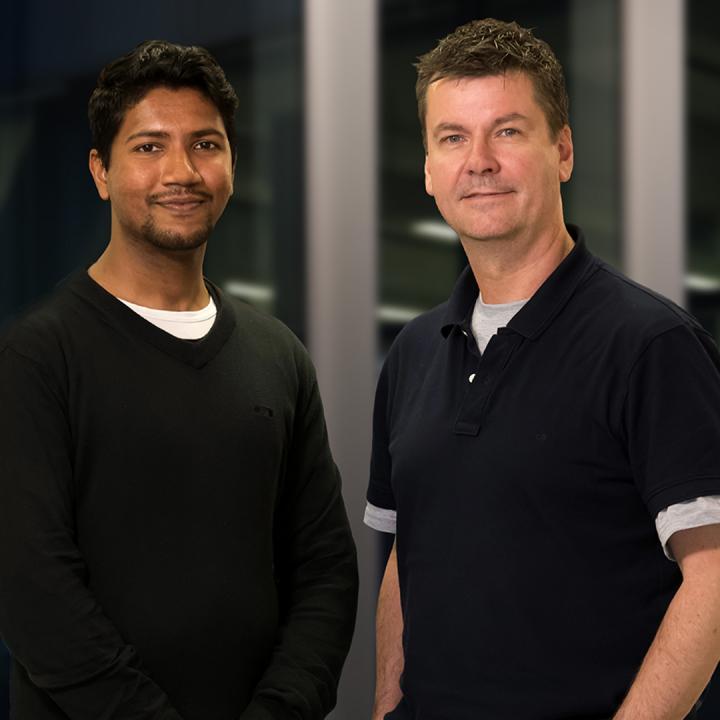
IMAGE

Credit: Steve Morton

A hand-made super-microscope – capable of seeing the actual building blocks of a bacterial cell wall – has helped Monash researchers decipher how bacteria are able to literally build a wall against the immune system, leading to often deadly disease.

One of the keys to understanding antimicrobial-resistant "superbugs" is to see in great detail the outer surface that they present to the human immune system. A team led by Professor Trevor Lithgow, from the Monash Biomedicine Discovery Institute, has accomplished the first nanoscale interrogation of the wall of the bacteria Escherichia coli (E. coli), discovering highly-organised precincts of "beta-barrel assembly machines", that build the bacterial cell surface.

The work, published today in Cell Reports, is, according to Professor Lithgow, "a big step in knowing how these bacteria form a wall against the immune system – and also a big step towards stopping the superbugs in their tracks."

Super-resolution microscopy, which won its developers the Nobel Prize in 2014, is a technique that can "see" beyond the diffraction of light, providing unprecedented views of cells and their interior structures and organelles.

Even the most accurate light microscopes are unable to see the surface features of a live superbug, so when Professor Lithgow heard that Dr Toby Bell, head of the Single Molecule and Super-Resolution Fluorescence Group, had hand-built a super-resolution microscopy in his lab, they hatched a plan to create and optimise a super resolution microscope, called STORM, that could see single molecules in a bacterium.

"Toby and his team were amazing in what they installed at the Monash Micro Imaging facility," Professor Lithgow recalls.

While there are other super resolution microscopes elsewhere, Professor Lithgow believes it is unusual to have one tailor made to look at the landscape of a bacterial cell wall.

Critical to the five-year project was the work of PhD student, and co-first author Dilshan Gunasinghe.

"Dilshan pushed the technology to its limit through the preparation of samples of bacteria, and working with analyst Keith Schulze who rewrote the software so the microscope could drill down to the nano-scale," Professor Lithgow said.

The audacious project brought together biochemists, microscopists, physicists, biologists and computer programmers to visualize what had never been seen before, in what "will provide researchers with key knowledge to disarm superbug resistance to the immune system," Professor Lithgow said.

###

Read the full paper in Cell Reports titled The WD40 protein BamB mediates coupling of BAM complexes into assembly precincts in the bacterial outer membrane.

DOI: 10.1016/j.celrep.2018.04.093

About the Monash Biomedicine Discovery Institute

Committed to making the discoveries that will relieve the future burden of disease, the newly established Monash Biomedicine Discovery Institute at Monash University brings together more than 120 internationally-renowned research teams. Our researchers are supported by world-class technology and infrastructure, and partner with industry, clinicians and researchers internationally to enhance lives through discovery.

Media enquiries:

Tania Ewing
+61 408 378 422
taniaewing@taniaewing.com

Media Contact

Grace Williams
Grace.Williams@monash.edu
61-399-059-597
@MonashUni

http://www.monash.edu.au

Related Journal Article

http://dx.doi.org/10.1016/j.celrep.2018.04.093

Share13Tweet8Share2ShareShareShare2

Related Posts

US Metabolic Health Declined Post-Pandemic as High-Risk Zones Expanded Northward

US Metabolic Health Declined Post-Pandemic as High-Risk Zones Expanded Northward

November 11, 2026
Formal and informal clerkship feedback capture different sides of student experience

Formal and informal clerkship feedback capture different sides of student experience

November 11, 2026

New 25-Item Scale Measures the Operating Room Learning Environment for Anaesthesiology Residents in Türkiye

November 11, 2026

Clear Margins Associated with Improved Survival in Pelvic Bone Tumour Surgery

November 11, 2026
Please login to join discussion

POPULAR NEWS

  • Thicker Fetal Nuchal Translucency Linked to Higher Pregnancy Risks

    Thicker Fetal Nuchal Translucency Linked to Higher Pregnancy Risks

    29 shares
    Share 12 Tweet 7
  • CT Markers Show Most Reproducible Links to Death by Neurologic Criteria

    29 shares
    Share 12 Tweet 7
  • Young Swiss Cancer Survivors Report Growth After Diagnosis, But Resilience Tells a Different Story

    29 shares
    Share 12 Tweet 7
  • Transvalvular Leads Not Associated With Worse Tricuspid Repair Success in Selected Patients

    29 shares
    Share 12 Tweet 7

About

We bring you the latest biotechnology news from best research centers and universities around the world. Check our website.

Follow us

Recent News

US Metabolic Health Declined Post-Pandemic as High-Risk Zones Expanded Northward

Formal and informal clerkship feedback capture different sides of student experience

New 25-Item Scale Measures the Operating Room Learning Environment for Anaesthesiology Residents in Türkiye

Subscribe to Blog via Email

Enter your email address to subscribe to this blog and receive notifications of new posts by email.

Join 87 other subscribers
  • Contact Us

Bioengineer.org © Copyright 2023 All Rights Reserved.

Welcome Back!

Login to your account below

Forgotten Password?

Retrieve your password

Please enter your username or email address to reset your password.

Log In
No Result
View All Result
  • Homepages
    • Home Page 1
    • Home Page 2
  • News
  • National
  • Business
  • Health
  • Lifestyle
  • Science

Bioengineer.org © Copyright 2023 All Rights Reserved.