New detection technique based on quantum technology developed at IST Austria — Study published in Science Advances
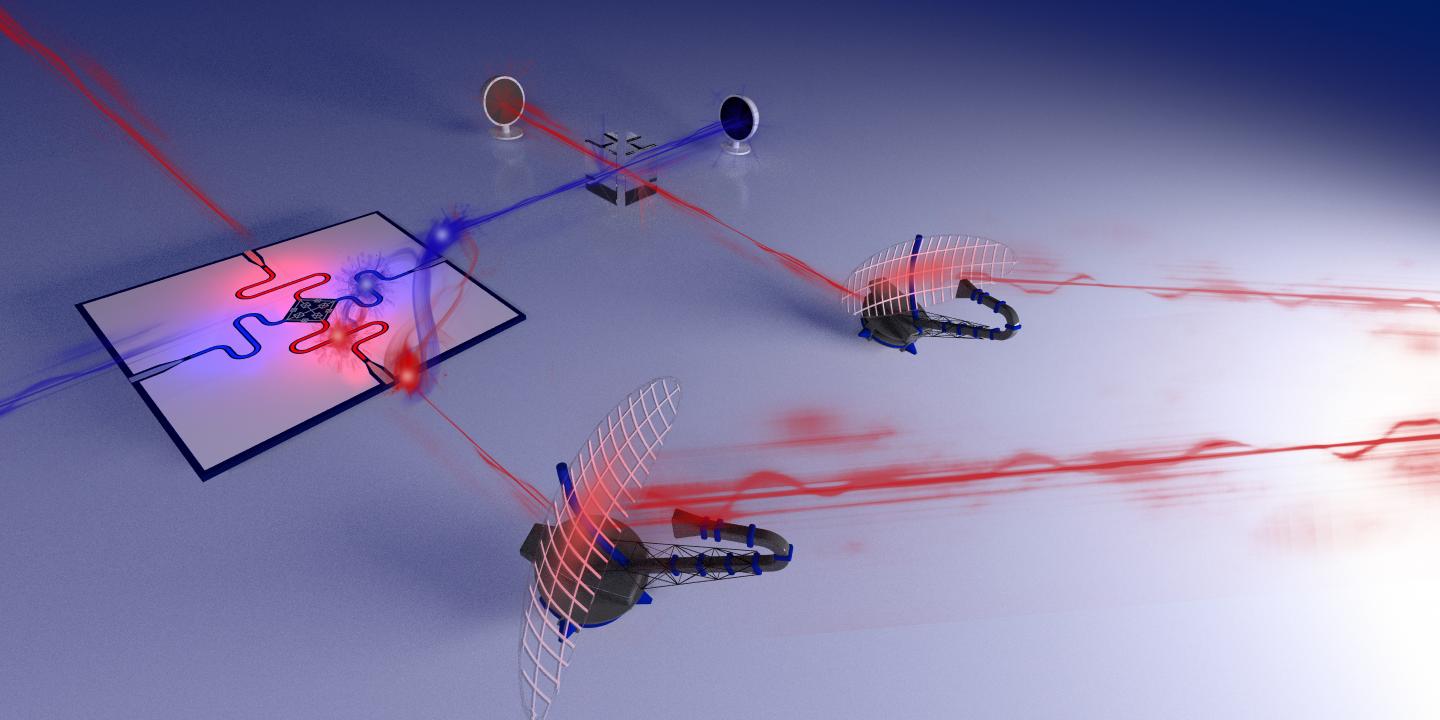
Credit: © IST Austria/Philip Krantz
Quantum entanglement is a physical phenomenon where two particles remain inter-connected, sharing physical traits regardless of how far apart they are from one another. Now, scientists from the research group of Professor Johannes Fink at the Institute of Science and Technology Austria (IST Austria) along with collaborators Stefano Pirandola from the Massachusetts Institute of Technology (MIT) and the University of York, UK, and David Vitali from the University of Camerino, Italy — have demonstrated a new type of detection technology called ‘microwave quantum illumination’ that utilizes entangled microwave photons as a method of detection. The prototype, which is also known as a ‘quantum radar’, is able to detect objects in noisy thermal environments where classical radar systems often fail. The technology has potential applications for ultra-low power biomedical imaging and security scanners.
Using quantum entanglement as a new form of detection
The working principles behind the device are simple: Instead of using conventional microwaves, the researchers entangle two groups of photons, which are called the ‘signal’ and ‘idler’ photons. The ‘signal’ photons are sent out towards the object of interest, whilst the ‘idler’ photons are measured in relative isolation, free from interference and noise. When the signal photons are reflected back, true entanglement between the signal and idler photons is lost, but a small amount of correlation survives, creating a signature or pattern that describes the existence or the absence of the target object–irrespective of the noise within the environment.
“What we have demonstrated is a proof of concept for Microwave Quantum Radar,” says lead author and at the time of the research project postdoc in the Fink group Shabir Barzanjeh, whose previous research helped advance the theoretical notion behind quantum enhanced radar technology. “Using entanglement generated at a few thousandths of a degree above absolute zero (-273.14 °C), we have been able to detect low reflectivity objects at room-temperature.”
Quantum technology can outperform classical low-power radar
While quantum entanglement in itself is fragile in nature, the device has a few advantages over conventional classical radars. For instance, at low power levels, conventional radar systems typically suffer from poor sensitivity as they have trouble distinguishing the radiation reflected by the object from naturally occurring background radiation noise. Quantum illumination offers a solution to this problem as the similarities between the ‘signal’ and ‘idler’ photons — generated by quantum entanglement — makes it more effective to distinguish the signal photons (received from the object of interest) from the noise generated within the environment. Barzanjeh who is now an Assistant Professor at the University of Calgary on the prototype’s performance: “The main message behind our research is that ‘quantum radar’ or ‘quantum microwave illumination’ is not only possible in theory but also in practice. When benchmarked against classical low-power detectors in the same conditions we already see, at very low-signal photon numbers, that quantum-enhanced detection can be superior.”
Prominent milestone towards advancing 80 year-old radar technology
Throughout history, basic science has been one of the key drivers of innovation, paradigm shift and technological breakthrough. Whilst still a proof of concept, the group’s research has effectively demonstrated a new method of detection that, in some cases, may already be superior to classical radar.
“Throughout history, proof of concepts such as the one we have demonstrated here have often served as prominent milestones towards future technological advancements. It will be interesting to see the future implications of this research, particularly for short-range microwave sensors.” says Barzanjeh.
Last author and group leader Professor Johannes Fink adds “This scientific result was only possible by bringing together theoretical and experimental physicists that are driven by the curiosity of how quantum mechanics can help to push the fundamental limits of sensing. But to show an advantage in practical situations we will also need the help of experienced electrical engineers and there still remains a lot of work to be done in order to make our result applicable to real-world detection tasks.”
###
About the Fink Group at IST Austria
Professor Johannes Fink leads a research group at IST Austria which is positioned between quantum optics and mesoscopic condensed matter physics. The group studies quantum physics in electrical, mechanical, and optical chip-based devices with the goal to advance and integrate quantum technology for simulation, communication, metrology, and sensing. More information about the group can be found here.
Media Contact
Patrick Müller
[email protected]
Related Journal Article
http://dx.