A newly synthesized cyanide-bridged molecular coordination compound designated as O-Co-CN activates lattice oxygen to overcome efficiency bottlenecks in the oxygen evolution reaction during water electrolysis. Developed to improve electrocatalytic performance, the catalytic material integrates atomically isolated cobalt centers within an engineered coordination network, enabling an alternative reaction pathway that directly engages structural oxygen atoms to generate oxygen gas.
The synthesis of the molecular coordination structure is carried out under hydrothermal conditions using specific chemical precursors to control atomic architecture. During this hydrothermal process, formamide decomposes in situ to release cyanide and amide ions, while 2-methylimidazole serves as an anchoring ligand. This anchoring ligand immobilizes excess cobalt ions into a bimetallic coordination framework characterized by atomically isolated cobalt active centers.
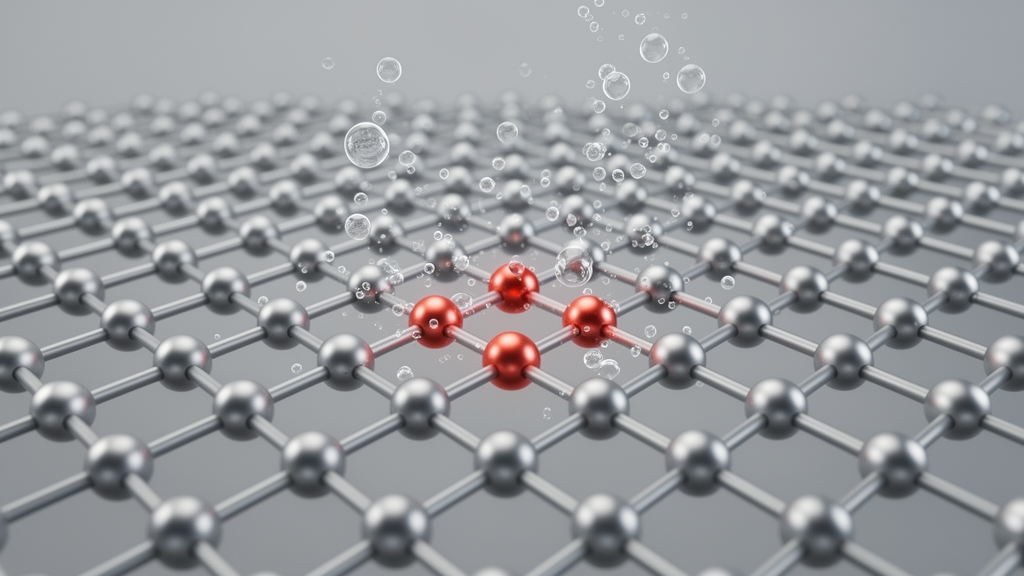
Rather than remaining as temporary surface adsorbates, inserted oxygen atoms migrate directly into the cobalt-carbon-nitrogen framework under the alkaline hydrothermal conditions. These oxygen atoms occupy interstitial lattice positions to establish genuine lattice-oxygen sites. Covalent interactions between the interstitial oxygen atoms and adjacent cobalt centers lower the energetic penalty required for oxygen-oxygen chemical coupling, triggering a lattice-oxygen-participation mechanism cycle.
Within this lattice-oxygen-participation pathway, the structural lattice oxygen is directly evolved into molecular oxygen during catalytic operation. Hydroxide ions supplied from the surrounding electrolyte immediately replenish the resulting lattice vacancies. This rapid replenishment mechanism maintains the structural integrity of the catalyst and prevents structural collapse, ensuring continuous catalytic activity without degrading the coordination framework during the electrochemical oxygen generation process.
To address physical stability and mass transport challenges during high-current operation, the catalytic layer is supported on a three-dimensional printed nickel conical substrate. This specialized conical architecture accelerates the detachment of generated gas bubbles and suppresses localized fluctuations in alkalinity. Consequently, the conical substrate mitigates surface corrosion that would otherwise be induced by transient oxygen-vacancy intermediates formed along the lattice-oxygen reaction route.
Electrochemical testing demonstrates that the resulting freestanding electrode delivers an overpotential of only 210 millivolts at a current density of 10 milliamperes per square centimeter in a 1.0 molar potassium hydroxide electrolyte solution. In durability evaluations, the system maintains stable catalytic operation for 100 hours at a current density of 20 milliamperes per square centimeter without any detectable activity decay.
The study demonstrates a general design strategy for integrating lattice-oxygen-active molecular catalysts with hierarchical electrode architectures. By combining isolated cobalt coordination centers with a bubble-detaching conical support, the freestanding system addresses both electronic reaction barriers and transient intermediate corrosion, establishing a pathway toward large-scale, high-current water electrolysis applications.
Subject of Research: Lattice-oxygen-activated molecular electrocatalysts for water electrolysis
Article Title: Atomically isolated O-Co-CN activate lattice-oxygen for efficient oxygen evolution
Article References: Liu, X., Wang, X., Jia, G., Xie, M., Li, Y., Li, W., Zhu, G., Shuai, Y., & Wang, Z. (2026). Atomically isolated O-Co-CN activate lattice-oxygen for efficient oxygen evolution. Advanced Composites and Hybrid Materials. https://doi.org/10.1007/s42114-026-02154-2
Image Credits: AI Generated
DOI: 10.1007/s42114-026-02154-2
Keywords: oxygen evolution reaction, water electrolysis, electrocatalysis, molecular coordination compound, lattice oxygen mechanism, atomically isolated cobalt, formamide, 2-methylimidazole, interstitial lattice oxygen, oxygen-oxygen coupling, 3D-printed nickel substrate, bubble detachment, alkalinity fluctuations, surface corrosion mitigation, overpotential, potassium hydroxide electrolyte, freestanding electrode
News Source: Denise Maddox. (November 23, 2026). Isolated Cobalt Catalysts Activate Lattice Oxygen for Efficient Water Electrolysis. Scienmag.