Injecting pellets of frozen hydrogen fuel into the plasma of a fusion reactor helps repair tears in the surrounding magnetic field, improving the prospects for efficient energy production
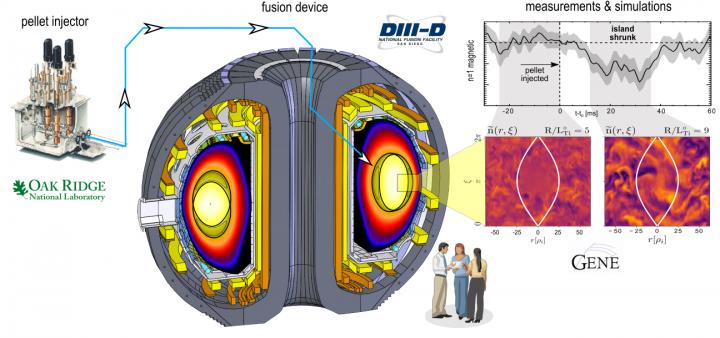
Credit: Composite image by the author; Graphics courtesy General Atomics and Oak Ridge National Laboratory.
Fort Lauderdale, Fla.–Fusion is a non-carbon-based process for energy production, where lighter atoms fuse into heavier ones. Fusion reactors operate by confining a “soup” of charged particles, known as a plasma, within powerful magnetic fields. But these magnetic fields must contain the plasma long enough that it can be heated to extreme temperatures–hotter than the sun–where fusion reactions can occur.
But like a balloon holding air, the magnetic fields can be leaky, allowing the plasma energy to escape. One form of a “leak” is a phenomenon known as a magnetic island. These are unstable structures within the magnetic fields that tear holes in the field and release energy from the plasma, stopping the fusion reaction. For future fusion power plants to produce electricity efficiently, the growth of magnetic islands must be prevented or eliminated. In some cases, the islands can be eliminated by driving a localized current inside them.
Recently, however, researchers at the DIII-D National Fusion Facility in San Diego discovered a new way to eliminate islands. They observed that firing frozen pellets of the hydrogen isotope deuterium deep into the plasma causes the magnetic islands to shrink. Using computer simulations, they determined that the shrinkage was likely caused by increased turbulence in the plasma due to the injected pellets (Figure 1). Theoretical calculations show that the shrunken islands can be completely eliminated with 70 percent less current inside the island than what is normally needed without the help of pellet injection.
“This is an important discovery, as it can extend the magnetic island control solution to operational regimes where other methods are not applicable,” said Dr. Laszlo Bardoczi, the General Atomics scientist who led the effort. “In addition, it can free up heating and current drive resources that would otherwise be needed to maintain magnetic stability. Saving these resources will allow us to improve the net electricity output of a reactor, or they could be used to further manipulate the plasma to achieve better performance. Thus, the approach may offer substantial benefits for future reactors.”
###
This work is supported by the General Atomics Postgraduate Research Participation Program administered by Oak Ridge Associated Universities. This material is based upon work supported by the U.S. Department of Energy, Office of Science, Office of Fusion Energy Sciences, using the DIII-D National Fusion Facility, a DOE Office of Science user facility, under Award DE-FC02-04ER54698.
For additional information see also:
Bardoczi et al., 2019, Nucl. Fusion, Controlled NTM Healing via Fueling Pellets and its Impact on ECCD Requirements for Complete NTM Stabilization, https:/
Contact: Laszlo Bardoczi, General Atomics, [email protected]
Abstract:
Controlled Healing of NTMs by Fueling Pellets in DIII-D and KSTAR and Impact on ECCD Requirements for Complete NTM Stabilization
9:30 AM – 12:30 PM, Wednesday, October 23, 2019
Room: Floridian Ballroom AB
http://meetings.
About APS/DPP:
The 61st Annual Meeting of the American Physical Society’s Division of Plasma Physics will take place from October 21-25, 2019 in Fort Lauderdale, Florida. All technical sessions will be located at the Fort Lauderdale/Broward County Convention Center, where over 1,900 papers will be presented by scientists from over 20 countries around the world.
The American Physical Society (APS) is a nonprofit membership organization working to advance and diffuse the knowledge of physics through its outstanding research journals, scientific meetings, and education, outreach, advocacy, and international activities. APS represents over 55,000 members, including physicists in academia, national laboratories, and industry in the United States and throughout the world.
Media Contact
Saralyn Stewart
[email protected]
512-694-2320