• HOME
  • NEWS
  • EXPLORE
    • CAREER
      • Companies
      • Jobs
    • EVENTS
    • iGEM
      • News
      • Team
    • PHOTOS
    • VIDEO
    • WIKI
  • BLOG
  • COMMUNITY
    • FACEBOOK
    • INSTAGRAM
    • TWITTER
Saturday, February 7, 2026
BIOENGINEER.ORG
No Result
View All Result
  • Login
  • HOME
  • NEWS
  • EXPLORE
    • CAREER
      • Companies
      • Jobs
        • Lecturer
        • PhD Studentship
        • Postdoc
        • Research Assistant
    • EVENTS
    • iGEM
      • News
      • Team
    • PHOTOS
    • VIDEO
    • WIKI
  • BLOG
  • COMMUNITY
    • FACEBOOK
    • INSTAGRAM
    • TWITTER
  • HOME
  • NEWS
  • EXPLORE
    • CAREER
      • Companies
      • Jobs
        • Lecturer
        • PhD Studentship
        • Postdoc
        • Research Assistant
    • EVENTS
    • iGEM
      • News
      • Team
    • PHOTOS
    • VIDEO
    • WIKI
  • BLOG
  • COMMUNITY
    • FACEBOOK
    • INSTAGRAM
    • TWITTER
No Result
View All Result
Bioengineer.org
No Result
View All Result
Home NEWS Science News Biology

Is the sky the limit?

Bioengineer by Bioengineer
June 19, 2018
in Biology
Reading Time: 2 mins read
0
Share on FacebookShare on TwitterShare on LinkedinShare on RedditShare on Telegram
IMAGE

Credit: Polechová

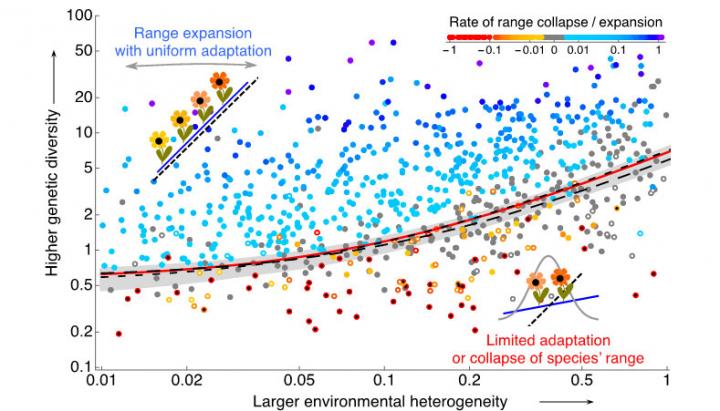
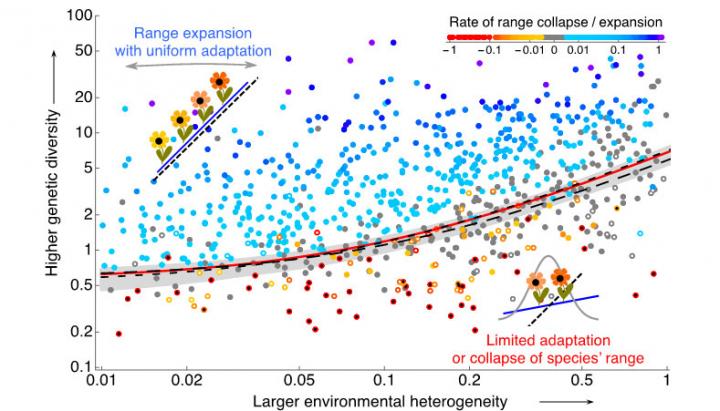
All species have restricted distributions. Yet a joint coherent theory explaining the span and borders of species' ranges has been missing both due to the complexity of the problem and the disparate traditions in ecology and evolution. Jitka Polechová provides a general, testable prediction for formation of species' range margins. The theory includes both population and evolutionary dynamics, and elucidates the role of dispersal for adaptation across a species' range. Dispersal has conflicting effects: on the beneficial side, it increases the genetic variation that is necessary for adaptation and counters the loss of genetic diversity due to genetic drift. However, dispersal also carries a cost: it may swamp adaptation to local conditions. This interplay is crucial for the evolution of a species' range.

The novel theory demonstrates that adaptation across a species' range depends on two dimensionless parameters: i) the fitness cost of dispersal – a measure of environmental heterogeneity, and ii) the strength of genetic drift – a measure of the reduction of genetic diversity. The more heterogeneous is an environment, the more challenging it is to expand into, and the lower the genetic diversity, the more limited is the scope for potential adaptation. Together, these two parameters define an expansion threshold: adaptation fails when the number of individuals accessible by dispersal within one generation is so small that genetic drift reduces genetic diversity below that required for adaptation to a heterogeneous environment. This threshold provides a testable prediction for the formation of a range margin and for the collapse of a species' range.

Interestingly, the parameters are independent of the genetic architecture, offering a wide scope for empirical tests of the theory across many species. Furthermore, the theory explains that the benefits of dispersal into marginal populations are likely to outweigh the costs, offering a theoretical base for management strategies of threatened populations.

###

Publication in "PLoS Biology"

Polechová J. (2018) Is the sky the limit? On the expansion threshold of a species' range. PLoS Biology.
doi: https://doi.org/10.1371/journal.pbio.2005372

Scientific contact

Jitka Polechová, PhD.
Faculty of Mathematics
University of Vienna
Oskar-Morgenstern-Platz 1
1090 Vienna, Austria
M +43-664-374-1607
[email protected]

Press contact

Mag. Alexandra Frey
Press office of the University of Vienna
Research and Teaching
1010 Vienna, Universitätsring 1
T +43-1-4277-175 33
M +43-664-602 77-175 33
[email protected]

Media Contact

Jitka Polechová, PhD
[email protected]
43-664-374-1607
@univienna

http://www.univie.ac.at/en/

Related Journal Article

http://dx.doi.org/10.1371/journal.pbio.2005372

Share12Tweet8Share2ShareShareShare2

Related Posts

Florida Cane Toad: Complex Spread and Selective Evolution

Florida Cane Toad: Complex Spread and Selective Evolution

February 7, 2026
New Study Uncovers Mechanism Behind Burn Pit Particulate Matter–Induced Lung Inflammation

New Study Uncovers Mechanism Behind Burn Pit Particulate Matter–Induced Lung Inflammation

February 6, 2026

DeepBlastoid: Advancing Automated and Efficient Evaluation of Human Blastoids with Deep Learning

February 6, 2026

Navigating the Gut: The Role of Formic Acid in the Microbiome

February 6, 2026
Please login to join discussion

POPULAR NEWS

  • Robotic Ureteral Reconstruction: A Novel Approach

    Robotic Ureteral Reconstruction: A Novel Approach

    82 shares
    Share 33 Tweet 21
  • Digital Privacy: Health Data Control in Incarceration

    63 shares
    Share 25 Tweet 16
  • Study Reveals Lipid Accumulation in ME/CFS Cells

    57 shares
    Share 23 Tweet 14
  • Breakthrough in RNA Research Accelerates Medical Innovations Timeline

    53 shares
    Share 21 Tweet 13

About

We bring you the latest biotechnology news from best research centers and universities around the world. Check our website.

Follow us

Recent News

Personalized Guide to Understanding and Reducing Chemicals

Inflammasome Protein ASC Drives Pancreatic Cancer Metabolism

Phage-Antibiotic Combo Beats Resistant Peritoneal Infection

Subscribe to Blog via Email

Enter your email address to subscribe to this blog and receive notifications of new posts by email.

Join 73 other subscribers
  • Contact Us

Bioengineer.org © Copyright 2023 All Rights Reserved.

Welcome Back!

Login to your account below

Forgotten Password?

Retrieve your password

Please enter your username or email address to reset your password.

Log In
No Result
View All Result
  • Homepages
    • Home Page 1
    • Home Page 2
  • News
  • National
  • Business
  • Health
  • Lifestyle
  • Science

Bioengineer.org © Copyright 2023 All Rights Reserved.