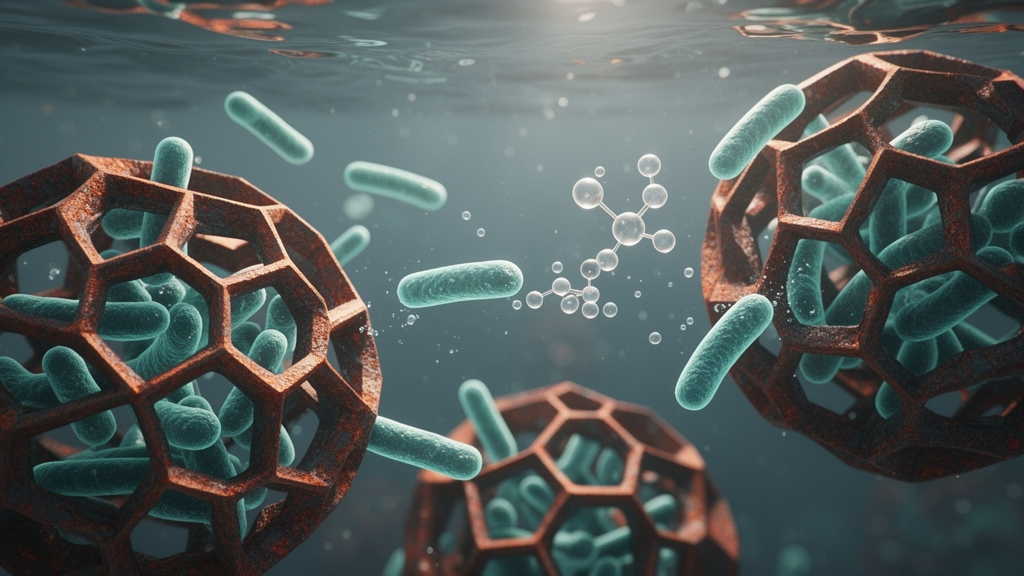
Scientists have shown that Fe/Mn-MOFs accelerate electron transfer to promote bisphenol A biodegradation by Proteus mirabilis. In laboratory experiments described in BMC Microbiology, the bimetallic material, known as Fe/Mn-MOFs, promoted the breakdown of 10 milligrams per liter of BPA by a strain called SQ-2 under both oxygen-rich and oxygen-free conditions, with promotion rates of 98 percent and 75 percent respectively. The work, led by Zhaoqiong Chen, Guotao Liu, Hongmei Yang and Siyu Hou, was published on 31 October 2026 as an open access research article.
The central question was why an exogenous nanomaterial helps bacteria degrade a pollutant. The researchers approached this from the perspective of electron transfer. Electron transfer efficiency is closely related to how efficiently bacteria degrade BPA, yet few studies had revealed the mechanisms by which added nanomaterials promote this ability. The team used Fe/Mn bimetallic metal-organic frameworks prepared in their previous work together with the BPA-degrading strain SQ-2 as their research materials.
Under aerobic conditions, the investigation revealed that inhibited ubiquinone activity was the limiting factor in the electron transfer chain of SQ-2. Fe/Mn-MOFs significantly alleviated this inhibition, achieving a relief rate of 148.94 percent.
Integrated morphological, electrochemical and proteomic analyses indicated that, regardless of whether ubiquinone was inhibited, Fe/Mn-MOFs could enhance electron generation and also act as electron shuttles to enhance bacterial electron transfer activity.
When ubiquinone was working normally, the frameworks strengthened electron transfer efficiency by upregulating NADH dehydrogenase, cytochrome c oxidase and riboflavin production, thus accelerating degradation.
The researchers also examined the strain when ubiquinone was inhibited. Under those conditions, Fe/Mn-MOFs stimulated upregulation of NADH dehydrogenase and replenished quinone species to alleviate the inhibition of the electron transfer chain. Beyond that, the material constructed an alternative electron transfer pathway independent of ubiquinone to restore electron flow.
Concurrently, the frameworks enhanced stress resistance abilities, ultimately restoring the degradation performance of the strain.
The authors conclude that Fe/Mn-MOFs function not only as electron transfer enhancers under normal conditions but may also act as bypass reconstructors capable of sustaining BPA degradation when ubiquinone function is impaired. They note that the results provide a new research reference for using exogenous materials to enhance the bacterial degradation of BPA.
Subject of Research: How iron-manganese metal-organic frameworks accelerate bacterial bisphenol A degradation through electron transfer enhancement and bypass reconstruction
Article Title: Mechanism of Fe/Mn-MOFs accelerating electron transfer to promote bisphenol A biodegradation by Proteus mirabilis
Article References: Chen, Z., Liu, G., Yang, H., & Hou, S. (2026). Mechanism of Fe/Mn-MOFs accelerating electron transfer to promote bisphenol A biodegradation by Proteus mirabilis. BMC Microbiology. https://doi.org/10.1186/s12866-026-05872-1
Image Credits: AI Generated
DOI: 10.1186/s12866-026-05872-1
Keywords: bisphenol A, Fe/Mn-MOFs, electron transfer, Proteus mirabilis, biodegradation, ubiquinone, NADH dehydrogenase, riboflavin, metal-organic frameworks, environmental biotechnology, Mechanism, Mn-MOFs
News Source: Drew Townsend. (November 10, 2026). Iron-Manganese Frameworks Boost Bacteria That Break Down Bisphenol A. Scienmag.