Credit: ©Science China Press
The rapid development of electronic devices and power equipment, such as new-energy vehicles and robots, has sparked extensive demand for portable power sources. Electrochemical energy storage, mainly based on ionic intercalation/motion or adsorption/diffusion in electrodes, has been utilized in last two centuries. Ionic transport is slower yet complicated in electrodes when compared to electronic transport. Indeed, charging/discharging processes in batteries typically take several hours for the efficient use of internal space or pores; supercapacitors can be fully charged/discharged within few seconds if the ionic transport is fast enough. Obviously, high ionic conductivity and optimized ion kinetics in electrodes are desirable for the better electrochemical energy storage.
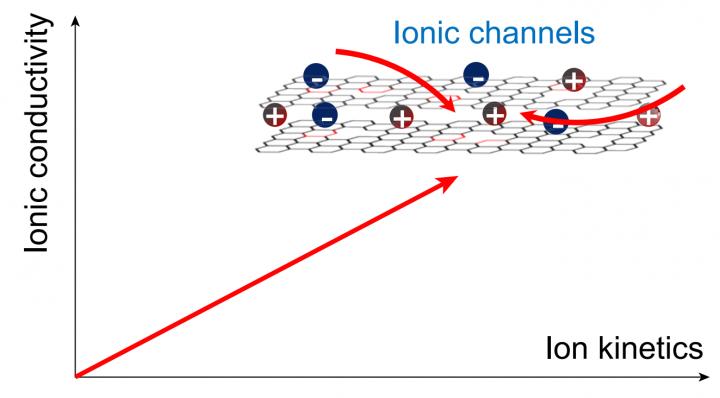
Carbon materials, including traditional graphite and activated carbons (ACs), novel carbons such as nanotubes (CNTs), graphene (G), and their derivatives have been demonstrated to be promising candidates for improved energy storage performance, due to their regulable structural features and diverse properties, including-but not limited to-excellent electric conductivity, high intrinsic capacity and chemical stability. Although big progresses have been achieved based on novel carbons for electrochemical energy storage, the eventual performance is limited by the ion-configuration and ion-kinetics (e.g., LiC6 for graphite in Li-ions battery). Ideally, efficient ionic channels in carbon electrodes shall generate fast electrolyte transport by migration/diffusion, excellent accessibility of electrolyte in the inner pores, possible new types of ions manner, as well as fast cathodic/anodic reactions. The ionic behavior has been one of the old yet emerging object for researchers aiming to produce advanced artificial ionic channels.
In a recent overview published in the National Science Review, scientists at the University of Science and Technology of China (USTC) in Hefei, China and at the Université Paul Sabatier (UPS) in Toulouse, France, present the latest advances in designing ionic channels in novel carbons for efficient energy storage. The authors have traced the typical microfabrication strategies for ionic channels in carbons and the state-of-the-art of studies on energy storage applications; they also reviewed the special ionic responses and kinetic processes among ionic channels, including the constitutive size effects and carbon surface; finally, they proposed that graphene stacking is an ideal model of 2D ionic channels, for the fundamental understanding of ion-configuration/transport in confined space.
“Just like the blood vessel in organisms, a fast ion diffusion towards active sites in ionic channels ensures sufficient energy storage and power delivery of portable devices.” Prof. Yanwu Zhu said, “In a broader perspective, with the improvement in both engineering production of atomically tailored channels and full understanding of ion responses, these carbon electrodes can be embedded into clean energy storage devices, for multi-functional alternative under various working conditions.”
###
This research has been supported by the funding from Natural Science Foundation of China.
See the article:
Jianglin Ye, Patrice Simon and Yanwu Zhu
Designing ionic channels in novel carbons for electrochemical energy storage
Natl Sci Rev (September 2019) doi: 10.1093/nsr/nwz140
https:/
The National Science Review is the first comprehensive scholarly journal released in English in China that is aimed at linking the country’s rapidly advancing community of scientists with the global frontiers of science and technology. The journal also aims to shine a worldwide spotlight on scientific research advances across China.
Media Contact
Yanwu Zhu
[email protected]
Related Journal Article
http://dx.