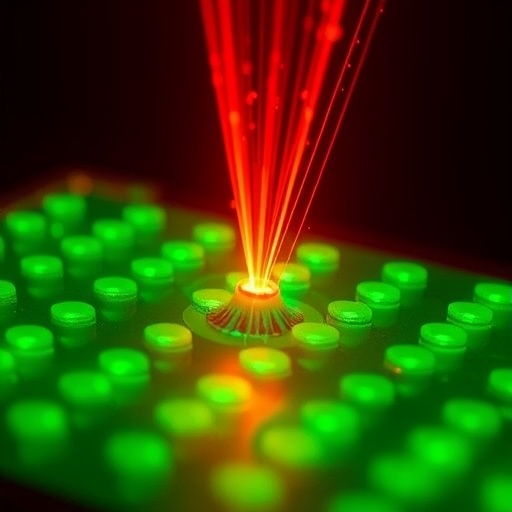
In a groundbreaking development poised to redefine the landscape of quantum optics and information processing, researchers have unveiled a novel approach to fluorescent light collection from ions by leveraging trap-integrated photonics. This technology represents a significant leap forward, promising enhanced efficiency in capturing ion-emitted photons critical for quantum computing and precision measurement applications. The innovative fusion of ion traps with photonic waveguides integrates the light collection mechanism tightly with the ion confinement environment, thereby maximizing the fluorescence signal and overcoming long-standing challenges in photon capture and routing.
Traditional methods of collecting fluorescence from trapped ions have relied on bulky, external optical components such as lenses and mirrors, which often suffer from limited numerical apertures and alignment complexity. By embedding photonic structures within the ion trap itself, the researchers have demonstrated a compact and highly efficient solution that minimizes photon loss. This intrinsic integration circumvents the inefficiencies caused by free-space optics, delivering a structurally streamlined platform that is both scalable and robust against environmental perturbations.
The key to this technological breakthrough lies in the fabrication of photonic waveguides directly onto the trap substrate, allowing emitted photons from a single ion to be guided with unprecedented precision. These waveguides channel the fluorescence into photodetectors or further quantum optical circuitry with minimal scattering or absorption losses. This approach not only enhances the photon collection efficiency but also ensures that the spatial mode quality of the collected light is preserved, which is vital for subsequent quantum information processing tasks such as entanglement distribution and state readout.
Moreover, the trap-integrated photonics platform exhibits an exceptional improvement in signal-to-noise ratio. By confining the light collection path within the trap environment, stray background light and ambient noise are significantly reduced. This environmental shielding inherently improves the fidelity of quantum measurements, enabling more accurate qubit state discrimination and extending practical coherence times. Such improvements are crucial in advancing the reliability and scalability of ion-trap quantum computers and sensors.
Another remarkable aspect of this research is the customization potential of integrated photonic circuits tailored to specific ion species and operational wavelengths. The team engineered waveguides optimized for the particular fluorescence spectrum of commonly used ions in quantum computing, such as ytterbium and calcium. This spectral matching maximizes photon throughput and reduces modal dispersion, which can otherwise degrade system performance. The flexible fabrication techniques employed also suggest future adaptability to incorporate multi-ion arrays and integrate complex photonic networks, opening new avenues for scalable quantum hardware.
In addition to the photonic waveguides, the researchers incorporated on-chip modulators and resonators that actively manipulate the captured photons. These components enhance the interaction between the ion’s emission and the photonic modes, providing dynamic control over photon routing and timing essential for synchronized quantum operations. Such active control elements embedded within the trap environment are a paradigm shift, enabling holistic integration that merges ion-trapping and photonic manipulation in a single microfabricated device.
The implications of this technology extend well beyond quantum computation. Precision metrology, including optical clocks and high-sensitivity magnetometers, can benefit from heightened fluorescence collection efficiencies that improve signal quality and stability. Enhanced light-matter interaction facilitated by integrated photonics could also enable new protocols in quantum communication networks, where single-photon sources serve as fundamental building blocks. The robustness and miniaturization afforded by this platform make it highly suitable for deployment in field applications, including space-based quantum sensing missions or portable quantum devices.
Critically, the researchers validated their integrated system through experimental trials that demonstrated a remarkable increase in photon collection efficiency compared to conventional free-space optics setups. They reported fluorescence enhancement factors that translate directly into improved qubit readout contrast and reduced measurement times. By significantly lowering the photon detection threshold, the work paves the way for new experimental regimes where single-ion fluorescence can be monitored with near real-time precision, enabling faster feedback and error correction cycles in quantum algorithms.
Furthermore, the integration approach also addresses thermal and electrical noise management issues prevalent in ion traps. By situating photonic elements on the trap chip, the design minimizes extraneous heat sources and electrical interference, which have historically contributed to decoherence. The microfabrication strategies implemented ensure high-quality material interfaces and surface smoothness, critical factors that reduce scattering losses and maintain optical coherence within the waveguides. The resultant device architecture represents a holistic design philosophy aimed at harmonizing optical, electronic, and quantum mechanical considerations.
Importantly, this work signifies a confluence of advanced microfabrication, materials science, and quantum optics engineering. The team navigated formidable challenges in integrating photonic materials with ion-trapping substrates, which demand complementary physical and chemical properties. Utilizing state-of-the-art deposition techniques and lithographic patterning, they achieved precise alignment and robust bonding between the photonic circuits and trapping electrodes. Such interdisciplinary mastery demonstrates the maturity of integrated quantum photonics platforms and charts a pragmatic course toward mass-producible quantum hardware.
Beyond the immediate experimental successes, the research suggests exciting prospects for expanding to multi-modal quantum processors, where multiple ion species and photonic pathways coexist and interact. The modularity of integrated photonic designs allows for intricate architectures that could perform complex quantum logic operations in parallel, dramatically increasing the computational throughput. Additionally, the incorporation of nonlinear optical materials on-chip might facilitate quantum frequency conversion, further enhancing connectivity between disparate quantum systems.
While challenges remain in optimizing fabrication yield and ensuring long-term device stability, the foundational results set a compelling precedent. The synergy of ion traps with integrated photonics heralds a new era in quantum technology where miniaturization, precision, and scalability are simultaneously achievable. As global efforts intensify to realize practical quantum computers and sensors, innovations like trap-integrated fluorescence collection stand as critical milestones that accelerate this transformative journey.
In summary, this pioneering research embodies a paradigm shift in how light emitted by trapped ions is harnessed and utilized. By embedding photonic waveguides and active optical components within the ion trap itself, the study presents a transformative path toward compact, efficient, and scalable quantum devices. This integration not only streamlines device architecture but also unlocks new levels of measurement sensitivity and operational fidelity. As the quantum frontier advances, such technologies will undoubtedly play a vital role in shaping the next generation of quantum information science and technology.
Subject of Research: Collection of fluorescence from trapped ions using integrated photonic structures.
Article Title: Collection of fluorescence from an ion using trap-integrated photonics.
Article References:
Knollmann, F.W., Corsetti, S.M., Clements, E.R. et al. Collection of fluorescence from an ion using trap-integrated photonics. Light Sci Appl 15, 95 (2026). https://doi.org/10.1038/s41377-025-02138-9
Image Credits: AI Generated
DOI: 29 January 2026
Tags: compact optical systemsenvironmental robustness in opticsfluorescence signal maximizationion fluorescence collectionion traps technologyphoton capture efficiencyphotonic waveguides integrationprecision measurement techniquesQuantum Computing Applicationsquantum optics advancementsscalable photonic structurestrap-integrated photonics