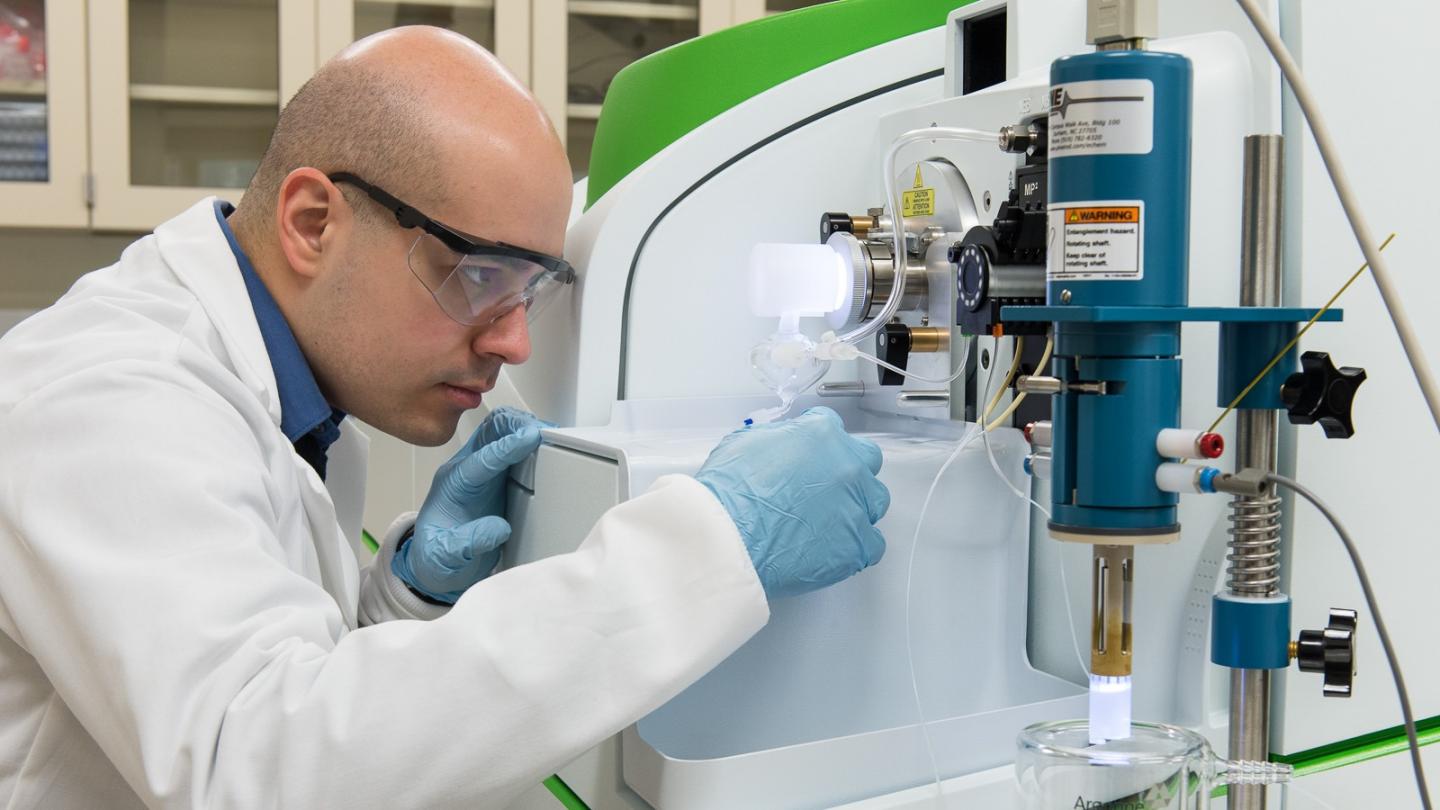
Credit: Image by Mark Lopez, Argonne National Laboratory.
Scientists discover dynamics of electrochemical interfaces at the atomic scale.
The quest to find viable alternatives to fossil fuel in energy production has experienced a recent revolution as scientists search for materials that do not require precious metals to produce active and stable reactions.
Central to many of these reactions is the oxygen evolution reaction (OER), an important electrochemical part of water-splitting in electrolyzers to produce hydrogen that can power fuel cells.
“The profound implications of the decoupling of virtual stability and true stability will extend the design rules for producing active and stable interfaces.” — Vojislav Stamenkovic, Energy Conversion and Storage group leader in Argonne’s Materials Science division
Scientists at the U.S. Department of Energy’s (DOE) Argonne National Laboratory used a combination of high-precision materials science and electrochemistry to provide important insight into the mechanisms that drive stability and activity of materials during the OER. This insight will guide the practical design of materials for electrochemical fuel production.
“Our explanation removes some of the fog surrounding the effects of impurities on stability of a material at both an atomic scale and a macro scale,” said Argonne Distinguished Fellow Nenad Markovic, a chemist in the lab’s Materials Science division.
The scientists studied an electrolyzer material, called a hydr(oxy)oxide, to discover that, although electrolyzerscan behave as if they are wholly stable, on an atomic scale the systems are extremely dynamic. Iron atoms present in the electrode repeatedly fall away and reattach to the interface, or the surface on which the important, oxygen-producing reactions take place. This careful balance between dissolution and redeposition allows for the overall stability of the material.
“Traditionally, scientists measure how long an electrolyzer can produce oxygen, and they use that to determine stability,” said Argonne postdoctoral scientist Dongyoung Jung, first author on the study. “We decoupled the overall stability of the material on a macro scale from the stability of the material on the atomic scale, which will help us to understand and develop new materials.”
The scientists developed ultrasensitive electrochemical measurement tools to monitor the iron activity in situ during the OER and to test the system with various levels of impurities to see what variables affect the overall stability of the material. The behavior of the iron at the interface is responsible for how well the material can produce oxygen in the OER process.
“By measuring the iron content in the electrode and the electrolyte with ultrahigh sensitivity, we found unexpected discrepancies that point to a dynamic stability of the iron in the system,” said Pietro Lopes, an Argonne assistant scientist on the study.
The dynamic stability in the material — characterized by stable behavior at the macroscopic level despite high activity at the atomic level — is not necessarily a bad thing for electrolyzers. The scientists hope to take advantage of their new understanding of this phenomenon to create materials with better performance.
“Once we identify the role of iron and how its movement affects the oxygen evolution process, we can modify materials to take advantage of dynamic stability, ensuring that iron is always present at the interface, boosting oxygen production,” said Lopes.
“We are addressing a major misconception in the field,” said Vojislav Stamenkovic, Energy Conversion and Storage group leader in Argonne’s Materials Science division. “The profound implications of the decoupling of virtual stability and true stability will extend the design rules for producing active and stable interfaces.”
The study’s corresponding paper, published in Nature Energy on March 16, is titled “Dynamic stability of active sites in hydr(oxy)oxides for the oxygen evolution reaction.”
This research was funded by the DOE‘s Office of Basic Energy Sciences. In situ X-ray analysis for the study was conducted at Argonne’s Advanced Photon Source (APS), and density functional theory (DFT) calculations were performed using computational facilities at Argonne’s Center for Nanoscale Materials (CNM). Both APS and CNM are DOE Office of Science User Facilities.
About Argonne’s Center for Nanoscale Materials
The Center for Nanoscale Materials is one of the five DOE Nanoscale Science Research Centers, premier national user facilities for interdisciplinary research at the nanoscale supported by the DOE Office of Science. Together the NSRCs comprise a suite of complementary facilities that provide researchers with state-of-the-art capabilities to fabricate, process, characterize and model nanoscale materials, and constitute the largest infrastructure investment of the National Nanotechnology Initiative. The NSRCs are located at DOE‘s Argonne, Brookhaven, Lawrence Berkeley, Oak Ridge, Sandia and Los Alamos National Laboratories. For more information about the DOE NSRCs, please visit https:/
About the Advanced Photon Source
The U. S. Department of Energy Office of Science’s Advanced Photon Source (APS) at Argonne National Laboratory is one of the world’s most productive X-ray light source facilities. The APS provides high-brightness X-ray beams to a diverse community of researchers in materials science, chemistry, condensed matter physics, the life and environmental sciences, and applied research. These X-rays are ideally suited for explorations of materials and biological structures; elemental distribution; chemical, magnetic, electronic states; and a wide range of technologically important engineering systems from batteries to fuel injector sprays, all of which are the foundations of our nation’s economic, technological, and physical well-being. Each year, more than 5,000 researchers use the APS to produce over 2,000 publications detailing impactful discoveries, and solve more vital biological protein structures than users of any other X-ray light source research facility. APS scientists and engineers innovate technology that is at the heart of advancing accelerator and light-source operations. This includes the insertion devices that produce extreme-brightness X-rays prized by researchers, lenses that focus the X-rays down to a few nanometers, instrumentation that maximizes the way the X-rays interact with samples being studied, and software that gathers and manages the massive quantity of data resulting from discovery research at the APS.
###
This research used resources of the Advanced Photon Source, a U.S. DOE Office of Science User Facility operated for the DOE Office of Science by Argonne National Laboratory under Contract No. DE-AC02–06CH11357.
Argonne National Laboratory seeks solutions to pressing national problems in science and technology. The nation’s first national laboratory, Argonne conducts leading-edge basic and applied scientific research in virtually every scientific discipline. Argonne researchers work closely with researchers from hundreds of companies, universities, and federal, state and municipal agencies to help them solve their specific problems, advance America’s scientific leadership and prepare the nation for a better future. With employees from more than 60 nations, Argonne is managed by UChicago Argonne, LLC for the U.S. Department of Energy’s Office of Science.
The U.S. Department of Energy’s Office of Science is the single largest supporter of basic research in the physical sciences in the United States and is working to address some of the most pressing challenges of our time. For more information, visit https:/
Media Contact
Diana Anderson
[email protected]
Original Source
https:/
Related Journal Article
http://dx.