New research in Nature Communications examines thermal transport in metal organic frameworks
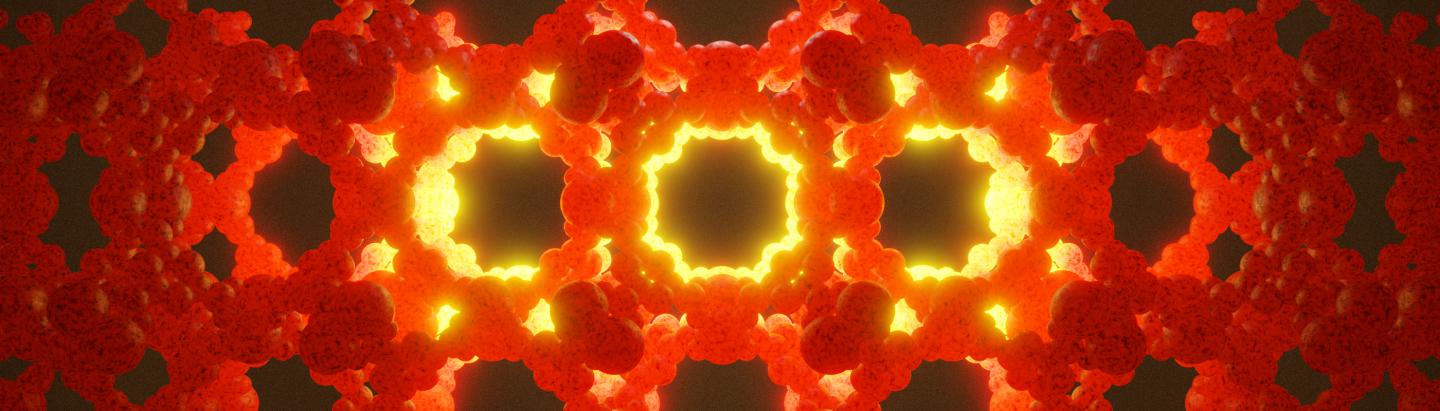
Credit: Christopher E. Wilmer / University of Pittsburgh
To the naked eye, metal organic frameworks (MOFs) look a little like sand. But if you zoom in, you will see that each grain looks and acts more like a sponge–and serves a similar purpose. MOFs are used to absorb and hold gases, which is useful when trying to filter toxic gases out of the air or as a way to store fuel for natural gas- or hydrogen gas-powered engines.
New research led by an interdisciplinary team across six universities examines heat transfer in MOFs and the role it plays when MOFs are used for storing fuel. Corresponding author Christopher Wilmer, William Kepler Whiteford Faculty Fellow and assistant professor of chemical and petroleum engineering at the University of Pittsburgh’s Swanson School of Engineering, coauthored the work with researchers at Carnegie Mellon University, the University of Virginia, Old Dominion University, Northwestern University, and the Karlsruhe Institute of Technology in Karlsruhe, Germany. The findings were recently published in Nature Communications.
“One of the challenges with using MOFs for fuel tanks in cars is that you have to be able to fill up in a few minutes or less,” explains Wilmer. “Unfortunately, when you quickly fill these MOF-based tanks with hydrogen or natural gas they get very hot. It’s not so much a risk of explosion–though there is one–but the fact that they can’t store much gas when they’re hot. The whole premise of using them to store a lot of gaseous fuel only works at room temperature. For other industrial applications you face a similar problem – whenever gases are loaded quickly the MOFs become hot and no longer work effectively.”
In other words, for MOFs to be useful for these applications, they would need to be kept cool. This research looked at thermal transport in MOFs, to explore how quickly they can shed excess heat, and the group found some surprising results.
“When you take these porous materials, which to begin with are thermally insulating, and you fill them with gas, it appears that they become even more insulating. This is surprising because usually, empty pockets like those in insulation or double-paned windows provide good thermal insulation,” explains Wilmer. “By taking porous materials and filling them, thereby removing those gaps, you would expect the thermal transport to improve, making it more thermally conductive. The opposite happens; they become more insulating.”
To reach their conclusion, researchers conducted two simultaneous experiments using two different methods and MOFs synthesized in two different labs. Both groups observed the same trend: that the MOFs become more insulated when filled with adsorbates. Their experimental findings were also validated by atomistic simulations at Pitt in collaboration with Carnegie Mellon University.
“Our work indicates potential challenges ahead for the use of MOFs outside of research labs, but that is a necessary step in the process,” says Alan McGaughey, professor of mechanical engineering at Carnegie Mellon. “As these materials advance toward broad, real-world usage, researchers will need to continue investigating once-overlooked properties of these materials, like thermal transport, and find the best way to use them to fit our needs.”
###
The paper, “Observation of Reduced Thermal Conductivity in a Metal-Organic Framework,” (DOI: 10.1038/s41467-020-17822-0) was published in Nature Communications. Coauthors include Hasan Babaei (Pitt), Mallory E. DeCoster (UVA), Minyoung Jeong (CMU), Zeinab M. Hassan (KIT), Timur Islamoglu (Northwestern), Helmut Baumgart (Old Dominion), Alan J. H. McGaughey (CMU), Redel Engelbert (KIT), Omar K. Farha (Northwestern), Patrick E. Hopkins (UVA), Jonathan A. Malen (CMU), and Christopher E. Wilmer.
Acknowledgements
H.B. and C.E.W. gratefully acknowledge support from the National Science Foundation (NSF), awards CBET-1804011 and OAC-1931436, and also thank the Center for Research Computing (CRC) at the University of Pittsburgh for providing computational resources. J.A.M. gratefully acknowledges support from the Army Research Office, grant W911NF-17-1-0397. A.J.H.M. gratefully acknowledges support from the NSF, award DMR-1507325. O.K.F. gratefully acknowledges support from the Defense Threat Reduction Agency, HDTRA1?18?1?0003. P.E.H. appreciates support from the Army Research Office, Grant. No. W911NF-16-1-0320. Financial support by Deutsche Forschungsgemeinschaft (DFG) within the COORNET Priority Program (SPP 1928) is gratefully acknowledged by E.R. and He.B. (Helmut Baumgart). Z.M.H. acknowledges financial support from the Egyptian Mission Foundation. We would also like to thank Ran Cao for collecting additional PXRD data for this study.
Media Contact
Maggie Pavlick
[email protected]
Related Journal Article
http://dx.