• HOME
  • NEWS
  • EXPLORE
    • CAREER
      • Companies
      • Jobs
    • EVENTS
    • iGEM
      • News
      • Team
    • PHOTOS
    • VIDEO
    • WIKI
  • BLOG
  • COMMUNITY
    • FACEBOOK
    • INSTAGRAM
    • TWITTER
Wednesday, April 1, 2026
BIOENGINEER.ORG
No Result
View All Result
  • Login
  • HOME
  • NEWS
  • EXPLORE
    • CAREER
      • Companies
      • Jobs
        • Lecturer
        • PhD Studentship
        • Postdoc
        • Research Assistant
    • EVENTS
    • iGEM
      • News
      • Team
    • PHOTOS
    • VIDEO
    • WIKI
  • BLOG
  • COMMUNITY
    • FACEBOOK
    • INSTAGRAM
    • TWITTER
  • HOME
  • NEWS
  • EXPLORE
    • CAREER
      • Companies
      • Jobs
        • Lecturer
        • PhD Studentship
        • Postdoc
        • Research Assistant
    • EVENTS
    • iGEM
      • News
      • Team
    • PHOTOS
    • VIDEO
    • WIKI
  • BLOG
  • COMMUNITY
    • FACEBOOK
    • INSTAGRAM
    • TWITTER
No Result
View All Result
Bioengineer.org
No Result
View All Result
Home NEWS Science News Chemistry

Intricate magnetic configuration of 3D nanoscale gyroid networks revealed

Bioengineer by Bioengineer
April 30, 2020
in Chemistry
Reading Time: 3 mins read
0
IMAGE
Share on FacebookShare on TwitterShare on LinkedinShare on RedditShare on Telegram

IMAGE

Credit: Justin Llandro and David Love and András Kovács

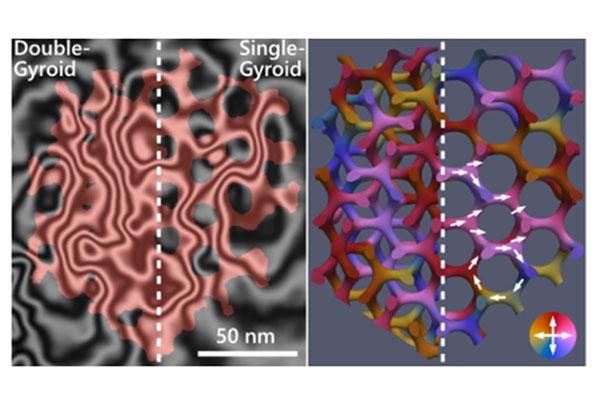
A multinational team of researchers from Tohoku University and institutions in the UK, Germany and Switzerland has revealed the magnetic states of nanoscale gyroids, 3D chiral network-like nanostructures. The findings add a new candidate system for research into unconventional information processing and emergent phenomena relevant to spintronics.

Arrays of interacting nanostructures offer the ability to realize unprecedented material properties, as interactions can give rise to new, “emergent” phenomena. In magnetism, such emergent phenomena have so far only been demonstrated in 2D, in artificial spin ices and magnonic crystals. However, progress towards realizing magnetic “metamaterials”, which could form the basis of advanced spintronic devices by displaying emergent effects in 3D, has been hampered by two obstacles. The first is the need to fabricate complex 3D building blocks at dimensions smaller than 100 nm (comparable to intrinsic magnetic lengthscales) and the second is the challenge of visualizing their magnetic configurations.

The research team therefore decided to study nanoscale magnetic gyroids, 3D networks composed of 3 connected vertices defined by triads of curved nanowire-like struts (Figure 1). Gyroids have attracted much interest, as despite their complexity they can self-assemble from a carefully formulated combination of polymers, which can be used as a 3D mold or template to form free-standing nanostructures (Figure 2). As the struts connect to form spirals, gyroids have a “handedness” or chirality, and their shape makes magnetic gyroids ideal systems to test predictions of new magnetic properties emerging from curvature. Measurements of the optical properties of gyroids even showed that gyroids can have topological properties, which along with chiral effects are currently the subject of intense study to develop new classes of spintronic devices. However, the magnetic states which might exist in gyroids had not yet been established, leading to the present study.

The researchers produced Ni75Fe25 single-gyroid and double-gyroid (formed from a mirror-image pair of single-gyroids) nanostructures with 11 nm diameter struts and a 42 nm unit cell, via block co-polymer templating and electrodeposition. These dimensions are comparable to domain wall widths and spin wave wavelengths in Ni-Fe. They then imaged the gyroid nanoparticles with off-axis electron holography, which could map the magnetization and stray magnetic field patterns in and around the gyroids’ struts with nanometer spatial resolution. Analysis of the patterns with the aid of finite-element micromagnetic simulations revealed a very intricate magnetic state which is overall ferromagnetic but without a unique equilibrium configuration (Figure 3), implying that a magnetic gyroid can adopt a large number of stable states.

“These findings establish magnetic gyroids as a candidate of interest for applications such as reservoir computing and spin-wave logic,” said lead author Justin Llandro.” The research takes an exciting first step towards 3D nanoscale magnetic metamaterials which can be used to uncover new emergent effects and advance both fundamental and applied spintronics research.”

###

Media Contact
Shunsuke Fukami
[email protected]

Original Source

https://www.tohoku.ac.jp/en/press/magnetic_configuration_3d_nanoscale_gyroid_networks.html

Related Journal Article

http://dx.doi.org/10.1021/acs.nanolett.0c00578

Tags: Chemistry/Physics/Materials Sciences
Share12Tweet8Share2ShareShareShare2

Related Posts

Creating Desktop Particle Accelerators to Open New Frontiers in Scientific Research

Creating Desktop Particle Accelerators to Open New Frontiers in Scientific Research

April 1, 2026
Photochargeable Semiconductor Powers Efficient Amine Coupling

Photochargeable Semiconductor Powers Efficient Amine Coupling

April 1, 2026

From Cells to Smart Gels: Advancing Frontiers in Motion Science

March 31, 2026

Tides Amplify Biochar’s Carbon Capture Efficiency in Coastal Wetlands

March 31, 2026
Please login to join discussion

POPULAR NEWS

  • blank

    Revolutionary AI Model Enhances Precision in Detecting Food Contamination

    96 shares
    Share 38 Tweet 24
  • Imagine a Social Media Feed That Challenges Your Views Instead of Reinforcing Them

    1006 shares
    Share 398 Tweet 249
  • Promising Outcomes from First Clinical Trials of Gene Regulation in Epilepsy

    51 shares
    Share 20 Tweet 13
  • Popular Anti-Aging Compound Linked to Damage in Corpus Callosum, Study Finds

    43 shares
    Share 17 Tweet 11

About

We bring you the latest biotechnology news from best research centers and universities around the world. Check our website.

Follow us

Recent News

Tracking Research on Adult Outcomes After Complex Perinatal History

Unveiling the Biological Pathways Linking Pesticides to Cancer Risk: New Study Sheds Light on Environmental Health Impacts

Inequities in Family Engagement Within the NICU

Subscribe to Blog via Email

Success! An email was just sent to confirm your subscription. Please find the email now and click 'Confirm' to start subscribing.

Join 78 other subscribers
  • Contact Us

Bioengineer.org © Copyright 2023 All Rights Reserved.

Welcome Back!

Login to your account below

Forgotten Password?

Retrieve your password

Please enter your username or email address to reset your password.

Log In
No Result
View All Result
  • Homepages
    • Home Page 1
    • Home Page 2
  • News
  • National
  • Business
  • Health
  • Lifestyle
  • Science

Bioengineer.org © Copyright 2023 All Rights Reserved.