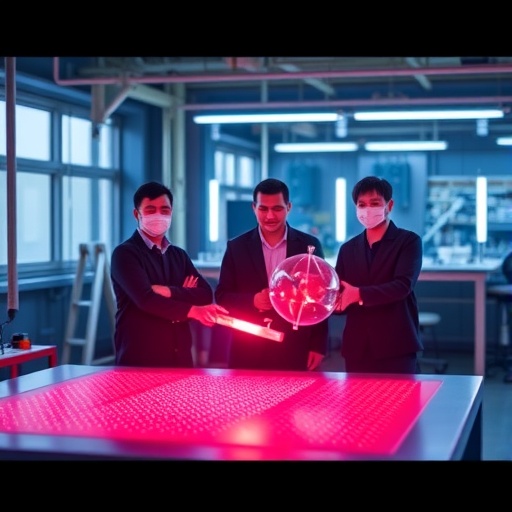
The relentless pursuit of materials capable of conducting electricity without energy loss at room temperature represents one of the most pivotal quests in contemporary physics. Such a breakthrough promises transformative advancements across various technologies, including the development of lossless power transmission systems, more efficient electric motors and generators, enhanced quantum computing architectures, and significantly reduced costs in medical imaging technologies like MRI. Despite intense investigation over decades, room-temperature superconductivity has remained elusive, constrained by fundamental and practical barriers. However, a new strategy paper authored by an international consortium of researchers, including Christoph Heil from the Institute of Theoretical and Computational Physics at Graz University of Technology (TU Graz), offers a fresh and systematic approach for identifying and engineering these enigmatic materials.
Published in the esteemed journal Proceedings of the National Academy of Sciences (PNAS), the paper undertakes a comprehensive assessment of the current state of superconductivity research while proposing innovative directions to overcome existing limitations. Importantly, the authors affirm there are no fundamental physical laws prohibiting superconductivity at ambient temperature. This fundamental optimism fuels the research ambition to finally achieve these unprecedented superconducting states outside cryogenic environments—a feat that would redefine the landscape of material science and technology.
Recent experimental advancements have catalyzed this renewed optimism. The paper cites a landmark study conducted by scientists at the University of Houston that recalibrated the record for superconductivity under ambient pressure conditions through a groundbreaking technique known as pressure quenching. By subjecting the mercury-based superconductor Hg-1223 — previously the ambient pressure record-holder since 1993 — to extreme pressures of up to 300,000 atmospheres at temperatures near absolute zero, researchers enhanced its superconducting critical temperature from 133 Kelvin to a remarkable 151 Kelvin. Crucially, this elevated critical temperature persisted for two weeks following rapid decompression, enabling the highest ambient pressure superconducting transition temperature documented to date, replicated across multiple samples.
This experimental breakthrough encapsulates a vital message: superconductivity, far from being a rare or isolated phenomenon, appears to be a near-universal property of non-magnetic metals, given the appropriate physical conditions. Consequently, the research endeavor shifts from serendipitous discovery to a more deliberate, programmable search. The authors delineate two fundamental challenges driving this transformation. Firstly, the field demands pronounced advances in computational modeling techniques to predict superconductive behavior with higher fidelity, not only confirming superconducting phases but also assessing the feasibility of material synthesis. This holistic prediction framework aims to sift vast multi-element chemical combinations computationally, streamlining experimental efforts to promising industrially viable superconductors.
The second challenge involves precisely engineering materials to achieve or amplify superconducting states through purposeful manipulation. The paper identifies a suite of physical intervention techniques—including the application of extreme pressure, controlled chemical doping, the design of nanoscale architectures, and the deployment of ultrafast light pulses—that can drastically modify or initiate superconductivity. Such materials are conceptualized as “quantum metamaterials,” where superconducting properties emerge from the interplay of nanoscale structural arrangements rather than simply from elemental composition. This reframing introduces a paradigm shift, emphasizing the engineering of quantum interactions over traditional chemical synthesis paths.
Central to the proposed strategy is the tight coupling of theoretical modeling, experimental validation, and machine learning methods. Christoph Heil emphasizes that recent progress in ab-initio computational simulations now allows researchers to investigate superconductivity at nanometer length scales, matching the spatial domains accessible in experiments—a leap from earlier capabilities restricted to unit cells on the scale of angstroms, approximately an order of magnitude smaller. This spatial refinement enhances the accuracy and relevance of theoretical insights.
By integrating advanced artificial intelligence and machine learning algorithms with these state-of-the-art simulations, the team believes they can navigate the labyrinthine space of potential superconducting materials more efficiently than ever before. Such computational tools facilitate high-throughput screening, guiding experimentalists towards the most promising candidates and continually refining models with empirical feedback. This dynamic interplay promises to drastically accelerate discovery cycles, moving beyond the traditional trial-and-error approach that has long dominated superconductor research.
Moreover, the authors highlight the importance of interdisciplinary and international collaboration. The multifaceted nature of the problem demands expertise spanning condensed matter physics, materials science, theoretical chemistry, and computational sciences, alongside cutting-edge experimental techniques. This collaborative spirit underscores the necessity of uniting the global research community behind a common, AI-enhanced goal—to systematically push the boundaries of superconductivity towards true room-temperature operation.
The envisioned roadmap articulates a future where researchers coordinate around iterative loops of prediction, synthesis, and characterization, wherein improved theoretical understanding directs experimental design, while experimental results promptly refine and recalibrate computational models. Such a feedback-driven approach is poised to unravel the complex mechanisms governing superconductivity, including electron-phonon interactions, unconventional pairing symmetries, and the role of quantum criticality. It further offers a pathway to rationally design and tailor superconducting quantum metamaterials for specific applications.
Realizing room-temperature superconductivity carries profound implications. The eventual integration of such materials into commercial technologies could revolutionize energy grids by eliminating transmission losses—a critical efficiency bottleneck today. More compact and powerful electric motors would emerge, reshaping transportation and industrial machinery. Quantum information technologies, long reliant on cryogenic infrastructures, could miniaturize and scale dramatically. Medical diagnostics would become more accessible and affordable as MRI machines no longer require costly cooling systems. In essence, this research trajectory promises widespread societal and technological benefits, redefining the parameters of what is physically and economically attainable.
In summary, the collective effort highlighted in this seminal paper charts a transformative course for superconductivity research. Combining computational breakthroughs, AI-guided discovery, and innovative material engineering, the approach transcends past limitations and rekindles hope of achieving the coveted goal of room-temperature superconductivity. The team’s comprehensive vision not only elevates the science but calls for expanding the collaboration across disciplines and continents to marshal the resources and intellectual capital necessary for success. This milestone paper serves as both a map and a clarion call to the scientific community, heralding a new era in the search for lossless, ambient-condition electrical conduction.
Subject of Research: Not applicable
Article Title: The path to room-temperature superconductivity: A programmatic approach
News Publication Date: 9-Mar-2026
Web References: 10.1073/pnas.2520324123
Image Credits: Lunghammer – TU Graz
Keywords
Room-temperature superconductivity, quantum metamaterials, ab-initio simulations, pressure quenching, quantum materials, machine learning, computational materials science, high-temperature superconductors, AI in physics, nanostructures, materials engineering, electron-phonon interactions