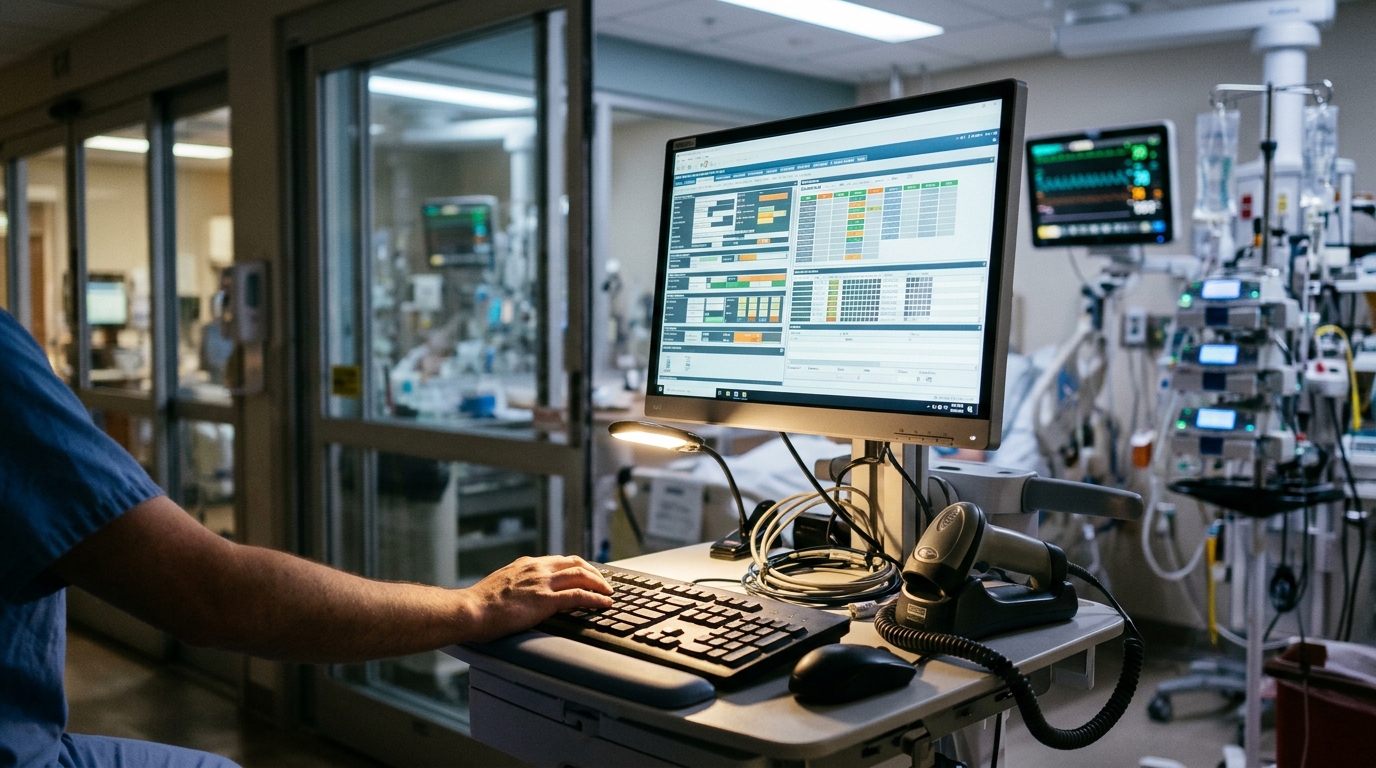
A qualitative investigation evaluating an electronic medical record interface across two intensive care units revealed that design flaws frequently compromise clinicians during high-stakes patient care, with failure in error management, restricted user control, and irreversible charting actions representing fifty-seven percent of all recorded usability violations. Conducted over a twelve-month span from April 2025 to March 2026 within a large teaching hospital in Shiraz, southern Iran, the research explored how critical care personnel interact with an institutional clinical documentation platform progressively expanded since 2015. Intensive care units generate hundreds of distinct clinical data points per patient every day, requiring physicians and nurses to synthesize rapidly evolving physiological indicators under intense time pressure and severe cognitive load. By examining frontline clinicians operating at active computer workstations, the researchers sought to uncover specific, task-oriented user interface barriers that disrupt clinical workflows, elevate documentation burdens, and create latent hazards within high-acuity treatment environments where digital missteps carry severe operational consequences.
To rigorously examine these human-system interactions, the investigative team framed their protocol around fourteen validated usability heuristics formulated by Jiajie Zhang, which expand classic design principles to address the unique functional demands of health information software. The researchers employed a contextual inquiry methodology, pairing workplace observations with semi-structured, face-to-face interviews that lasted between thirty and sixty minutes. A purposive sample of nine healthcare professionals—comprising two attending physicians, two supervisory head nurses, and five staff nurses ranging in age from twenty-two to forty-five years—participated in the investigation after attending preliminary educational sessions on non-clinical interface concepts. All participants possessed at least one year of direct operational experience with the hospital documentation software, with cumulative system familiarity extending up to six years. Interviews were conducted within an intensive care conference room, where clinicians logged into active user accounts using personal credentials to demonstrate authentic charting workflows, routine data retrieval tasks, and frequent administrative workarounds while researchers recorded verbal discourse, interaction patterns, and contextual field observations.
Data analysis proceeded deductively and inductively through directed content analysis utilizing MAXQDA 2020 software, with two independent analysts highlighting meaning units corresponding to violations of the established heuristics. Across the transcribed sessions, the researchers extracted one hundred and eighty-one open codes, which were subsequently synthesized into seventy consolidated codes, twenty-seven distinct subcategories, and nine overarching heuristic categories. Problems were systematically prioritized using a composite severity scoring framework that combined reported frequency across participants with a four-point impact scale evaluating task disruption, delays, and completion failures. Because nine clinicians participated, the minimum non-zero problem frequency registered at eleven point one percent, establishing an attainable severity scale spanning from three to eight points. In practice, the observed severity scores ranged between three and six, with a score of six designating the most critical interaction barriers. The analysis revealed that the error prevention heuristic accumulated forty-six violations, the user control principle registered thirty-one violations, and the reversible actions category accounted for twenty-six violations, collectively dominating the identified interface defects.
Within the error prevention heuristic, input validation vulnerabilities attained the maximum observed severity score of six, driven by the system routinely accepting physiologically impossible numerical values without issuing warning prompts or validation blocks. Clinicians reported that the software permitted extreme vital sign figures, including blood pressure readings as high as one thousand, to enter the official medical record without verification challenges. Participants also detailed silent automated data corrections where the interface arbitrarily capped extreme numerical inputs at fixed limits, such as forty-five, without notifying the operator that the entered value had been modified. Compounding these data entry hazards, clinical decision support features in medication ordering workflows received an equivalent severity rating of six due to the complete lack of structured guidance, automated dose-range limits, and vital organ function cross-checks, forcing overburdened prescribers to rely entirely upon manual vigilance or use non-standard shortcuts like right-clicking to close unmanageable screens.
Critical documentation oversights extended into recurring care tracking and life-support records, where the system failed to deliver automated reminders for time-sensitive nursing duties and legal authorizations. In mechanical ventilation charting, which received a severity score of five, nurses encountered minimal protective friction against erroneous selections, describing instances where complete ventilation parameters were saved for patients who lacked endotracheal tubes entirely. Gaps in software automation further exacerbated these vulnerabilities, as bedside physiological monitors were not digitally interfaced with the electronic medical record.
Severe usability barriers similarly impaired user control and reversibility, as the software repeatedly trapped clinicians in rigid pathways that prohibited the modification or deletion of inadvertent charting mistakes. Frontline nurses noted that while historical paper charts allowed transparent, annotated corrections, the digital interface permanently locked saved data on critical documentation modules, including primary ventilation records and routine vital sign sheets. Furthermore, routine workflows imposed inflexible administrative constraints, requiring staff to complete formal patient assignments before executing basic data entry tasks such as recording external laboratory findings. Rigid time-stamped documentation windows also restricted entries attempted slightly before or after designated charting intervals, disrupting inter-shift clinical handovers. Meanwhile, access permissions for correcting records varied unpredictably between staff nurses and head nurses, creating operational friction that necessitated programmer interventions to resolve locked transfer or discharge files.
Deficiencies under the visibility of system status heuristic earned a maximum severity score of six, primarily due to the interface failing to provide salient visual cues for critical physiological shifts and temporal transitions. Vital sign trends and specialized intensive care sheets lacked dynamic color-coding to highlight acute abnormalities, such as temperatures exceeding thirty-eight degrees Celsius, requiring attending clinicians to scan dense monochrome tables manually to detect historical maximums, minimums, or rapid deteriorations in oxygenation parameters and ventilator modes. Diagnostic tracking exhibited comparable opacity, as the software recorded the initial placement of orders for electroencephalograms, computed tomography scans, and specialty consultations without displaying real-time execution status, completion timestamps, or automated arrival alerts. Clinicians remained uncertain whether ordered interventions were actively pending, in progress, or finalized, compelling personnel to rely on informal paper notations, telephone confirmations, or external inquiries. Additionally, key contextual parameters were concealed behind unindicated hover states, forcing users to discover essential interactive elements through unguided trial and error.
Working memory demands placed an extensive cognitive burden on supervisory personnel, as all subcategories categorized under the memory heuristic scored a severity rating of four. Because the electronic platform lacked centralized tracking dashboards and internal laboratory search utilities, head nurses were forced to maintain mental tallies of pending diagnostic tests across multiple patients, reviewing non-integrated record tabs one by one to verify whether critical culture reports or imaging results had been returned. The interface offered no dedicated digital scratchpads or structured Kardex fields to capture intermediate handoff notes, prompting staff to transcribe vital reminders into unrelated text fields or maintain legacy paper Kardex forms for long-stay patients. Clinicians also highlighted an absence of embedded reference tools, noting that the software lacked visual scales for assessing pupil sizes, clickable diagnostic criteria for the Richmond Agitation-Sedation Scale, and integrated calculators capable of auto-populating patient data to derive glomerular filtration rates, body mass index, or heparin-induced thrombocytopenia scores.
System adaptability and feedback mechanisms exhibited parallel structural deficiencies, with the interface consistently failing to acknowledge user commands through standard system messages. When clinicians attempted to save vital signs, click interactive controls in the Kardex module, or finalize medication orders, the software rarely generated explicit success or failure confirmations, forcing operators to infer system registration from screen refreshes or subtle changes in timestamps. Heuristic violations concerning flexibility and real-world alignment revealed extensive interoperability gaps, characterized by the absence of keyboard shortcuts, missing copy-and-paste functionality, and an inability to sort or filter laboratory lists. In response, physicians selected incorrect surrogate formulations and added explanatory clarifications within unstructured comment boxes, inadvertently dispersing vital pharmacological instructions into free text where they risked downstream misinterpretation.
These operational vulnerabilities were further compounded by a near-total absence of embedded training documentation, user guidance, or systematic onboarding materials across the hospital documentation platform. Aside from isolated question-mark tooltips within an intravenous therapy module, the software provided no built-in documentation, forcing novice nurses and rotating physicians to rely on experiential word-of-mouth training, personal smartphone references, and informal trial-and-error exploration to master shift workflows. Conversely, several classic usability categories demonstrated zero recorded violations throughout the investigation, as researchers identified no specific codes under consistency and standards, task closure, system error messages, or minimalist design, while the user language heuristic was analytically merged into the real-world match category. The five identified match violations, though low in frequency, carried a consistent severity score of four, demonstrating that semantic and logistical misalignments between software logic and ICU workflows systematically pushed routine clinical tasks into brittle, manual adaptations.
Evaluating these findings, the authors emphasized that the identified usability violations clustered into three interconnected systemic vulnerabilities: structural fragility across the error management cycle, interface configurations that elevate cognitive demands while eroding situational awareness, and severe operational misalignment with authentic clinical logic. The investigators explicitly cautioned that their qualitative study examined perceived challenges and potential safety implications rather than directly measuring objective cognitive load, verified clinical error frequencies, or quantitative patient safety outcomes. Furthermore, because the research was conducted within a single medical center utilizing a locally engineered documentation system, the resulting severity rankings, interface defects, and specific user recommendations remain context-bound and cannot be directly generalized to commercial enterprise platforms. Nevertheless, the study demonstrates the utility of Zhang’s heuristic framework for systematically diagnosing role-specific software vulnerabilities, highlighting that future intensive care health technologies must prioritize robust error recovery, intuitive undo capabilities, and automated physiological integration to safeguard clinicians operating in high-acuity environments.
Subject of Research: Usability and human factors evaluation of intensive care electronic medical record user interfaces using Zhang's heuristic principles
Article Title: Human factors and usability challenges of electronic medical record system user interface in intensive care units: a qualitative study based on Zhang’s principles
Article References: Abareshi, F., Mokarami, H., Sharifian, R., Choobineh, A., & Zand, F. (2026). Human factors and usability challenges of electronic medical record system user interface in intensive care units: a qualitative study based on Zhang’s principles. Human Factors in Healthcare, 10, Article 100166. https://doi.org/10.1016/j.hfh.2026.100166
Image Credits: AI Generated
DOI: 10.1016/j.hfh.2026.100166
Keywords: Electronic Medical Records, Intensive Care Units, Human Factors Engineering, Usability Evaluation, Zhang's Principles, Clinical Workflow, Error Prevention, User Interface Design, Clinical Decision Support, Cognitive Load, Situational Awareness, Qualitative Health Research, Patient Safety, Medical Informatics, Contextual Inquiry, Shiraz University of Medical Sciences
News Source: Ophelia Keating. (November 25, 2026). Intensive Care Usability Study Identifies Critical Electronic Medical Record Interface Flaws. Scienmag.