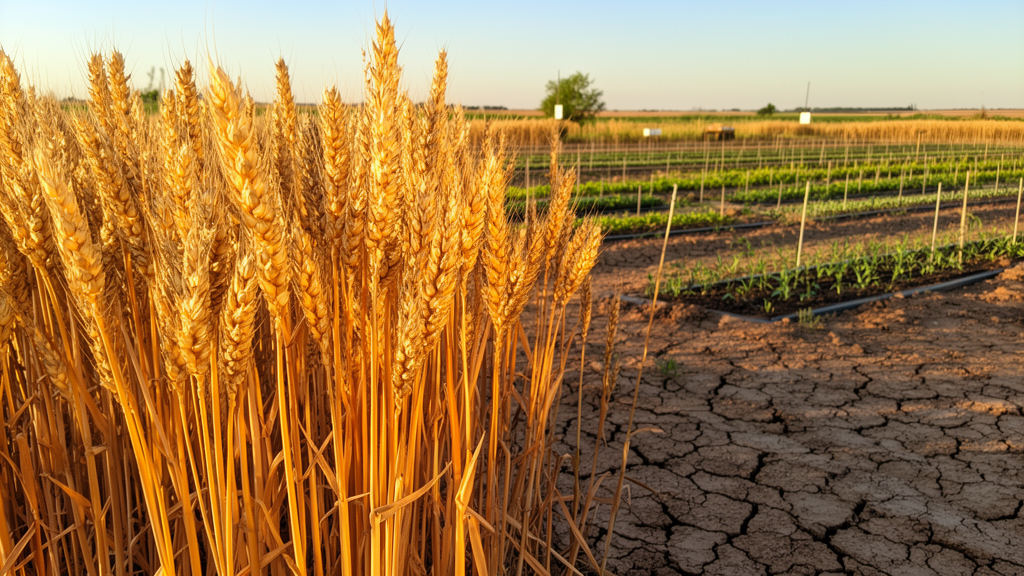
Late-season drought poses a severe operational constraint on bread wheat productivity, yet isolating superior genotypes based on individual drought response indices has historically remained difficult because different metrics often evaluate distinct and highly correlated dimensions of stress performance. In a newly published investigation, researchers tested an integrated analytical approach designed to resolve these analytical ambiguities by combining twelve yield-derived drought tolerance and susceptibility indices with genotype-by-trait biplot analysis alongside two multi-trait selection procedures, the Multi-Trait Genotype–Ideotype Distance Index and Factor Analysis and Ideotype-Design Best Linear Unbiased Prediction.
The experimental evaluation was conducted across two consecutive growing seasons, monitoring sixty-four bread wheat genotypes grown under comparative well-watered and late-season drought stress regimes. Drought stress was systematically imposed during the developmental window spanning from the booting stage through to physiological maturity at a single experimental location. Grain yield determinations collected under both moisture conditions provided the baseline empirical observations required to calculate the full suite of twelve specialized tolerance and susceptibility metrics.
Multivariate evaluations and correlation profiles demonstrated substantial statistical redundancy across productivity-oriented parameters, specifically highlighting close overlaps among the Stress Tolerance Index, Geometric Mean Productivity, Mean Productivity, and Harmonic Mean. In contrast to these yield-potential measures, susceptibility-related metrics formed a contrasting analytical dimension of plant stress reaction, demonstrating that single-index selection cannot comprehensively capture the divergence between baseline productivity and relative stability under terminal water deficit.
To evaluate these multidimensional interactions across the combined two-season dataset, the research team implemented a genotype-by-trait biplot model. The resulting biplot structure accounted for 98.88 percent of the total observed variation among the evaluated materials. This high degree of explained variance enabled researchers to distinctly differentiate between overall productivity characteristics, yield-maintenance capacity, and specific drought-susceptibility profiles across the diverse panel of wheat lines.
When applying multi-trait ideotype selection, the Multi-Trait Genotype–Ideotype Distance Index identified genotypes G29, G43, and G12 as exhibiting the closest geometric proximity to the predefined optimal breeding ideotype. These top-ranked lines were followed in rank order by genotypes G38, G3, G5, G52, G40, G24, and G42 within the overall index hierarchy.
Parallel ranking conducted under the Factor Analysis and Ideotype-Design Best Linear Unbiased Prediction framework similarly placed G29, G43, and G12 as the three leading candidates. Comparing the selection profiles generated by both computational techniques revealed a 60 percent compositional overlap, with six genotypes—specifically designated as G29, G43, G12, G5, G40, and G52—consistently selected across both analytical frameworks.
The study authors emphasized that the six jointly selected genotypes represent prioritized candidate materials for further agronomic evaluation rather than definitively proven commercial solutions. The observed agreement reflects analytical concordance derived from identical underlying yield data rather than an independent biological validation of stress resilience across wider environments. Because field testing was restricted to one geographic site over two growing seasons with stress timed specifically from booting to maturity, broader multi-environment trials remain necessary before establishing stable agronomic superiority or practical breeding utility.
Subject of Research: Evaluation of late-season drought tolerance indices and multi-trait selection models in bread wheat
Article Title: Integrating yield-based drought tolerance indices with GT biplot, MGIDI and FAI-BLUP for selection of bread wheat genotypes under late drought
Article References: Öztürk, A., Türkoğlu, A., Aydın, M., Bocianowski, J., & Alipour, H. (2026). Integrating yield-based drought tolerance indices with GT biplot, MGIDI and FAI-BLUP for selection of bread wheat genotypes under late drought. BMC Plant Biology. https://doi.org/10.1186/s12870-026-10334-x
Image Credits: AI Generated
DOI: 10.1186/s12870-026-10334-x
Keywords: bread wheat, drought tolerance, late-season drought, MGIDI, FAI-BLUP, GT biplot, genotype selection, crop breeding, grain yield, yield maintenance, susceptibility indices, stress tolerance index, geometric mean productivity, harmonic mean, mean productivity, agricultural science, plant biology
News Source: Alan Morgan. (November 13, 2026). Integrated Selection Framework Identifies Six Late-Drought Tolerant Bread Wheat Genotypes. Scienmag.