A comprehensive review published in Discover Plants details a unified framework combining multi-omics platforms, artificial intelligence, genome editing, and nanotechnology to accelerate cotton breeding and bolster crop resilience against dynamic environmental pressures. Global cotton production faces acute yield stagnation driven by climate-induced drought, heat stress, irregular precipitation, and escalating infestations from pests such as bollworms, whiteflies, and aphids. Traditional breeding and early transgenic interventions, including insect-resistant Bt cultivars, achieved notable gains against lepidopteran pests, yet the complex genetic architecture of Gossypium species has increasingly limited the pace of genetic gain. Addressing this bottleneck, researchers Subhashini Selvaraj, Keerthivarman Krishnan, and Aravind Krishnamoorthy synthesize contemporary advances across plant genomics, systems biology, and computational modeling. The authors present a cohesive data-driven pipeline that links biological data generation with predictive analytics and precise field interventions.
The foundational complexity of cotton improvement stems from its allotetraploid genome structure, which arose from the hybridization of Old World A-genome and New World D-genome diploid progenitors roughly one to two million years ago. In Gossypium hirsutum, this evolutionary history yielded an approximately 2.5-gigabase genome containing around 70,000 predicted genes distributed across dual subgenomes. Following allopolyploidization, duplicated homoeologous gene pairs underwent extensive divergence through subfunctionalization and neofunctionalization, partitioning ancestral functions across tissues and developmental stages. This architecture is governed by homoeolog expression bias and expression level dominance, wherein specific subgenomes preferentially drive vital processes. During fibre development, homoeologs encoding cellulose synthase complexes exhibit pronounced subgenome-specific expression that enhances cellulose deposition. Under abiotic stress, homoeolog expression undergoes dynamic remodeling to buffer cellular stability. Epigenetic modifications, including DNA methylation and chromatin reorganization, further refine these subgenomic expression patterns, establishing regulatory plasticity that underpins agronomic performance.
At the biochemical level, cotton fibre development and defence responses operate as interdependent metabolic sinks that compete for photosynthetically derived carbon resources. Photosynthetically fixed sucrose represents the primary currency partitioned between primary structural pathways and protective secondary metabolism. In developing fibres, which are elongated single cells derived from the ovular epidermis, cellulose biogenesis dominates the secondary cell wall stage, ultimately constituting over ninety percent of mature fibre dry weight. Cellulose biosynthesis is executed by plasma membrane-localized cellulose synthase complexes formed by isoforms such as CesA4, CesA7, and CesA8. These multi-subunit complexes polymerize nucleotide sugars supplied by sucrose synthase and UDP-glucose pyrophosphorylase into glucan chains that crystallize into microfibrils. Disruptions within CesA genes significantly impair fibre strength and thickness. Under optimal conditions, metabolic flux directs carbon toward uninterrupted cellulose deposition, whereas environmental stress redirects carbon intermediates toward secondary compounds, creating physiological trade-offs between structural quality and plant survival.
The developmental trajectory of cotton fibres—spanning initiation, elongation, secondary wall thickening, and maturation—is tightly orchestrated through phytohormone crosstalk and convergent transcriptional networks. Auxin acts as a pivotal regulator of early fibre differentiation, where polar transport mediated by PIN-FORMED proteins establishes localized gradients that promote cell initiation and cytoskeletal reorganization. Concurrently, gibberellins accelerate fibre lengthening by stimulating cell wall-loosening enzymes, including expansins and pectin methylesterases, which relax wall rigidity to facilitate extension. Brassinosteroids and ethylene further modulate cell expansion and reactive oxygen species homeostasis. These distinct hormonal streams converge upon shared transcription factor hubs, notably ARF, BES1/BZR1, MYB, and NAC families. Regulatory factors such as GhMYB25 and GhHD1 coordinate the activation of downstream cellulose synthase genes while integrating defence-related cues. When experimental models perturb GhMYB25-like function, lint and fuzz development undergo severe reductions, demonstrating how transcriptional nodes integrate hormonal inputs into structural outcomes.
Secondary metabolic pathways generate essential non-structural chemical defences that protect cotton plants from herbivores, pathogens, and oxidative stress. Gossypol, a prominent sesquiterpenoid aldehyde stored within specialized glandular tissues, confers robust protection against insect pests such as the cotton bollworm Helicoverpa armigera. Its biosynthesis proceeds through the cyclization of farnesyl diphosphate catalyzed by cadinene synthase, followed by successive oxidations involving cytochrome P450 enzymes like CYP706B1 and dehydrogenases. Regulated by WRKY and MYB transcription factors, gossypol is ecologically vital, yet its presence in seeds renders cottonseed toxic to non-ruminants and humans. Parallel phenylpropanoid and shikimate pathways yield protective flavonoids and phenolic acids, including quercetin, kaempferol, caffeic acid, and ferulic acid, synthesized via enzymes such as chalcone synthase and phenylalanine ammonia-lyase. These compounds scavenge reactive oxygen species and reinforce cell wall cross-linking under environmental extremes. Advances in seed-specific silencing allow researchers to decouple defensive foliage chemistry from edible cottonseed products.
To resolve phenotypic variation that eludes single-reference assemblies, researchers have transitioned to pan-genomic frameworks that categorize the cotton gene repertoire into core, dispensable, and private gene subsets. Core genes maintain fundamental physiological functions across all accessions, whereas dispensable and private accessory genes frequently encode proteins involved in pathogen resistance, secondary metabolism, and abiotic stress adaptation. Single-reference genomes fail to detect structural variations, presence-absence variations, and copy-number changes, leading to missing heritability in conventional mapping studies. Long-read sequencing platforms like PacBio and Oxford Nanopore enable haplotype-resolved assemblies that uncover structural variants influencing complex agronomic traits. For instance, copy number variations in cellulose synthase genes directly correlate with fibre wall thickness, while presence-absence variants in stress-responsive loci dictate drought and salinity resilience. Integrating structural variation datasets into genome-wide association studies provides high-resolution marker intervals, shifting genetic analyses toward structure-aware genomic prediction models.
Genome-wide transcriptomic profiling and non-coding RNA investigations have illuminated how diverse abiotic and biotic pressures converge upon shared regulatory architectures. When cotton experiences drought, high salinity, extreme temperatures, or pathogen attack, cellular signalling cascades channel responses through common hubs dominated by abscisic acid signaling, reactive oxygen species detoxification, and calcium-dependent kinases. Key transcription factor families, including DREB, NAC, WRKY, and bZIP, coordinate downstream activation of protective chaperones, ion transporters like NHX and SOS1, and antioxidant enzymes. Post-transcriptional gene regulation adds another supervisory tier through microRNAs, long non-coding RNAs, and circular RNAs. Specifically, miR828 and miR858 direct the repression of MYB transcription factors controlling secondary wall synthesis and flavonoid flux. Long non-coding RNAs act as competing endogenous RNAs to sequester these microRNAs, while circular RNAs act as stable molecular sponges. This multi-tiered RNA circuitry modulates developmental phase changes while buffering metabolic flux against fluctuating environmental cues.
Next-generation crop improvement leverages multi-omics data integration to move beyond isolated correlations toward predictive systems biology models. High-dimensional data encompassing genomics, transcriptomics, proteomics, metabolomics, and phenomics are fused using multi-layer network frameworks such as weighted gene co-expression network analysis. Because empirical studies document weak linear correlations between transcript abundance, translated protein quantities, and active metabolite pools, advanced analytical approaches are necessary to decipher true biological causality. Machine learning algorithms, including Random Forests and Support Vector Machines, excel at processing noisy, structured omics data, while deep learning architectures like convolutional neural networks analyze image-based phenotyping data. Empirical evaluations indicate that artificial intelligence-driven genomic prediction can improve trait selection accuracy by approximately ten to twenty percent over classical linear models such as GBLUP and Bayesian regression. These algorithms uncover non-linear epistatic interactions, prioritize informative biomarkers, and simulate genotype-by-environment dynamics across diverse growing environments.
Translational biotechnology relies increasingly on precision genome editing platforms, most notably CRISPR-Cas nucleases, base editors, and prime editing systems, to engineer complex agronomic traits. In polyploid cotton, targeted mutagenesis requires multiplexed guide designs capable of simultaneously modifying redundant homoeologous loci across both subgenomes while minimizing off-target events. Precise manipulation of key regulators has produced substantial phenotypic improvements in experimental trials, where targeted modifications in GhMYB25, GhHD1, and CesA genes yielded five to twenty percent increases in fibre length, five to twenty-five percent gains in tensile strength, and five to ten percent improvements in fineness. Concurrent editing of stress-related genes and gossypol biosynthetic enzymes like CYP706B1 enables multi-trait stacking, simultaneously conferring abiotic tolerance and eliminating seed toxicity without incurring vegetative penalties. Furthermore, emerging prime editing tools allow subtle adjustments in homoeolog expression levels, bypassing double-strand breaks to achieve fine-tuned physiological modifications.
Nanotechnology functions as an indispensable delivery and physiological modulation interface that bridges molecular engineering with field implementation. Engineered nanocarriers—including carbon nanotubes, lipid nanoparticles, and polymeric vesicles—cross plant cell wall pores measuring approximately five to twenty nanometers through passive diffusion or endocytosis. This nanoscale delivery facilitates the direct transport of ribonucleoprotein complexes, plasmids, and editing machinery into plant cells without relying on tissue culture procedures, thereby circumventing somaclonal variation and genotype-dependent recalcitrance. Beyond genetic transformation, nano-enabled agriculture utilizes nanofertilizers formulated with zinc, iron, and silica to enhance nutrient uptake kinetics, boost chlorophyll biosynthesis, and stimulate antioxidant enzymes under drought and salinity stress. Nanoparticle-encapsulated pesticides and RNA interference agents provide slow, targeted release, minimizing chemical runoff and dosage requirements. Additionally, plant-integrated nanosensors generate continuous measurements of internal hydration, nutrient fluxes, and localized stress responses, supplying immediate phenotypic feedback to optimize crop management regimens.
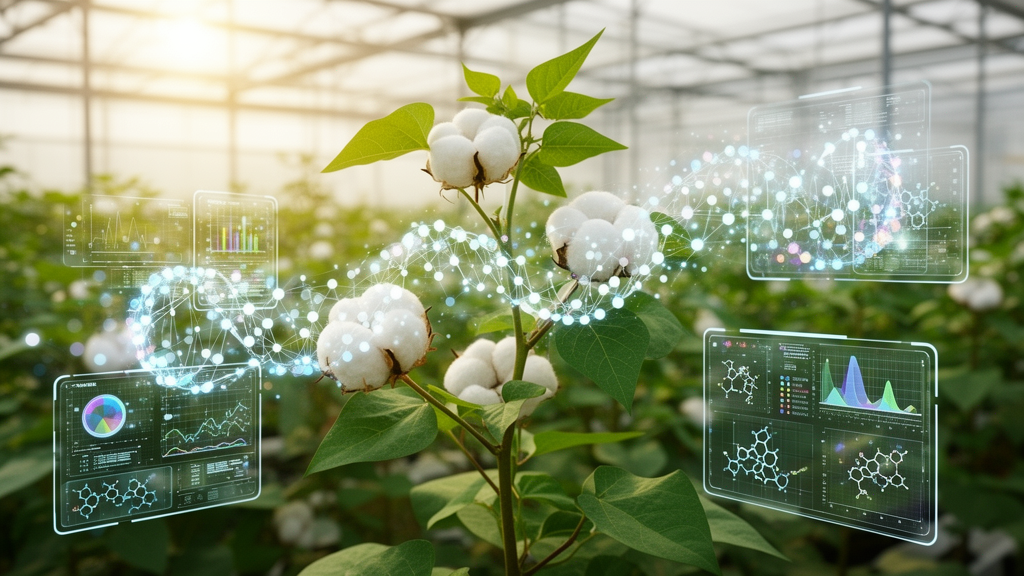
The conceptual synthesis presented by Selvaraj and colleagues converges on an autonomous breeding ecosystem defined as a predict-edit-deliver-phenotype-learn operational cycle. In this closed-loop continuum, multi-omics platforms and artificial intelligence predict candidate alleles and regulatory targets; genome editing introduces precise alterations; nanotechnology delivers molecular payloads; and high-throughput phenotyping platforms evaluate performance across variable field conditions. Despite its promise, this framework encounters notable technical and translational bottlenecks, including data heterogeneity, computational complexity, incomplete functional annotation of polyploid cotton genomes, and fluctuating genotype-by-environment-by-management interactions. Furthermore, nanoparticle persistence in soils, cytotoxicity risks, and divergent regional biosafety regulations surrounding gene-edited crops present hurdles to commercial deployment. Resolving these challenges requires standardized data integration protocols, explainable machine learning models, and collaborative translational pipelines that unite molecular biologists, data scientists, and agronomists to develop high-yielding, climate-resilient cultivars capable of sustaining global textile and agricultural systems.
Subject of Research: Integrated multi-omics, artificial intelligence, and advanced biotechnologies for cotton crop improvement
Article Title: Next-generation cotton improvement through integrated biosynthetic pathways, multi-omics, artificial intelligence and advanced breeding technologies
Article References: Selvaraj, S., Krishnan, K., & Krishnamoorthy, A. (2026). Next-generation cotton improvement through integrated biosynthetic pathways, multi-omics, artificial intelligence and advanced breeding technologies. Discover Plants, 3(1), Article 509. https://doi.org/10.1007/s44372-026-00801-y
Image Credits: AI Generated
DOI: 10.1007/s44372-026-00801-y
Keywords: cotton breeding, Gossypium hirsutum, allotetraploidy, multi-omics integration, artificial intelligence, CRISPR-Cas genome editing, nanotechnology, cellulose biosynthesis, CesA complexes, gossypol biosynthesis, homoeolog expression bias, pan-genomics, fibre quality, abiotic stress tolerance, high-throughput phenotyping, genomic prediction, non-coding RNAs, plant systems biology
News Source: Blake Davidson. (November 15, 2026). Integrated Multi-Omics and Artificial Intelligence Pipeline Accelerates Climate-Resilient Cotton Breeding. Scienmag.