Analytical scientists have successfully engineered an advanced volumetric dried blood spot microsampling platform that directly integrates an isotopically labelled internal standard into the collection matrix to quantify phosphatidylethanol 16:0/18:1, a primary direct biomarker of human alcohol consumption. Published in Analytical and Bioanalytical Chemistry by an international research team led by Martina Galletto and Alberto Salomone, the study demonstrates that embedding deuterated phosphatidylethanol onto the collection disc of a modified volumetric microsampling card resolves major analytical discrepancies that historically hindered conventional dried blood spot workflows. By applying a rapid ultra-high performance liquid chromatography-tandem mass spectrometry method with a five-minute runtime, the researchers established a reliable bioanalytical framework capable of measuring blood biomarker levels across clinically crucial decision boundaries, bridging a long-standing gap between minimally invasive patient sampling and stringent forensic measurement standards.
Phosphatidylethanol 16:0/18:1, commonly abbreviated as PEth, represents an abnormal phospholipid generated specifically in red blood cell membranes when ethanol is present in circulating blood. Under normal physiological circumstances, the ubiquitous cellular enzyme phospholipase D catalyzes the hydrolysis of phosphatidylcholine into phosphatidic acid and free choline using water as an enzymatic substrate. However, when ethanol enters the bloodstream, phospholipase D exhibits a transphosphatidylation specificity constant approximately 250 times higher for ethanol than for water, preferentially synthesizing phosphatidylethanol instead. Because this biochemical reaction requires ethanol, PEth serves as an exceptionally specific indicator of alcohol exposure that persists in circulation for up to four weeks. While investigators have catalogued 48 distinct PEth homologues, the 16:0/18:1 molecular species constitutes approximately 37 to 46 percent of total circulating PEth in human blood, establishing it as the benchmark analyte for monitoring compliance in abstinence programs, assessing prospective organ transplant candidates, evaluating alcohol consumption during pregnancy, and resolving legal custody or driver reinstatement proceedings.
Biomedical interpretation of phosphatidylethanol concentrations relies upon internationally recognized clinical decision thresholds established in whole blood, designating 20 nanograms per milliliter to differentiate abstinence or low consumption from moderate drinking, and 200 nanograms per milliliter to indicate chronic excessive alcohol misuse. Dried blood spot sampling has long represented an attractive alternative to conventional liquid venipuncture because phosphatidylethanol exhibits recognized chemical instability in liquid whole blood stored at ambient temperatures or refrigerated at minus 20 degrees Celsius. In contrast, dried blood spots immobilize cellular constituents and preserve PEth over at least 60 days across diverse storage temperatures ranging from minus 20 degrees to 18 degrees Celsius. However, standard dried blood spot workflows introduce significant technical challenges, most notably the hematocrit effect seen in non-volumetric filter papers and the inevitable physical and temporal separation between endogenous target analytes and reference internal standards.
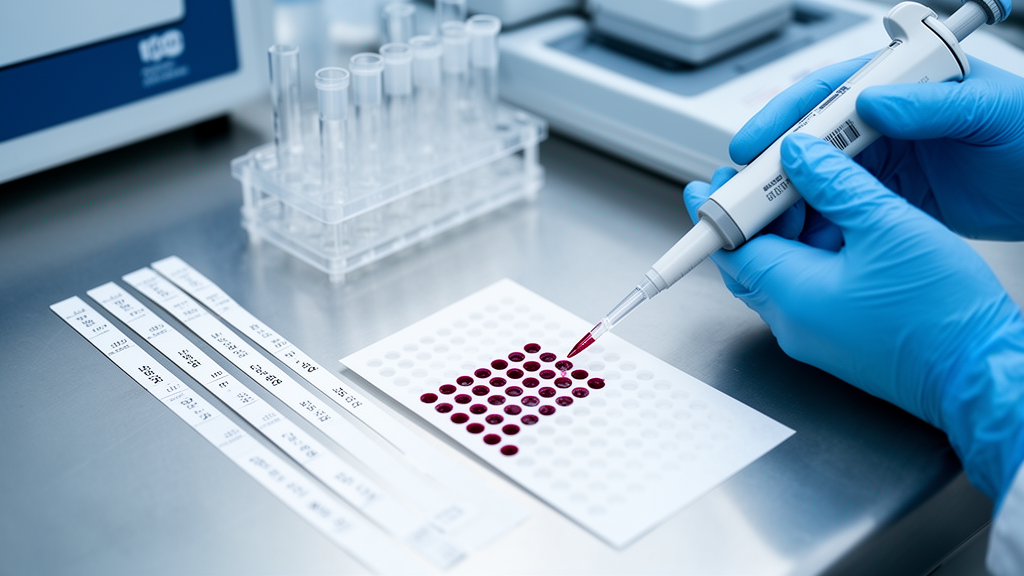
To overcome these methodological vulnerabilities, the investigators leveraged the Capitainer B10 Vanadate microsampling card, a commercial medical device engineered with microfluidic channels that meter and isolate a precise ten-microliter volume of whole blood onto an Ahlstrom grade 222 paper disc measuring six millimeters in diameter. The vanadate device incorporates sodium metavanadate directly into the collection matrix to inhibit residual phospholipase D activity, thereby preventing post-sampling synthesis of phosphatidylethanol driven by circulating ethanol. In conventional bioanalytical testing, internal standards are introduced into the extraction solvent long after the blood spot has dried, preventing the reference calibrator from compensating for sample dissolution variability, incomplete recovery, or ambient environmental degradation during transit. The newly designed internal-quantification dried blood spot strategy, termed iqDBS, circumvents this weakness by impregnating a five-deuterium labelled internal standard, d5-PEth, directly into the sampling disc prior to blood deposition, ensuring continuous co-extraction and equivalent chemical exposure throughout sample processing.
During preliminary assay development, the research team conducted an empirical evaluation comparing four distinct approaches for introducing internal standards using pooled human whole blood: pre-spotting d5-PEth onto blank filter paper discs prior to blood deposition, pre-fortifying liquid whole blood with internal standard prior to card spotting, post-spotting internal standard onto previously dried blood specimens, and the traditional approach of introducing standard during organic solvent extraction. Quantifications were calculated both via unnormalized standard addition and using the ratio of analyte peak area to internal standard peak area. The pre-spotting strategy demonstrated the greatest numerical agreement between normalized and unnormalized evaluations, yielding an exceptionally stable internal standard response with an average coefficient of variation of only 3 percent across four fortified concentration levels. In sharp contrast, pre-fortification of whole blood produced an unacceptably high internal standard response variation of 52 percent due to incomplete liquid mixing, while traditional post-extraction addition showed a marked 44 percent coefficient of variation at baseline endogenous levels.
To explore whether simplified synthetic substitutes could circumvent the difficulty of sourcing genuine biomarker-free whole blood, the investigators systematically compared internal standard extraction efficiency between genuine dried blood spots and a surrogate matrix consisting of two percent weight-per-volume bovine serum albumin formulated in phosphate-buffered saline. Using Tukey honestly significant difference tests across twelve replicate samples per matrix, the team documented a statistically significant divergence in d5-PEth extraction efficiency, characterized by a probability value of 0.00323. Furthermore, when calibration curves constructed in bovine serum albumin were used to quantify endogenous phosphatidylethanol in a pooled blood specimen, the calculated concentration reached 211 nanograms per milliliter, compared to 65.0 nanograms per milliliter derived from a matched whole blood standard addition model. This profound discrepancy demonstrated that protein-supplemented buffers fail to mimic the complex physical interactions of cellular blood matrices, underscoring the absolute necessity of authentic biological substrates for valid assay calibration.
Sample preparation procedures underwent extensive chemical and mechanical optimization to maximize chromatographic signal-to-noise ratios. After removing the six-millimeter Ahlstrom disc from the plastic housing, the paper matrix was pre-wetted with 20 microliters of high-purity water for five minutes to relax cellulose fibers before adding 400 microliters of isopropanol. Ultrasonic extraction for 30 minutes at room temperature, followed by centrifugation at 4000 times gravity at 4 degrees Celsius for 10 minutes, proved significantly superior to gentle orbital shaking or methanol extraction. Evaporating the organic supernatant under a stream of pure nitrogen and reconstituting the dry residue in 30 microliters of methanol delivered a vital pre-concentration effect, boosting mass spectrometric signal intensity from 13,000 counts to 82,300 counts for the primary transition. Furthermore, experiments evaluating sodium metavanadate deposition identified that reducing the applied inhibitor volume from 2.0 to 1.0 microliters of a 0.10 molar solution avoided structural disruption of the internal poly(vinyl alcohol) membranes, successfully reducing internal standard extraction variability from 21 percent down to 8 percent.
Chromatographic separation was achieved on a Waters Acquity BEH C18 column measuring 50 by 2.1 millimeters with 1.7-micrometer particles, operated at 45 degrees Celsius with a two-microliter injection volume and a constant mobile phase flow rate of 0.5 milliliters per minute. The mobile phase comprised 10 millimolar ammonium acetate in an 80:20 water-acetonitrile mixture for solvent A and an 80:20 methanol-acetonitrile mixture for solvent B. The gradient initiated at 15 percent solvent A and 85 percent solvent B, ramped linearly over 2.5 minutes to 2 percent A and 98 percent B, maintained isocratic conditions for one minute, reverted to initial conditions over 0.5 minutes, and re-equilibrated for one minute, maintaining stable operating pressures between 460 and 470 bar. Negative-mode heated electrospray ionization tandem mass spectrometry monitored selected reaction monitoring transitions at mass-to-charge ratios 701.5 to 255.2 for PEth quantification, 701.5 to 281.2 for qualitative confirmation, and 706.5 to 281.2 and 706.5 to 255.2 for d5-PEth monitoring, with collision energy set at minus 30 volts across all transitions.
Rigorous assay validation adhered to bioanalytical method guidelines issued by the United States Food and Drug Administration, evaluating nine individual calibration curves across three independent analytical runs spanning non-consecutive days. Due to heteroscedastic variance across the 10.0 to 500 nanogram per milliliter range, the team implemented a weighted linear regression model utilizing a 1/x-squared weighting factor. Applying the Hubaux-Vos statistical calculation algorithm to the initial four calibrators established a limit of detection of 4.20 nanograms per milliliter, which was experimentally verified at 2.40 nanograms per milliliter based on a signal-to-noise ratio of three. The lower limit of quantification was formally set at 10.0 nanograms per milliliter, meeting predefined acceptance thresholds of precision and bias within 20 percent. Across all six calibration levels, intra-day and inter-day accuracy remained well within the required plus-or-minus 15 percent bias interval, demonstrating exceptional analytical robustness directly at the critical 20.0 and 200 nanogram per milliliter diagnostic cut-offs.
Matrix effect and absolute extraction recovery were thoroughly characterized at low, medium, and high quality-control concentrations of 10.0, 75.0, and 300 nanograms per milliliter by systematically analyzing blank blood extracts, non-blood filter matrices, and fortified blood substrates. The overall analytical extraction recovery averaged 57 plus-or-minus 18 percent, a modest extraction yield that remains typical for volumetric micro-matrices due to tight entrapment within cellulose fibers and small solvent volumes. The method exhibited slight ion enhancement at the lowest calibrator level alongside moderate ion suppression at higher concentrations. Independent examination of d5-PEth revealed matrix effect values of 89 percent, 124 percent, and 141 percent across the three concentration steps, proving that pre-impregnated isotopic analogues participate directly in matrix-related ionization phenomena. When matrix calculations incorporated internal standard ratios, analytical precision improved substantially compared to uncorrected measurements, confirming that pre-impregnation successfully offsets variable ionization losses.
To evaluate potential product shelf life and determine how long pre-treated collection devices remain viable for clinical use, prototype cards containing deposited vanadate and d5-PEth were sealed inside protective aluminum packaging and subjected to accelerated thermal aging at 70 degrees Celsius. Based on standard medical device stability protocols employing an acceleration factor of 1.8 per 10-degree temperature increment, five days at 70 degrees Celsius mathematically simulates approximately 70 days, or 2.5 months, of ambient storage at 25 degrees Celsius. Quality-control samples prepared at 10.0 and 300 nanograms per milliliter after one, three, and five days of thermal stress displayed no statistically significant deterioration via one-way analysis of variance, with probability values exceeding 0.05. The overall internal standard peak area maintained a tight coefficient of variation of 12 percent across 24 analyses, verifying that the carbon-deuterium bonds and physical disc structure remain stable under accelerated storage.
While these experimental findings demonstrate the feasibility of the integrated internal standard volumetric platform, the authors delineated several distinct boundaries regarding current interpretation. First, developmental testing was conducted using fortified venous blood rather than capillary blood obtained via routine finger prick, necessitating subsequent clinical studies to verify performance across varying hematocrit ranges. Second, although thermal stress models verified chemical stability for 2.5 months, real-time stability protocols extending to one full year remain necessary before broad commercial rollout. Third, the manual deposition of one microliter of internal standard solution introduces minor pipetting uncertainty that industrial manufacturing would replace with automated nano-spray deposition techniques. Nonetheless, this study provides an empirically verified proof-of-concept that integrating an internal standard directly into a volumetric dried blood spot card dramatically enhances quantitative accuracy for phosphatidylethanol 16:0/18:1, establishing an objective analytical pathway for clinical monitoring and forensic toxicology.
Subject of Research: Volumetric dried blood microsampling with integrated internal standard for phosphatidylethanol quantification
Article Title: Integrated internal standard volumetric dried blood microsampling for the quantification of phosphatidylethanol 16:0/18:1
Article References: Galletto, M., Chace, D., Kamat, M., Garrett, T. J., & Salomone, A. (2026). Integrated internal standard volumetric dried blood microsampling for the quantification of phosphatidylethanol 16:0/18:1. Analytical and Bioanalytical Chemistry. https://doi.org/10.1007/s00216-026-06828-0
Image Credits: AI Generated
DOI: 10.1007/s00216-026-06828-0
Keywords: Phosphatidylethanol, PEth 16:0/18:1, Dried Blood Spots, Microsampling, Capitainer B10, Internal Standard, UHPLC-MS/MS, Alcohol Biomarkers, Selected Reaction Monitoring, Sodium Metavanadate, Bioanalytical Validation, Forensic Toxicology, Clinical Chemistry, Volumetric Sampling, Deuterated Standards, Matrix Effect, Extraction Recovery, Accelerated Aging
News Source: Bethany Barker. (November 25, 2026). Integrated Internal Standard Dried Blood Sampling Accurately Quantifies Alcohol Consumption Biomarker. Scienmag.