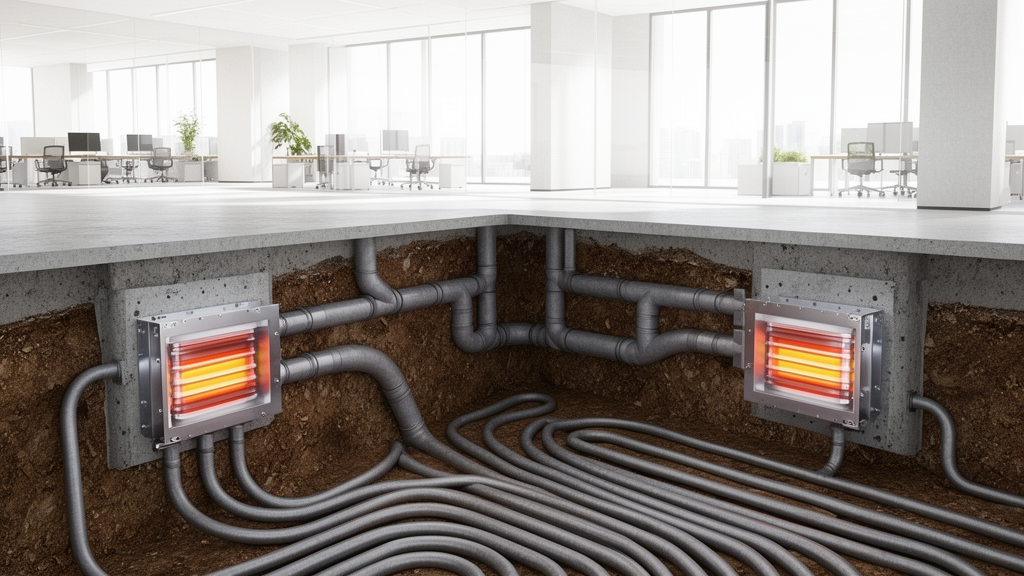
A computational investigation published in Discover Energy demonstrates that sequentially coupling underground phase change material storage modules, vertical borehole ground heat exchangers, and open-type ceiling radiant cooling panels can effectively regulate indoor office temperatures without relying on conventional mechanical refrigeration. Researchers Ahmed Kandil, Mohamed Emam, and Sameh Nada developed and simulated a three-stage sequential cooling architecture using three-dimensional finite-volume numerical models in ANSYS software. The simulated framework circulates domestic water initially at 30 degrees Celsius through buried phase change material containers to absorb early peak heat, routes the fluid through a 40-meter geothermal borehole to reject additional thermal energy into stable ground layers, and finally delivers the chilled water to suspended radiant ceiling panels. Across six consecutive peak operating hours, the integrated system lowered circulating water temperatures sufficiently to maintain comfortable indoor air conditions within a modeled office room subjected to internal heat gains ranging from 302 watts to 1208 watts, presenting a viable pathway toward decarbonizing building space cooling.
The urgent motivation behind developing passive and semi-passive space cooling technologies stems from the intense energy consumption and environmental burdens associated with commercial and residential building operations. Global reports from the International Energy Agency indicate that the building sector currently accounts for approximately 30 percent of final energy consumption worldwide and nearly 27 percent of energy-related carbon dioxide emissions. In response to these climate pressures, international frameworks such as the European Union Directives on the energy performance of buildings have mandated substantial decreases in building energy intensity and accelerated the deployment of renewable and low-carbon technologies. Mechanical air conditioning systems represent a significant share of peak electrical demand during warm seasons. While individual alternative technologies such as ground source heat exchangers, latent heat thermal storage, and radiant panels have shown considerable potential, existing literature has predominantly examined these systems in isolation. The authors sought to bridge this technological gap by establishing an integrated, sequential multi-stage system capable of providing continuous daytime cooling while eliminating the electrical demands of vapor-compression chillers.
The operational framework of the proposed design connects three dedicated subsystems into a unified, continuous hydronic loop where domestic water serves as the circulating heat-transfer medium. During operation, water pressurized at a flow rate of seven liters per minute first traverses a battery of underground phase change storage cubes installed inside a concrete chamber at a depth of three meters. In this preliminary stage, the water sheds its initial thermal load by melting the enclosed phase change material. Upon leaving the phase cubes, the partially cooled water is directed downward into a 40-meter vertical borehole heat exchanger, where it undergoes secondary cooling by dissipating sensible heat into the relatively cool, undisturbed soil. Finally, the exiting water stream supplies an open-type ceiling radiant cooling panel positioned near the ceiling of the office space. By using the outlet fluid state of each preceding subsystem as the inlet boundary condition for the subsequent unit, the authors achieved an energy-conserving thermal chain that maximizes natural heat sinks before conditioning the indoor occupied zone.
The initial stage of thermal moderation relies on specialized containers called phase cubes, designed to provide thermal buffering and suppress water temperatures prior to subsurface injection. To optimize both thermal density and heat transfer kinetics, the authors evaluated two distinct compact storage module arrangements: a half-circular inline configuration and a staggered cylindrical layout. Each phase cube comprises a thermally insulated enclosure constructed from 50-millimeter-thick foamed expanded polypropylene, which minimizes unwanted parasitic heat gains from the surrounding environment. Internally, each unit houses 60.6 kilograms of Rubitherm SP-24E phase change material encased within 0.48-millimeter-thick aluminum capsule frames selected for high thermal conductivity. Six identical phase cubes are connected in parallel to ensure uniform fluid distribution across the storage mass. Installing the assemblies inside an underground chamber at a depth of three meters leverages the local undisturbed soil temperature of Borg Al Arab City, which remains stable at roughly 19 degrees Celsius, thereby preventing premature melting prior to operational charging.
Numerical modeling of the melting process within the phase cubes revealed significant behavioral differences between the two storage module geometries during a six-hour daytime charging cycle. Operating with an inlet water temperature of 30 degrees Celsius, both configurations initially established an immediate seven-degree temperature drop, cooling the water to 23 degrees Celsius. Throughout the subsequent six hours, both designs successfully maintained their discharge water temperatures below 26.5 degrees Celsius. However, the half-circular inline design demonstrated superior heat extraction rates, absorbing approximately 532 watts at the start of charging compared to 456 watts for the staggered cylindrical modules. This enhanced heat transfer allowed the half-circular modules to reach a 50 percent liquid mass fraction within four hours and achieve complete melting in roughly eight hours. Conversely, the staggered cylinders exhibited greater internal thermal resistance, requiring approximately 12 hours for complete liquefaction but sustaining a more consistent heat absorption rate of roughly 250 watts during later charging stages.
After departing the phase change storage array, the circulating water enters the secondary cooling stage, comprised of a vertical borehole ground heat exchanger extending 40 meters into the subsoil. Shallow geothermal ground layers in the evaluated region maintain a steady ambient temperature of approximately 19 degrees Celsius, establishing an ideal natural heat sink for summer operations. The researchers examined two piping configurations constructed from durable polyvinyl chloride pipes: a single U-tube series flow design and a double U-tube parallel flow design. While both configurations handled the full seven liters per minute flow rate, the double U-tube design divided the volume into two parallel circuits carrying 3.5 liters per minute each, effectively doubling the contact surface area. Lateral temperature contours at depths of 20 and 40 meters demonstrated that the double U-tube geometry dissipated heat into the surrounding grout and soil much more efficiently, lowering the water outlet temperature to 22.5 degrees Celsius when coupled with the half-circular inline phase cubes after six operating hours.
The terminal phase of the integrated framework involves an open-type ceiling radiant cooling panel that directly extracts sensible heat from the indoor occupied zone. Fabricated from aluminum sheet to maximize conductive heat transfer, the panel measures 3.6 meters in width, 3.6 meters in length, and 0.03 meters in thickness, and is suspended at an elevation of 2.6 meters above the floor in an office measuring 4 meters by 4 meters by 2.9 meters. Because cooled water from the borehole heat exchanger circulates through the panel, its exterior surface assumes a stable, uniform temperature equal to the borehole outlet temperature. Sensible heat removal occurs via coupled radiation to interior room surfaces and natural convection with the surrounding air. Warm indoor air rises toward the cooled underside of the panel, while a portion enters the ceiling plenum through dedicated panel openings, shedding heat to the upper panel surface before descending along perimeter paths to establish continuous buoyancy-driven indoor circulation.
To rigorously simulate these interrelated multi-physics phenomena, the researchers formulated individual three-dimensional numerical models for each subsystem using ANSYS Fluent 20.1 and executed finite-volume discretizations. Fluid dynamics within the room and the heat exchanger pipes were modeled using the realizable k-epsilon turbulence formulation combined with scalable wall functions to accurately capture boundary layer behavior. Phase change kinetics within the storage cubes were captured via the enthalpy-porosity method, while radiative exchange among interior office surfaces and twelve cylindrical dummy heat sources was resolved using a surface-to-surface radiation model. Mesh independence was verified across all domains, maintaining a dimensionless near-wall distance of approximately one. Furthermore, each sub-model was validated against external experimental benchmarks: the phase change model agreed with published experimental data from Waqas and Kumar within an average discrepancy of 4.8 percent, the ground heat exchanger model matched numerical results from Serageldin et al. within 1.724 percent, and the radiant panel model replicated experimental thermal profiles from past literature with only 3.6 percent deviation.
Thermal performance evaluations of the completed system within the modeled office room considered an initial summer air temperature of 35 degrees Celsius across three distinct internal occupancy and equipment load scenarios simulated by twelve distributed dummy heat sources. Under Case 1, corresponding to a modest 302-watt heat load from two occupants and a desktop computer, the double U-tube and half-circular inline combination reduced room temperatures from 35 degrees Celsius to 22.8 degrees Celsius, keeping air well below the 24-degree threshold. Under Case 2, where internal loads doubled to 604 watts representing four occupants and two workstations, the system maintained an average room temperature of 24.88 degrees Celsius with the half-circular inline configuration. Even under Case 3, where heat loads reached 1208 watts from six individuals and three workstations, the combined system successfully curbed excessive thermal build-up, restricting peak indoor air temperatures to 27.88 degrees Celsius and achieving an overall temperature drop exceeding seven degrees without active mechanical chilling.
While these simulation results highlight the technical viability of coupling shallow geothermal loops with latent heat thermal storage and radiant panels, the authors noted several important analytical limitations. The soil domain was modeled under the assumption of homogeneous thermophysical properties, omitting variations in ground moisture migration, groundwater advection, and multi-year ground thermal saturation effects. Additionally, the radiant ceiling cooling panel was evaluated under steady-state peak thermal conditions rather than dynamic, full-year meteorological schedules, and moisture condensation risks on panel surfaces were addressed through operational boundary constraints rather than explicit multi-phase dehumidification modeling. The researchers emphasized that future research should focus on multi-seasonal transient simulations incorporating long-term geothermal regeneration, full-scale experimental testing of the physical multi-circuit prototype, and comprehensive techno-economic analyses to evaluate capital installation expenses against lifecycle electricity savings in sustainable commercial building applications.
Subject of Research: Sequential passive and active building cooling using underground phase change materials, borehole ground heat exchangers, and radiant ceiling panels
Article Title: Radiant panel free cooling of office building using a new ground heat exchanger integrated with phase change material cubes
Article References: Kandil, A., Emam, M., & Nada, S. (2026). Radiant panel free cooling of office building using a new ground heat exchanger integrated with phase change material cubes. Discover Energy, 6(1), Article 44. https://doi.org/10.1007/s43937-026-00162-3
Image Credits: AI Generated
DOI: 10.1007/s43937-026-00162-3
Keywords: phase change materials, ground heat exchangers, radiant ceiling cooling panels, free cooling, building energy efficiency, borehole heat exchangers, thermal energy storage, computational fluid dynamics, ANSYS Fluent, office thermal comfort, sensible heat removal, double U-tube, Rubitherm SP-24E, indoor air temperature, shallow geothermal energy, passive cooling
News Source: Audrey Campbell. (November 13, 2026). Integrated Geothermal Loops and Phase Change Modules Maintain Office Comfort Without Chillers. Scienmag.