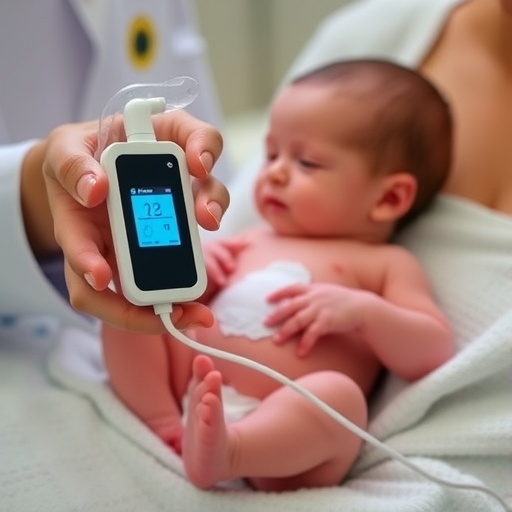
In the realm of neonatal care, the accurate measurement of urinary output is a fundamental yet challenging task that has far-reaching implications for diagnosis, treatment, and monitoring of various medical conditions. A groundbreaking solution has just emerged from the pioneering work of researchers Nauta, Corbeek, van Berkel, and their colleagues, who have developed an innovative urine collection device specifically designed to address the longstanding difficulties associated with urine collection in neonates and pre-continent infants. This breakthrough, published in Pediatric Research on April 13, 2026, promises to revolutionize clinical practices by delivering unprecedented precision in urinary measurements while ensuring comfort and safety for this vulnerable patient group.
Neonatal and infant patients present unique challenges in urine collection due to their limited communication abilities and physical fragility. Traditional methods, including absorbent pads and urine bags, often result in contamination, evaporation, or leakage, rendering urine volume and composition measurements less reliable. The novel device developed by the research team is a response to these critical limitations, designed to collect urine in a manner that is both non-invasive and highly accurate, laying the groundwork for improved diagnostic accuracy and therapeutic monitoring.
At the heart of this innovation lies a technology-driven design that integrates advanced biomaterials capable of maintaining urine integrity from collection to analysis. The device features a biocompatible collection surface that minimizes skin irritation and maximizes urine capture efficiency. Importantly, its architecture prevents cross-contamination and allows for easy detachment and transfer to laboratory settings. This integration of materials science and bioengineering ensures that even minuscule volumes can be reliably collected and analyzed without compromising the infant’s comfort or skin health.
The clinical significance of accurate urinary measurement in neonates cannot be overstated. Urine analysis is crucial in monitoring kidney function, hydration status, and metabolic imbalances, all of which are critical parameters in neonatal intensive care units (NICUs). Until now, the clinical community has struggled with suboptimal measurement techniques that can lead to diagnostic errors or delayed intervention. The advent of this novel device enables a paradigm shift in neonatal care, whereby consistent and precise urine measurements can be performed routinely, facilitating early detection and management of renal or systemic pathologies.
Furthermore, the multidisciplinary team approached the design with an emphasis on ease of use in busy NICU environments. The device’s form factor allows for quick and secure placement by nursing staff, reducing handling time and stress for infants. The system offers real-time data integration possibilities, making use of smart sensors that could transmit data directly to patient monitoring dashboards—a potential leap forward in clinical workflow efficiency and patient monitoring accuracy.
Validation studies detailed in the publication demonstrated the device’s superiority over conventional methods by a significant margin, showing improved recovery rates of urine samples and more reproducible analyte concentrations. These findings highlight the robustness of the device under varied clinical scenarios, including patients with low urine output or those requiring constant monitoring. The high fidelity of urine collection directly translates to better-informed clinical decisions and personalized care interventions.
The developers also addressed hygiene and sustainability in their design. The device employs single-use components constructed with biodegradable materials, aligning with environmental health goals while preventing nosocomial infections. This consideration is critical in hospital settings where infection control is paramount. The biodegradable nature ensures minimal ecological impact, marking a stride towards sustainable medical device innovation without compromising clinical efficacy.
Beyond the NICU, the implications of this novel urine collection system are profound. Pediatric wards globally grapple with the challenges of pediatric urine collection, where developmental factors complicate standard methods. Extending the application of this device to pre-continent infants broadens its utility, offering a universally applicable solution that bridges the gap between pediatric and neonatal care environments.
In addition to clinical and operational impacts, this technology is poised to enhance research capabilities significantly. Reliable urine collection facilitates longitudinal studies of renal development, drug metabolism, and disease progression in neonates and infants—populations traditionally underserved due to collection difficulties. This device could enable the generation of large-scale, high-quality data sets that inform future therapeutic innovations and deepen understanding of infant physiology.
The outstanding collaboration between engineers, clinicians, and material scientists exemplifies the cutting-edge multidisciplinary approaches shaping the future of personalized medicine. This device underscores how leveraging engineering ingenuity aligned with clinical needs can yield breakthroughs that transform patient care paradigms. As the device advances toward widespread implementation, it epitomizes the fusion of technology and compassionate care in modern medicine.
Looking ahead, ongoing trials are exploring integration with digital health platforms, enhancing the device’s connectivity and data analytics capabilities. The incorporation of artificial intelligence to interpret real-time urinary biomarker data could enable predictive modeling and proactive interventions. Such advancements will elevate neonatal care by providing clinicians with actionable insights derived from precise, continuous monitoring.
The research team’s efforts encapsulate a broader shift towards patient-centered innovation, emphasizing comfort, accuracy, and usability. By directly addressing the unique needs of neonates and pre-continent infants, the device sets a new standard in clinical diagnostics. Its dissemination could spur additional research and innovation in related domains, catalyzing advancements in pediatric medical technology at large.
In sum, this novel urine collection device stands to redefine standards in neonatal and pediatric care, offering a practical, efficient, and scientifically rigorous tool for urinary measurements. It overcomes longstanding barriers, supports clinical decision-making, and has the potential to improve outcomes for millions of vulnerable infants worldwide. As hospitals and healthcare systems adopt this technology, the future of neonatal monitoring appears brighter, grounded in precision and empathetic care.
The introduction of this device marks an epochal moment in neonatal medicine, where technological innovation meets clinical necessity to deliver transformative outcomes. The study published in Pediatric Research not only showcases a device but heralds a movement toward smarter, safer, and more effective infant care. The medical community and families alike stand to benefit profoundly as this technology enters standard practice.
Subject of Research: Neonatal and pre-continent infant urine collection technology for accurate urinary measurement.
Article Title: A novel urine collection device for accurate urinary measurements in neonates and pre-continent infants.
Article References:
Nauta, S.P., Corbeek, L.A., van Berkel, M. et al. A novel urine collection device for accurate urinary measurements in neonates and pre-continent infants. Pediatr Res (2026). https://doi.org/10.1038/s41390-026-04891-y
Image Credits: AI Generated
DOI: 13 April 2026
Tags: accurate urine output monitoring in infantsadvanced biomaterials in medical deviceschallenges in neonatal urine measurementimproving diagnostic accuracy in neonatesinnovative urine collection technologyneonatal care urine volume measurementneonatal urine measurement devicenon-invasive neonatal urine collectionpediatric urinary monitoring innovationreducing contamination in infant urine samplesurine collection device for fragile patientsurine collection in pre-continent infants