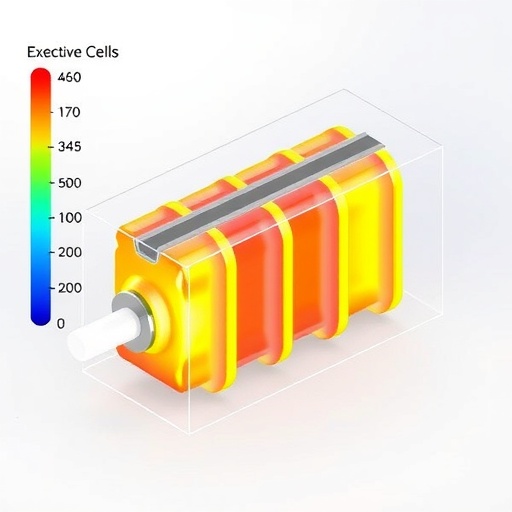
The pursuit of enhanced thermal management systems in battery technologies has reached a significant milestone with the publication of research conducted by Lorbeck and Fruehwirth. Their study, titled “Development of an electrochemically approximated simulation model and a hardware substitution cell approach for thermal management battery system tests,” addresses critical challenges that modern battery systems face amid increasing demands for reliability and performance. This research significantly contributes to the ongoing quest for more sustainable and efficient energy storage solutions.
At the heart of this study lies the necessity for effective thermal management in battery systems, especially as electric vehicles (EVs) and renewable energy storage solutions grow in popularity. As batteries are subjected to various operational loads, temperature fluctuations can adversely affect their performance, lifespan, and safety. The necessity to maintain an optimal operating temperature within the battery cells is paramount, as overheating can lead to reduced capacity, accelerated degradation, or even hazardous conditions like thermal runaway. With the burgeoning demand for electric mobility and energy storage solutions, researchers are called to innovate in thermal management techniques to enhance system efficiency.
The paper highlights an innovative electrochemically approximated simulation model that serves as a predictive tool for thermal performance in battery systems. Unlike conventional models that may overlook the intricate interactions occurring within the battery during charge and discharge cycles, this simulation seeks to replicate real-life conditions closely. By integrating electrochemical reactions into thermal management assessments, the simulation provides highly relevant data that can predict how temperature variations influence battery operations over time. This groundbreaking approach has profound implications for not just academic researchers but also engineers in the automotive and energy sectors.
The hardware substitution cell approach introduced in this study represents a paradigm shift in experimental methodologies for evaluating thermal management strategies. Traditional experimental setups often require significant resources and time for construction, testing, and modification. However, Lorbeck and Fruehwirth’s hardware substitution cell allows for quicker adjustments between tests, providing researchers with a flexible platform to explore various thermal management configurations. This adaptability can accelerate the research cycle, facilitating the rapid development and deployment of more robust battery systems.
Importantly, the study underscores the collaboration between theoretical modeling and practical applications. The simulation model acts as a virtual testing ground, enabling researchers to examine the potential impacts of different thermal strategies without the prolonged waiting periods required for physical experiments. Such cross-platform interplay exemplifies the future of battery system research, enabling quicker innovations that can meet the demands of markets expanding rapidly.
Battery developers are now tasked with understanding how to leverage these findings into practical designs. With electric vehicle manufacturers racing to enhance battery efficiency and safety, the insights from this research are particularly timely. Utilizing the findings from the electrochemically approximated simulation model, engineers can better predict performance outcomes based on specific materials, configurations, and thermal management strategies, potentially saving millions in research and development costs.
Moreover, the ongoing work by Lorbeck and Fruehwirth opens avenues for integrating machine learning approaches into thermal management research and battery performance predictions. Artificial intelligence technologies can analyze the large datasets generated by both the simulation model and experimental setups, unveiling patterns and relationships that might not be immediately apparent. These insights could lead to breakthrough advancements in battery technology that enhance not only performance but also environmental sustainability by promoting longer-lasting, higher-capacity battery solutions.
Furthermore, as the global push for clean energy continues to intensify, this study’s implications extend beyond automotive applications. The findings contribute to the broader context of renewable energy storage systems, where effective thermal management is crucial to optimize performance and ensure safety. As various renewable sources like solar and wind increasingly contribute to the energy mix, integrating robust thermal management solutions into these systems will be instrumental in making them more efficient and reliable.
In conclusion, as battery technology continues to evolve in response to the urgent demands of the modern world, the contributions of Lorbeck and Fruehwirth offer critical insights and innovative methodologies that will underscoring future research directions. By bridging theoretical models with hardware experimentation, the pair has not only advanced the field of battery thermal management but also set the stage for agile, effective solutions in an energy landscape that is rapidly progressing.
The research presented in this paper serves as a fundamental reminder of the intricate challenges involved in designing cutting-edge battery systems. As this area of study continues to grow, the integration of advanced simulation techniques and flexible experimental designs will be key in driving innovations that meet the evolving needs of consumers and industries.
With an eye toward the future, the efforts detailed by Lorbeck and Fruehwirth may inspire a new generation of battery researchers to approach thermal management as a multidimensional challenge—one that requires the blending of diverse scientific disciplines and practical engineering solutions. Ultimately, as the technology matures, we can expect to see consequent improvements in battery performance, safety, and longevity, hallmarks of the next generation of energy solutions.
This collaborative spirit within the scientific community will be vital as the world moves toward a more sustainable energy future.
Subject of Research: Thermal Management in Battery Systems
Article Title: Development of an electrochemically approximated simulation model and a hardware substitution cell approach for thermal management battery system tests
Article References:
Lorbeck, R., Fruehwirth, C. Development of an electrochemically approximated simulation model and a hardware substitution cell approach for thermal management battery system tests.
Automot. Engine Technol. 10, 2 (2025). https://doi.org/10.1007/s41104-024-00146-2
Image Credits: AI Generated
DOI: https://doi.org/10.1007/s41104-024-00146-2
Keywords: Thermal Management, Battery Systems, Electrochemical Simulation, Hardware Substitution, Energy Efficiency
Tags: battery lifespan and safetyelectric vehicle battery performanceelectrochemically approximated simulation modelenergy storage solutions sustainabilityenhancing battery system efficiencyhardware substitution cell approachInnovative battery thermal managementoptimal operating temperature for batteriespredictive tools for battery thermal performancerenewable energy storage innovationsthermal management challenges in batteriesthermal runaway prevention in batteries