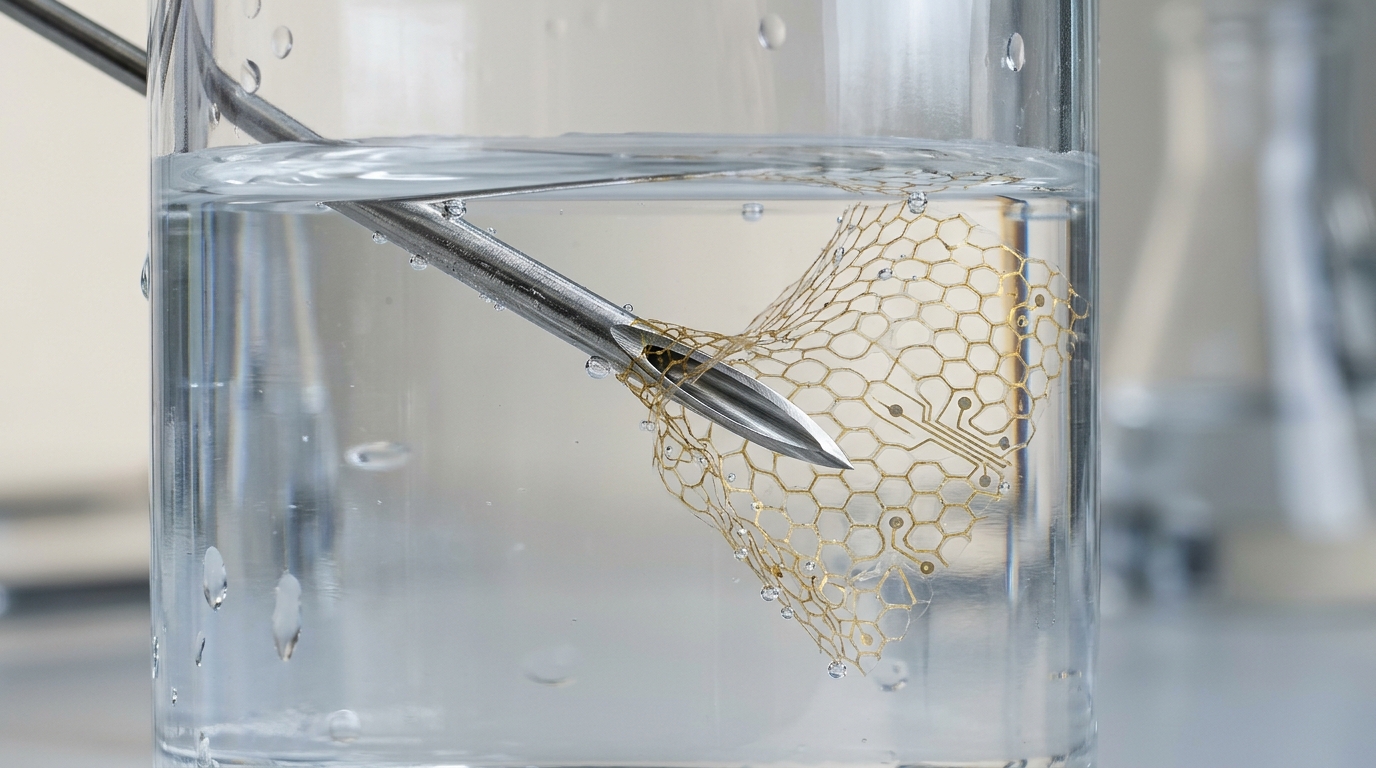
Implantable bioelectronic devices interface with biological tissues to diagnose, monitor, and treat human disease, yet their clinical utility remains constrained as permanent foreign bodies. As permanent foreign bodies, implants are associated with risks, including chronic inflammation, foreign body responses, implant-related trauma, and limited patient acceptance, constraining their long-term clinical use. Injectable bioelectronics offer a minimally invasive alternative, enabling device delivery directly through surgical needles or catheters to facilitate seamless mechanical integration with soft host tissues. Injectable bioelectronics combine minimally invasive delivery with localized sensing, stimulation, and therapy.
A central engineering challenge in advancing injectable bioelectronics involves balancing injectability, long-term biocompatibility, functional performance, and operational stability. Successful platforms must deliver multimodal sensing, active tissue stimulation, wireless communication, and closed-loop control without compromising host safety. To resolve these competing demands, researchers evaluate three complementary engineering strategies designed to overcome physical delivery constraints while maintaining device efficacy.
The silicon-centric integration strategy achieves injectability through aggressive device miniaturization and highly integrated wireless communication architectures. However, further scaling is constrained by power transfer, communication, alignment, and packaging requirements.
The shear-thinning biomaterial strategy leverages compliant, tissue-adaptive functional materials, particularly hydrogels, to enable minimally invasive delivery and improve tissue compatibility. After implantation, these materials reconstruct conductive, stimulatory, or field-transduction interfaces.
The metagel strategy encodes bioelectronic functionality directly within intrinsic material properties, engineered architectures, and field-responsive physical interactions. By distributing sensing and actuation mechanisms throughout structured material matrices, this paradigm enables wireless bioelectronic operations without conventional embedded electronic chips.
Emerging biomedical applications of injectable bioelectronics span several vital tissues, including the brain, heart, vasculature, and peripheral nervous network. Injectable platforms support neural recording and modulation. These devices also facilitate physiological monitoring and electrotherapy. Additionally, injectable systems support peripheral nerve stimulation.
Achieving clinical translation for injectable bioelectronic technologies requires overcoming critical operational, manufacturing, and regulatory hurdles before routine adoption. Systems must demonstrate reliable in vivo deployment, sustained long-term operation, safe bioresorbable degradation or retrieval protocols, robust wireless coupling, and scalable industrial manufacturing processes. Furthermore, establishing clear regulatory pathways will be essential as these minimally invasive devices advance toward autonomous, closed-loop diagnostic and therapeutic systems capable of delivering localized medical care directly within complex human tissues.
Subject of Research: Engineering strategies, tissue integration, and biomedical applications of injectable bioelectronics
Article Title: Injectable bioelectronics
Article References: Tang, H., Li, N., Pan, Z., Qin, L., Yang, Y., Tian, Y., & Zang, J. (2026). Injectable bioelectronics. Nature Reviews Bioengineering. https://doi.org/10.1038/s44222-026-00513-8
Image Credits: AI Generated
DOI: 10.1038/s44222-026-00513-8
Keywords: injectable bioelectronics, implantable devices, silicon-centric integration, shear-thinning biomaterials, hydrogels, metagels, chip-free actuation, neural recording, neuromodulation, physiological monitoring, electrotherapy, peripheral nerve stimulation, closed-loop systems, biocompatibility, minimally invasive delivery, wireless communication, tissue interfaces
News Source: Denise Maddox. (November 26, 2026). Injectable Bioelectronics Balance Delivery and Function Across Three Engineering Strategies. Scienmag.