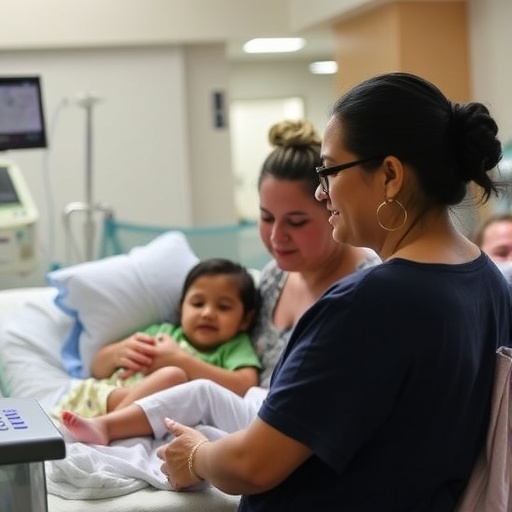
In the realm of neonatal intensive care, family presence and engagement with newborns play an indispensable role in promoting optimal developmental outcomes. However, a groundbreaking study published in the Journal of Perinatology in April 2026 sheds light on the persistent social and structural disparities influencing these critical aspects of neonatal care. Researchers Anand, Kalluri, Cordova-Ramos, and colleagues have meticulously dissected the influence of maternal sociodemographic variables and the Social Vulnerability Index (SVI) on the degree of family involvement within the NICU environment. Their findings illuminate systemic barriers that differentially impact families’ ability to breastfeed, provide skin-to-skin care, and participate in discharge teaching well in advance of hospital departure.
The context of neonatal intensive care units (NICUs) is inherently complex, characterized by high clinical acuity and the vulnerability of infants requiring life-sustaining interventions. Family engagement is not merely beneficial; it is fundamentally woven into the fabric of neonatal care standards worldwide. Evidence consistently shows that parental touch, breastfeeding, and comprehensive understanding of care protocols reduce infant morbidity and foster long-term health resilience. Nonetheless, access to such engagement opportunities is unevenly distributed, often dictated by broader societal inequities rather than infant medical status alone.
This study meticulously utilized the Social Vulnerability Index, a composite measure assessing factors such as socioeconomic status, household composition, minority status, housing type, and access to transportation, to evaluate the environmental determinants of family involvement. Maternal sociodemographic data including age, educational attainment, race, and income were cross-examined against NICU engagement metrics. These parameters together offer a multidimensional lens to critically analyze how social determinants of health reverberate within the microcosm of NICU care.
Intriguingly, the authors found that increased social vulnerability, as quantified by higher SVI scores, strongly correlated with reduced family presence in the NICU. The findings suggest that systemic vulnerabilities — encompassing economic hardships, limited social support, and infrastructural challenges — effectively erect invisible barriers that hinder consistent parental involvement. These impediments are particularly detrimental during the fragile neonatal period when family proximity and participation can materially influence infant outcomes.
The scope of family engagement investigated encompassed three primary indicators: the initiation and continuation of breastfeeding, provision of skin-to-skin care (also known as kangaroo care), and receipt of discharge teaching at least 48 hours prior to hospital release. Each of these factors individually represents a cornerstone of patient-centered NICU care, yet disparities emerged as consistent themes. Mothers facing greater social adversity were less likely to achieve early breastfeeding, a disparity with profound implications given the well-documented immunological and neurodevelopmental benefits of human milk.
Skin-to-skin care, a practice lauded for stabilizing heart rate, improving thermoregulation, and promoting neurobehavioral organization in preterm infants, was also less frequently practiced among socioeconomically marginalized families. The study highlights that logistical challenges—ranging from transportation difficulties to rigid work schedules—significantly curtailed opportunities for prolonged parental contact. This systemic exclusion undermines not only infant health but also parental confidence and bonding, foundational aspects of early childhood development.
Moreover, the timing and depth of discharge teaching, a critical phase where caregivers acquire essential knowledge to safely manage their infant post-hospitalization, were compromised among families with elevated social vulnerability scores. The lack of early and comprehensive education before discharge jeopardizes infant health continuity and increases potential for readmissions or adverse events. This emergent pattern underscores how structural inequities translate into tangible deficits in preparatory healthcare interactions at junctures critical for long-term neonatal wellbeing.
The implications of this research extend far beyond the NICU walls. By demonstrating the tangible impact of social vulnerability on healthcare engagement metrics, the study calls attention to the broader conversation surrounding health equity. It reveals how social determinants interface with clinical care environments, shaping patient trajectories. Crucially, the work encourages neonatal care systems to develop tailored interventions aimed at mitigating these disparities, such as flexible visitation policies, enhanced social work support, and transportation assistance programs.
From a methodological standpoint, the use of a robust dataset integrating individual maternal factors and community-level vulnerability indices strengthens the generalizability of these findings. The cross-sectional design, although limited in causal inference, carefully controlled for potential confounders, providing a clear associative framework. Future longitudinal research will be vital to elucidate dynamic changes in family engagement over time and after implementation of targeted equity-oriented strategies.
The study also provocatively situates NICU care within the larger sociopolitical landscape, acknowledging that improvements in neonatal outcomes are inextricably linked to addressing upstream social determinants. Healthcare institutions must reckon with how structural inequities are perpetuated within clinical settings and explore systemic reforms. Advocating for policies that enhance paid parental leave, improve transportation infrastructure, and facilitate health literacy can synergistically empower families from vulnerable backgrounds.
Technology and innovation also hold promise in closing the engagement gap. Telehealth platforms enabling virtual participation in care rounds or discharge teaching, for instance, can alleviate some logistical burdens placed on socioeconomically disadvantaged families. Nonetheless, such solutions must be deployed thoughtfully, considering digital divides and ensuring accessibility for all demographic groups.
At its core, this pioneering research underscores the indispensable value of partnership between families and healthcare providers in neonatal contexts. It calls for holistic approaches that integrate clinical excellence with equity-driven social support mechanisms. The urgency to act is magnified by the critical developmental window inherent to NICU care, where every interaction reverberates through an infant’s lifetime health trajectory.
In conclusion, the investigation conducted by Anand and colleagues constitutes a seminal contribution to neonatal health equity research. By quantifying the impact of maternal sociodemographic factors and social vulnerability on family engagement within the NICU, the authors provide a clarion call to reimagine neonatal care delivery models. Hospitals and healthcare policymakers must harness these insights to dismantle barriers and foster inclusive, family-centered environments that optimize outcomes for all newborns, regardless of social circumstances.
As this research gains traction, it opens avenues for interdisciplinary collaboration among neonatologists, social scientists, policymakers, and community advocates. Together, these stakeholders can catalyze transformative change poised to redefine standards of care. Equitable family engagement in the NICU is not just a healthcare imperative; it is a societal mandate that promises to shape healthier futures on both individual and population scales.
The evidence outlined within this report ultimately challenges us to view the NICU as more than a medical setting; it must be recognized as a social institution interwoven with broader patterns of inequality and opportunity. By leveraging data-driven insights and compassionate innovation, we can strive toward a neonatal care paradigm that fulfills both its clinical mission and its collective responsibility to nurture every vulnerable infant and family with dignity and equity.
Subject of Research: Maternal sociodemographic factors, Social Vulnerability Index, and their associations with family presence and engagement in the Neonatal Intensive Care Unit (NICU).
Article Title: Social and structural disparities in family presence and engagement in the NICU.
Article References:
Anand, N.S., Kalluri, N.S., Cordova-Ramos, E.G. et al. Social and structural disparities in family presence and engagement in the NICU.
J Perinatol (2026). https://doi.org/10.1038/s41372-026-02641-w
Image Credits: AI Generated
DOI: 01 April 2026
Tags: discharge teaching inequities in NICUdisparities in breastfeeding supportfamily engagement in NICUimpact of social determinants on neonatal outcomesimproving family-centered care in NICUsinequities in neonatal intensive carematernal sociodemographic factors in neonatal careneonatal health equity researchparental involvement in high-acuity NICU settingsskin-to-skin care access disparitiessocial vulnerability and NICU carestructural barriers to family involvement in NICU