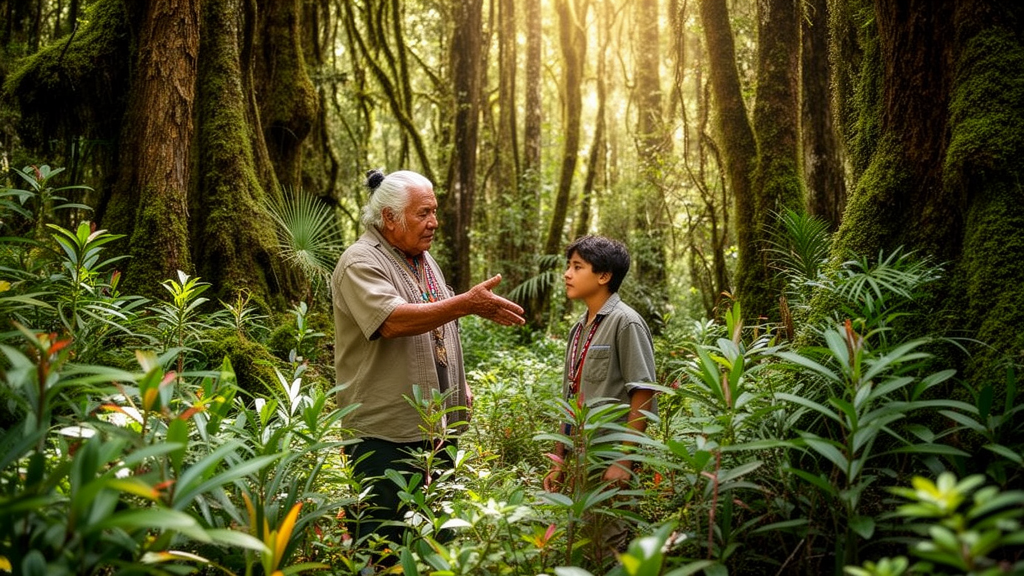
Over seventy-five percent of documented medicinal plant services are known exclusively to speakers of a single language, revealing that cultural and ecological wisdom is deeply vulnerable to global linguistic decline. According to an extensive narrative review led by Dr. Ngozi Tessy Onuora and colleagues, published in Frontiers in Conservation Science, traditional ecological knowledge does not merely accompany cultural diversity; it is structurally embedded within endangered vernaculars. With approximately forty percent of the world’s estimated seven thousand living languages currently facing extinction, the attrition of regional speech communities directly risks erasing irreplaceable botanical knowledge. The international synthesis evaluates decades of empirical, theoretical, and policy literature to introduce the Language-Ecology-Sustainability Interface model. By distinguishing verified empirical observations from theoretical proposals, the authors document how linguistic erosion compromises biodiversity stewardship while carefully outlining critical evidentiary boundaries across international conservation science.
The researchers established their synthesis by conducting purposive, iterative searches across the Web of Science Core Collection, Scopus, and PubMed Central, prioritizing investigations published between January 2020 and August 2026. The bibliographic screening captured contemporary empirical and systematic evidence, including two systematic reviews, a primary qualitative case study, and macroevolutionary modeling studies published between 2023 and 2024. These contemporary inquiries were supplemented by backward and forward citation chasing, seminal theoretical treatises, and a targeted supplementary query executed in October 2026 to identify qualifying or disconfirming literature regarding traditional ecological knowledge persistence. To ensure methodological transparency, candidate studies were screened against strict eligibility criteria requiring operationalized language measures, quantified environmental outcomes, and distinct indigenous or minority language settings. Individual sources were appraised across six methodological credibility domains, including temporal ordering, sample scope, construct validity, and adjustment for structural confounders.
Central to the empirical core of the review is a large-scale cross-sectional investigation examining 12,495 medicinal plant services across 236 languages and three global regions. That analysis demonstrated that more than three-quarters of recorded medicinal applications are linguistically unique, known entirely within the lexical and cultural repertoire of a single language community. Furthermore, these unique therapeutic services are disproportionately concentrated within threatened languages. While this finding confirms that specialized ethnobotanical wisdom is distributed along linguistic lines rather than broadly shared across cultures, the review emphasizes that the study examined a single analytical link. The research did not deploy a translation-recovery design, meaning that empirical evidence has not demonstrated whether such knowledge can be recovered post-loss through documentation or translation, nor did it directly evaluate downstream consequences on human conservation behavior or ecosystem integrity.
To contextualize these findings within real-world social-ecological systems, the synthesis examined empirical studies tracking traditional ecological knowledge across transitional rural communities. In a longitudinal panel investigation tracking 484 participants across 47 Tsimané villages in lowland Bolivia, cultural change and market integration were significantly associated with the erosion of plant knowledge, concentrated specifically in utilitarian, species-specific domains crucial for resource management. However, the explanatory variable in that longitudinal study was cultural attachment to traditional beliefs rather than an operationalized measure of language vitality. Concurrently, a cross-sectional investigation in Doñana, Spain, revealed that market integration eroded customary resource-management knowledge even within non-indigenous populations where no minority language was present. These patterns demonstrate that economic modernization and cultural change frequently act as powerful confounding factors, complicating the isolation of language loss as a distinct causal driver.
The review also highlighted evidence cautioning against simplistic assumptions that linguistic shift inevitably leads to the total extinction of ecological stewardship. A comprehensive global narrative review of trends in local ecological knowledge indicated that while approximately seventy-seven percent of analyzed studies reported knowledge erosion linked to globalization and market integration, approximately fifteen percent documented persistence or hybrid knowledge formation. In various regions, communities have consciously preserved customary practices or integrated contemporary development incentives into novel stewardship frameworks. This nuance reinforces a vital conceptual distinction articulated by the author team: language vitality, measured by intergenerational transmission, and knowledge retention are analytically distinct constructs. Ecological insights can occasionally persist through translated forms, just as vernacular fluency can continue even when specialized biological vocabularies fade.
Examining educational policy, the review evaluated how the medium of classroom instruction might influence environmental values and behavior among indigenous youth. A landmark Campbell systematic review encompassing 45 studies, including eleven randomized controlled trials across low- and middle-income countries, demonstrated that mother-tongue instruction may improve fundamental literacy, letter recognition, and reading comprehension in learners’ native languages. However, the literacy gains varied widely across interventions, curricula, and outcomes, with evidence regarding transition to national languages remaining inconclusive. Crucially, none of the 45 controlled trials evaluated environmental attitudes, ecological identity, or conservation actions. The review team emphasized that while experimental curriculum designs are methodologically feasible in indigenous educational contexts, empirical support linking mother-tongue classroom instruction directly to environmental stewardship remains an untested hypothesis rather than an established outcome.
At the landscape scale, the review critically reassessed global geographic patterns linking human populations to intact ecosystems. A landmark global spatial analysis demonstrated that formally recognized and managed indigenous lands encompass approximately 38 million square kilometers, covering more than twenty-five percent of Earth’s terrestrial surface and intersecting roughly forty percent of all protected areas and ecologically intact landscapes. While this spatial alignment confirms that indigenous governance plays an indispensable role in safeguarding global biodiversity, the underlying data measured land tenure and legal property rights rather than community language vitality. Spatial overlap does not confirm that language-vital communities perform higher rates of conservation stewardship, nor does it isolate language as the operative mechanism. The researchers insisted that treating land tenure, indigenous self-identification, and language vitality as interchangeable constructs invalidates rigorous causal attribution.
Broadening the ecological lens, the authors explored the macro-scale co-occurrence of biological and linguistic diversity. Descriptive spatial mappings show that approximately seventy percent of all living languages occur within recognized global biodiversity hotspots and high-biodiversity wilderness areas. Recent macroevolutionary and ecological modeling published in 2023 and 2024 offers mechanistic insight into this geographic coincidence, demonstrating that language endangerment mirrors the extinction-risk dynamics of threatened biological species, with geographic isolation acting as a shared structural predictor of diversification on islands and isolated landforms. However, existing correlational evidence cannot adjudicate between three competing theoretical explanations: a shared structural driver model where isolation drives both linguistic and biological speciation, a causal cascade model where language shift precipitates biodiversity decline, or a reverse causation model where environmental degradation disrupts language communities.
To organize these disparate findings, the authors introduced the Language-Ecology-Sustainability Interface model, a tripartite conceptual framework mapping language vitality and instruction upstream of cognitive transmission, identity formation, and collective governance capacity. The model positions classroom language of instruction as an actionable institutional policy lever, whereas ambient community vitality evolves across generations. Crucially, the review explicitly underscores that the framework represents a heuristic organizing scaffold rather than an experimentally validated causal engine. Not a single constituent pathway has been validated end-to-end through longitudinal or confound-controlled experiments. The cognitive-epistemic pathway possesses component-level empirical backing solely for its initial link regarding medicinal uniqueness, while governance pathways rely on adjacent tenure evidence and affective pathways remain grounded in theoretical propositions.
Addressing international policy implications, the review outlines four structured proposals for evaluation rather than uncritical, large-scale implementation. The proposals advocate for assessing language vitality as a candidate biodiversity indicator within monitoring frameworks, such as the Kunming-Montreal Global Biodiversity Framework, provided studies demonstrate incremental validity beyond existing tenure and socioeconomic measures. Other proposals suggest community-requested colocated funding for conservation and revitalisation, stepped-wedge environmental education trials, and participatory documentation of traditional ecological knowledge for climate resilience. The authors stress that all future investigations must respect strict ethical safeguards, adhering to the United Nations Declaration on the Rights of Indigenous Peoples, the CARE Principles for Indigenous Data Governance, and the Nagoya Protocol to ensure indigenous sovereignty, tiered access to sensitive biological knowledge, and equitable community benefit sharing.
Subject of Research: Narrative review synthesizing empirical and theoretical evidence on indigenous language vitality, language of instruction, and environmental sustainability outcomes
Article Title: Indigenous language vitality, language of instruction, and environmental behaviour: a narrative review of cultural transmission, ecological knowledge, and sustainability outcomes
Article References: Onuora, N. T., Igbokwe, B. N., Chukwu, K. U., Onyekelu, A. C., Ahumaraeze, C. I., Agwuocha, U. A., Isidienu, I. C., Okere, M. C., Ibeh, F. U., Nwulu, F. N., Ayozie, C. R., Eze, N. J., Osuji, M. A. C., Onuoha, E. N., & Obumneke, C. F. (2026). Indigenous language vitality, language of instruction, and environmental behaviour: a narrative review of cultural transmission, ecological knowledge, and sustainability outcomes. Frontiers in Conservation Science, 7, Article 1991310. https://doi.org/10.3389/fcosc.2026.1991310
Image Credits: AI Generated
DOI: 10.3389/fcosc.2026.1991310
Keywords: indigenous language vitality, traditional ecological knowledge, language of instruction, medicinal plant services, biocultural diversity, LESI model, biodiversity conservation, linguistic endangerment, environmental governance, indigenous land tenure, intergenerational transmission, bilingual education, climate change adaptation, disaster risk reduction, ethnobotany, environmental identity, macroevolutionary linguistics
News Source: Margaret Porter. (November 19, 2026). Indigenous Language Loss Threatens Unique Ecological Knowledge and Conservation Capacity. Scienmag.