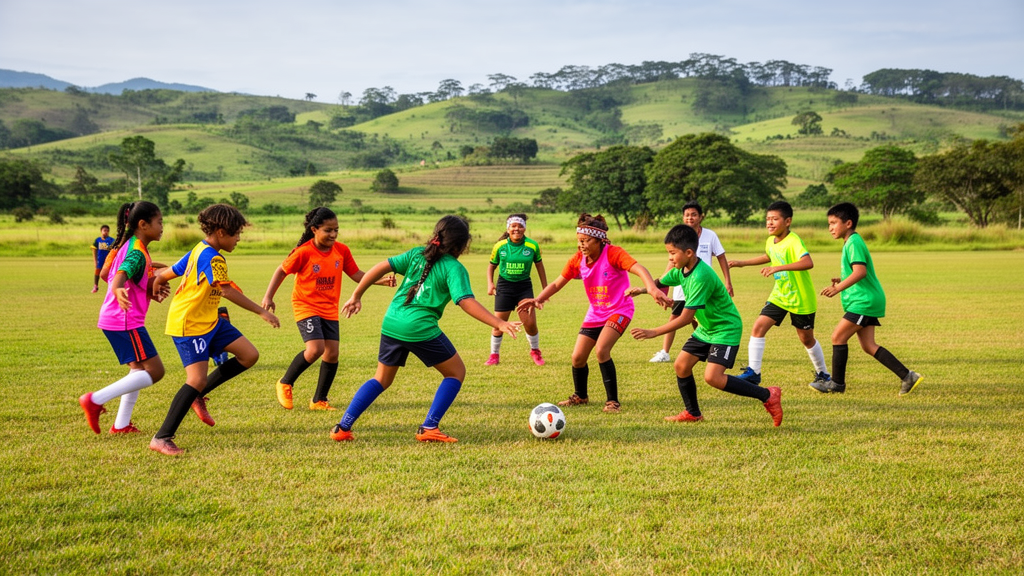
A collaborative action research study investigating the Project Niska sports initiative in the Atikamekw community of Opitciwan demonstrates that physical and outdoor activities can serve as an effective mediating framework for mutual learning and social bonding between Indigenous community members and non-Indigenous researchers. Published in Frontiers in Sports and Active Living by an interdisciplinary research team led by Tegwen Gadais and Luc Parlavecchio, the investigation examined how a six-week culturally adapted sports intervention functioned on the ground, tracing the concrete mechanisms of intercultural adaptation, personal growth, and collaborative program development. Rather than treating sport merely as a physical training exercise, the initiative analyzed its capacity to operate as a relational bridge, facilitating reciprocal human development across intrapersonal, interpersonal, and intercultural dimensions while respecting community realities and cultural safety.
The study originated from an explicit request made by local stakeholders in the First Nations community of Opitciwan in Quebec, who sought to adapt an established psychosocial sports intervention known as Alter-Action, originally created in 2009 by the non-profit Institut DesÉquilibres to support vulnerable urban youth. To transition this framework into an Indigenous setting respectfully, the non-Indigenous practitioner-researcher engaged in preliminary street-level outreach for more than three months within the community prior to formal implementation. This extended preliminary immersion was designed to build authentic social ties, establish community legitimacy, and identify local priorities through open intergenerational consultations involving youth, adults, elders, and leaders from the community’s health and education sectors, ultimately securing formal endorsement from the local Band Council.
Methodologically, the project was framed as collaborative action research grounded in research principles established with First Nations, treating community members as equal partners across the design, implementation, and analytical phases. Over a six-month period of consultation and project delivery, researchers sought to identify cross-cutting principles of intervention that could respect Indigenous self-determination while reducing implicit colonial power dynamics. The empirical investigation tracked twenty-one participants, including the forty-eight-year-old male practitioner-researcher, two local Indigenous trainee eductrainers aged thirty-four and thirty-nine, six Atikamekw adolescents aged fourteen to eighteen who completed the full training cycle, five administrative and pedagogical leaders from the local education and health services, and seven non-Indigenous academic researchers.
Data collection integrated multiple qualitative streams to capture the perspectives of participants and facilitators, combining eight semi-structured individual interviews lasting between ten and seventy-five minutes with a comprehensive two-hour focus group involving five community leaders and educators. To ensure cultural and linguistic safety, individual interviews were conducted in French or Atikamekw with the direct assistance of local Indigenous facilitators, allowing young participants to express their experiences in their preferred language. These verbal accounts were systematically complemented by detailed qualitative entries from the practitioner-researcher’s ongoing field logbook, which were subsequently explored and contextualized through a dedicated two-hour retrospective audio interview with the university-based analytical team.
The qualitative analysis followed an inductive thematic methodology using conceptual categories developed independently by two analytical sub-teams to interpret the primary units of meaning from the transcripts and logbook entries. The emergent themes were subsequently debated, refined, and validated in close consultation with Opitciwan community members to confirm interpretive accuracy. The analytical framework was organized around the Sport for Development Milestones structure, distinguishing between the fundamental rationale driving the program, designated as the why, and the concrete implementation mechanisms, designated as the how, to evaluate the observed outcomes across affective, spiritual, and professional spheres.
The physical structure of Project Niska unfolded over a six-week timeline comprising regular themed physical conditioning sessions held two to three times per week, culminating in three progressive outdoor endurance challenges. The first two-week phase focused on conditioning and walking, concluding with a collective hike up Mount Tcikatnaw. The second two-week phase incorporated technical preparation for an overnight canoe trip covering fifteen to twenty kilometers across the Gouin Reservoir. The final two weeks prepared the youth for an ambitious three-hundred-and-ten-kilometer non-stop relay expedition lasting approximately forty hours, combining a one-hundred-and-eighty-kilometer canoe leg along the Saint-Maurice River from La Tuque to Trois-Rivières with a one-hundred-and-thirty-kilometer running and cycling segment to Quebec City.
The empirical findings revealed that the operational success of the project depended heavily on the practitioner-researcher’s willingness to abandon rigid Western scheduling in favor of the community’s circular conception of time and natural operational rhythm. The practitioner-researcher documented the necessity of moderating proactivity and adopting a responsive stance, learning to accommodate delays, accept extended conversational silences, and pay heightened attention to nonverbal communication rather than reacting with discomfort. Furthermore, the pedagogical approach used to train local eductrainers had to be restructured away from formal theoretical presentations toward practical, hands-on modeling supported by concrete operational examples and situated demonstrations.
The choice of physical activities also underwent significant collaborative adaptation to reflect local heritage and cultural values. While the original non-Indigenous Alter-Action model relied heavily on conventional fitness training, cycling, and running, community feedback led to the integration of canoeing, hiking, and traditional games. Community leaders and youth consistently identified the canoe as a core symbol of Atikamekw identity and ancestral tradition, evoking connections to elders and historical nomadic ways of life. Blending these traditional outdoor practices with endurance running and cycling produced a hybrid curriculum that validated Indigenous cultural identity while fostering collective commitment toward the demanding physical expedition.
Across individual participant reports, the intervention yielded noticeable positive psychological and affective outcomes, particularly in building resilience, self-confidence, perseverance, and individual and collective pride. Participating youth reported developing the capacity to push through physical exhaustion and support their peers through mutual encouragement during grueling segments of the relay. The two Indigenous trainee eductrainers similarly experienced personal empowerment, overcoming self-doubt and acquiring structured facilitation, planning, and emotional identification skills that enhanced their ongoing professional roles within the community’s educational and social service organizations.
Beyond individual skill acquisition, the study highlighted broader spiritual and community-level impacts, with participants noting a renewed sense of cultural grounding linked to sustained contact with nature and the land. Observers from the local educational and health directorates reported a visible snowball effect throughout Opitciwan, noting that the successful completion of the three-hundred-and-ten-kilometer challenge inspired family members, local athletes, and neighboring First Nations communities. The public celebration of the youth’s achievement at the Grand Gathering of Indigenous Youth Leaders reinforced collective pride and showcased the community’s capacity to guide successful youth initiatives.
Despite these achievements, participants and leaders identified key areas for future project enhancement, emphasizing the need for improved coordination with existing community social initiatives, greater parental involvement, and stronger local visibility through social media networks rather than traditional radio broadcasts. Furthermore, participants recommended integrating deeper cultural components into future iterations, including traditional Atikamekw foods, traditional clothing, extended wilderness routes located further away from roadway corridors, and expanded instruction delivered in the Atikamekw language to enhance community ownership.
The authors candidly highlighted several methodological and systemic limitations inherent in the study, noting that while community members actively steered field execution, their direct involvement in academic writing and formal data analysis remained constrained by community service turnover and differing institutional priorities. Furthermore, while the physical project concluded within a single annual cycle, the associated longitudinal research extended from 2017 to 2023, underscoring the methodological challenge of assessing sustained, long-term developmental impacts. The researchers concluded that future sport for development initiatives in Indigenous contexts must continue developing culturally grounded evaluation tools and long-term monitoring structures to support genuine reciprocity, ethical co-construction, and lasting community benefit.
Subject of Research: Collaborative action research on an outdoor sport for development project in the Atikamekw community of Opitciwan
Article Title: Project Niska—a human development project of learning and mutual enrichment between non-Indigenous and Indigenous peoples centred around sport and the outdoors
Article References: Gadais, T., Parlavecchio, L., Bissonnette, F., Beauchamp, A.-A., Minville, E., Vinazco, S., Décarpentrie, L., & Chaubet, P. (2026). Project Niska—a human development project of learning and mutual enrichment between non-Indigenous and Indigenous peoples centred around sport and the outdoors. Frontiers in Sports and Active Living, 8, Article 1960549. https://doi.org/10.3389/fspor.2026.1960549
Image Credits: AI Generated
DOI: 10.3389/fspor.2026.1960549
Keywords: sport for development, Indigenous research, Opitciwan, Atikamekw Nation, collaborative action research, cultural safety, indigenization, outdoor education, canoeing, psychosocial intervention, intercultural learning, community engagement, youth development, qualitative methodology, DesÉquilibres, Alter-Action
News Source: Ophelia Keating. (November 20, 2026). Indigenous Community Sports Project Highlights Intercultural Learning and Collaborative Development Realities. Scienmag.