• HOME
  • NEWS
  • EXPLORE
    • CAREER
      • Companies
      • Jobs
    • EVENTS
    • iGEM
      • News
      • Team
    • PHOTOS
    • VIDEO
    • WIKI
  • BLOG
  • COMMUNITY
    • FACEBOOK
    • INSTAGRAM
    • TWITTER
Wednesday, April 1, 2026
BIOENGINEER.ORG
No Result
View All Result
  • Login
  • HOME
  • NEWS
  • EXPLORE
    • CAREER
      • Companies
      • Jobs
        • Lecturer
        • PhD Studentship
        • Postdoc
        • Research Assistant
    • EVENTS
    • iGEM
      • News
      • Team
    • PHOTOS
    • VIDEO
    • WIKI
  • BLOG
  • COMMUNITY
    • FACEBOOK
    • INSTAGRAM
    • TWITTER
  • HOME
  • NEWS
  • EXPLORE
    • CAREER
      • Companies
      • Jobs
        • Lecturer
        • PhD Studentship
        • Postdoc
        • Research Assistant
    • EVENTS
    • iGEM
      • News
      • Team
    • PHOTOS
    • VIDEO
    • WIKI
  • BLOG
  • COMMUNITY
    • FACEBOOK
    • INSTAGRAM
    • TWITTER
No Result
View All Result
Bioengineer.org
No Result
View All Result
Home NEWS Science News Biology

Incredible images reveal bacteria motor parts in unprecedented detail

Bioengineer by Bioengineer
February 9, 2018
in Biology
Reading Time: 2 mins read
0
Share on FacebookShare on TwitterShare on LinkedinShare on RedditShare on Telegram
IMAGE

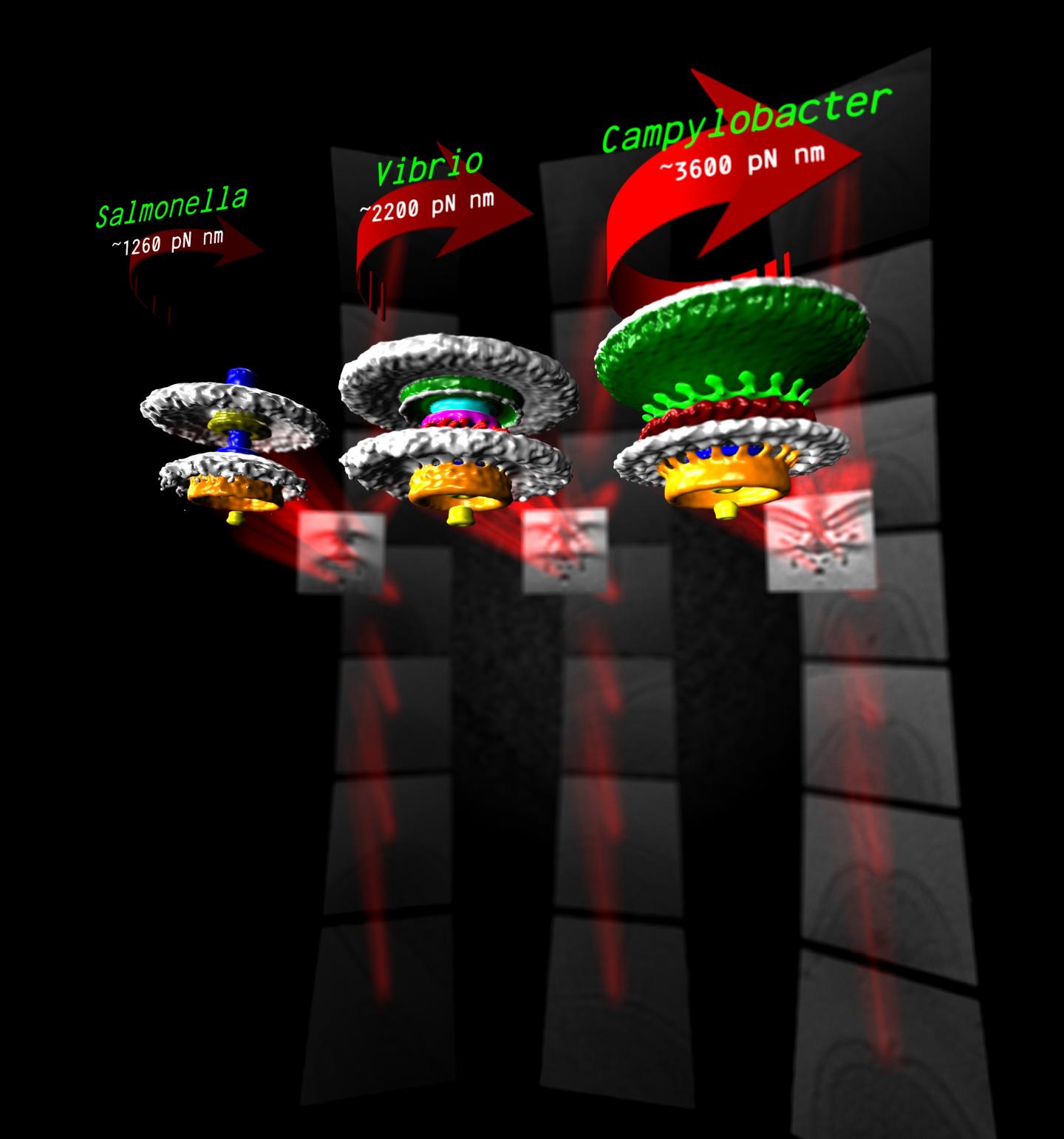
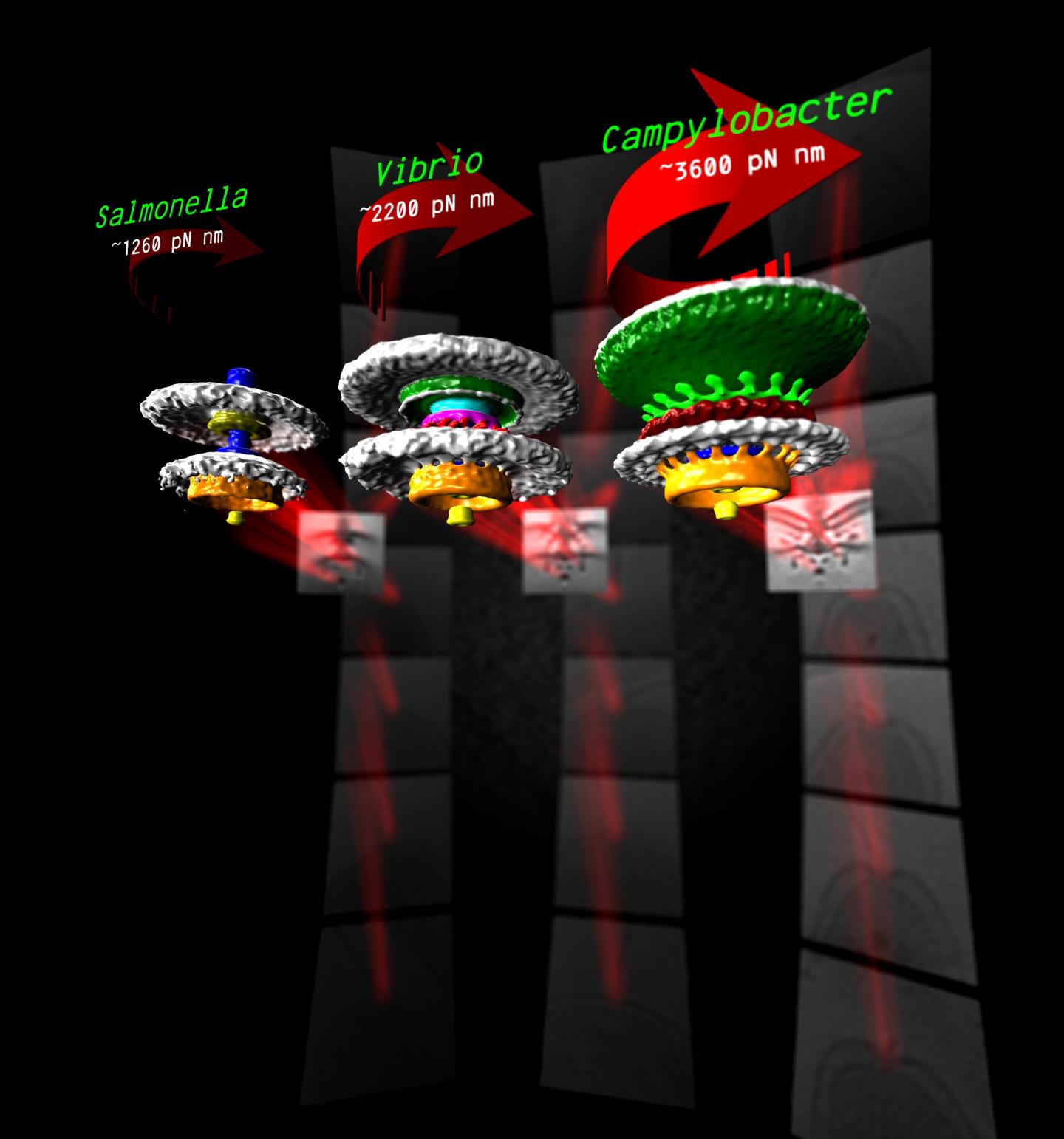
Many bacteria swim using flagella – long tails that are attached to tiny motors made of proteins, just tens of nanometres wide. These motors spin the flagella, which work as nanoscale propellers to drive the bacterium forward.

Despite motors in diverse bacteria having the same core structure, different bacteria vary widely in their swimming power. For example, Campylobacter jejuni, which causes food poisoning, can swim powerfully enough to bore through the mucus that lines the gut, an environment too thick and sticky for other bacteria to push through.

The reasons for these differences in swimming ability have remained obscure – until now. Using a recently installed high-powered electron microscope at Imperial, a team of researchers lead by Dr Morgan Beeby from the Department of Life Sciences has been able visualize these motors in unprecedented detail.

Their visualizations of these motors explains the differences in swimming ability, mathematically accounting for differences in motor power. The work is published in Proceedings of the National Academy of Sciences.

Bacterial flagellar motors work on a rotational mechanism, spinning their long flagellar tail to produce a helical propeller-like motion. The team found that stronger swimmers have evolved by adding extra parts to their motors, making more powerful motors that have increased turning force, or torque.

In flagellar motors, the turning force is produced by a ring of structures called stators around the motor. The team found that Campylobacter jejuni had almost twice as many stators positioned around the motor than in Salmonella, and that these structures sat in a wider ring. More stators provide increased torque, and the increased width of the ring means individual stators exert more leverage when rotating the helical propeller.

However, not all bacteria need to be so powerful and swim through such viscous environments as stomach mucus. Instead, another bacterium the team looked at, a close relative of Vibrio cholerae, the bacterium that causes cholera, has evolved a motor with only intermediate power.

"For the first time, we have been able to see and explain how these nanoscale molecular machines have evolved in bacteria to colonize new environments," said Dr Beeby. "It's a fascinating insight into the awe-inspiring diversity of life that has evolved on Earth, and also presents possible drug targets. We may be able to design drugs that specifically sabotage the flagella only in targeted bacterial species."

The team used a method called electron cryo-tomography to rapidly freeze the bacteria to -180 C. This prevents ice crystals from forming that would break the structure apart, allowing the researchers to image the flash-frozen motor from all angles and build up a 3D model.

By looking at distantly related bacteria from different branches of the evolutionary tree, the team speculate that the ability to alter torque in this way may have evolved up to two billion years ago.

"Entire branches of the bacterial family tree have evolved motors with different torques, leading to a diversity of species each geared to their own environment," said Dr Beeby. The team is now investigating how and when the evolutionary steps that altered motor torque happened.

###

Media Contact

Hayley Dunning
[email protected]
020-759-42412
@imperialspark

http://www.imperial.ac.uk/press

Share12Tweet7Share2ShareShareShare1

Related Posts

Do Your Genes Influence How Lifestyle Choices Affect Aging?

Do Your Genes Influence How Lifestyle Choices Affect Aging?

April 1, 2026
Combining Single-Cell Multiomics Unlocks Precise Identification of Rare Cell Types and States

Combining Single-Cell Multiomics Unlocks Precise Identification of Rare Cell Types and States

March 31, 2026

Genetically Engineered Marmosets Pave the Way for Advancements in Human Deafness Research

March 31, 2026

How Great Hammerhead Sharks Outsmart Ocean Temperature Swings: Insights from FIU Researchers

March 31, 2026
Please login to join discussion

POPULAR NEWS

  • blank

    Revolutionary AI Model Enhances Precision in Detecting Food Contamination

    96 shares
    Share 38 Tweet 24
  • Imagine a Social Media Feed That Challenges Your Views Instead of Reinforcing Them

    1006 shares
    Share 398 Tweet 249
  • Promising Outcomes from First Clinical Trials of Gene Regulation in Epilepsy

    51 shares
    Share 20 Tweet 13
  • Popular Anti-Aging Compound Linked to Damage in Corpus Callosum, Study Finds

    43 shares
    Share 17 Tweet 11

About

We bring you the latest biotechnology news from best research centers and universities around the world. Check our website.

Follow us

Recent News

Unveiling the Biological Pathways Linking Pesticides to Cancer Risk: New Study Sheds Light on Environmental Health Impacts

Inequities in Family Engagement Within the NICU

FGFR2b Links to Biomarkers, Tumor Diversity, Survival

Subscribe to Blog via Email

Enter your email address to subscribe to this blog and receive notifications of new posts by email.

Join 78 other subscribers
  • Contact Us

Bioengineer.org © Copyright 2023 All Rights Reserved.

Welcome Back!

Login to your account below

Forgotten Password?

Retrieve your password

Please enter your username or email address to reset your password.

Log In
No Result
View All Result
  • Homepages
    • Home Page 1
    • Home Page 2
  • News
  • National
  • Business
  • Health
  • Lifestyle
  • Science

Bioengineer.org © Copyright 2023 All Rights Reserved.