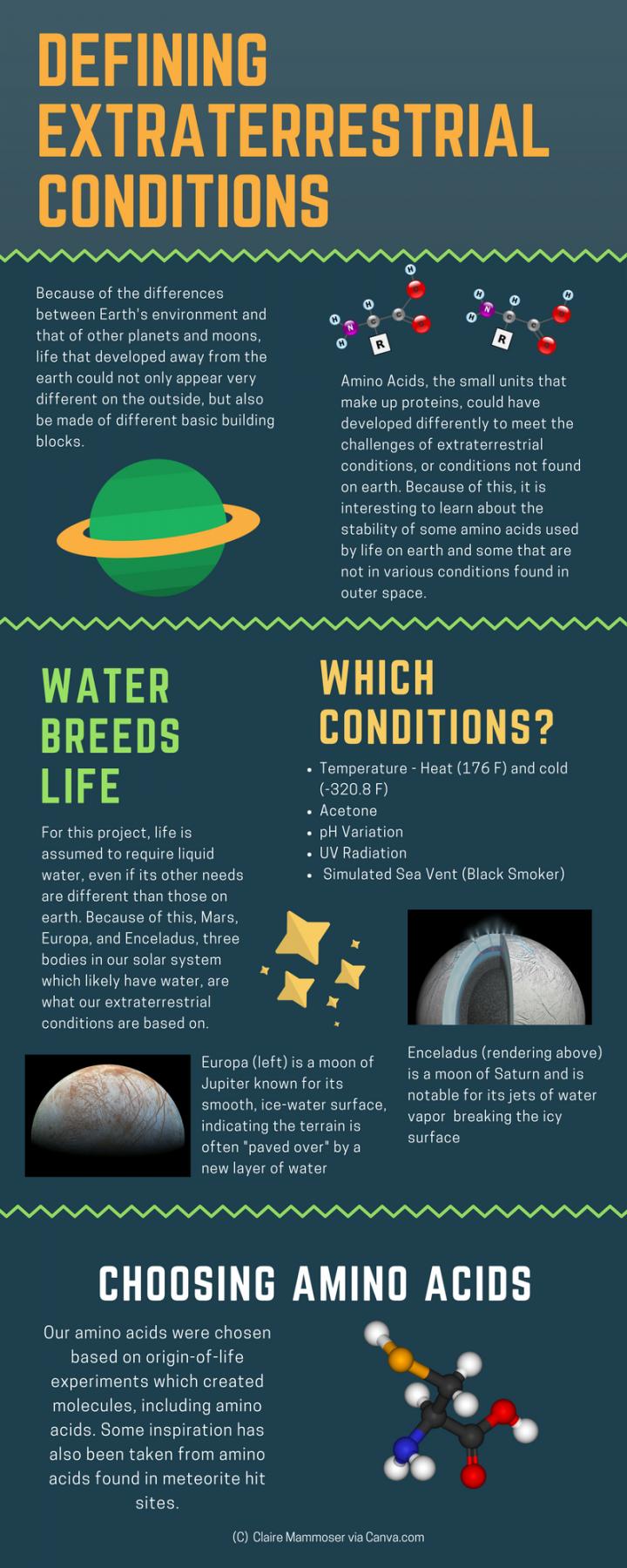
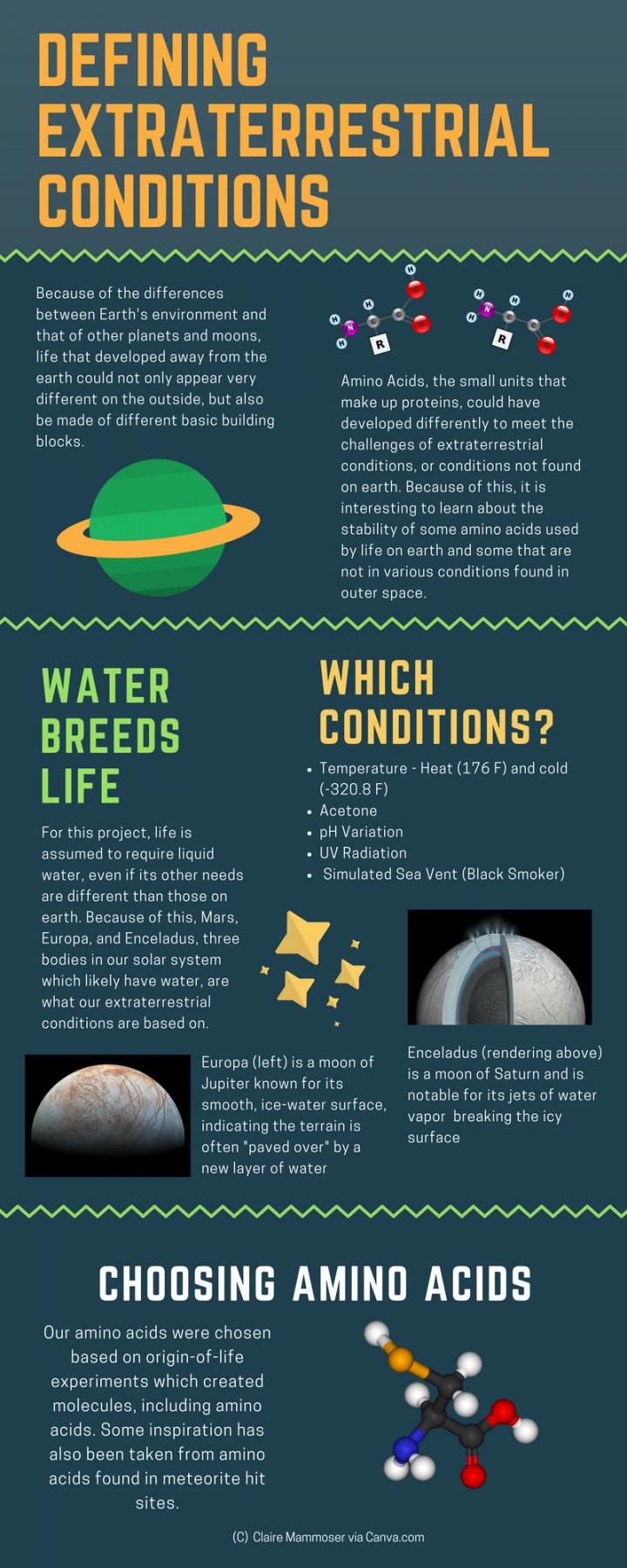
Credit: Claire Mammoser, Valparaiso University
Scientists are attempting to identify the amino acids–building blocks that make proteins and support all life on Earth–that might feasibly form the basis of extraterrestrial life. The researchers have analyzed how an assortment of 15 amino acids, some found here on Earth in living organisms and some not found in living organisms on Earth, hold up in the face of extreme conditions found on other planets and moons.
Claire Mammoser, an undergraduate research assistant in the laboratory of Laura Rowe at Valparaiso University, will present the work at the American Society for Biochemistry and Molecular Biology annual meeting during the Experimental Biology 2017 meeting, to be held April 22-26 in Chicago.
"In a different extraterrestrial locale, the proteins in an organism would not necessarily be the same as that of an organism on Earth, so they might use amino acids that are known to us but not used to make proteins on Earth," said Mammoser. "Our main goal with this research is to see if there are structural characteristics of some amino acids that lead to a higher stability in extraterrestrial conditions and then to see what those characteristics might be."
The team subjects vials of amino acids to extreme temperature, pH, ultraviolet radiation, gamma radiation and other conditions designed to mimic environments on Mars; Enceladus, a moon of Saturn; and Europa, a moon of Jupiter. Tracking the degree to which each amino acid remains intact or breaks down under these conditions, the team looks for patterns in the stability of amino acids with various characteristics, such as large size or the ability to bind with water.
"Finding trends in amino acid stability would give us an idea of what sort of amino acids may have survived in outer space long enough to create life," Mammoser explained.
Now that the team has refined its methods in a preliminary batch of amino acids, it is beginning a new round of experiments using amino acids that have been extracted from meteorites and ones created in origin-of-life experiments going back to the 1950s. They hope the research will help pin down the key characteristics that could foster extraterrestrial life.
"This work is exciting for us because there is not a lot of previous work in this area," said Mammoser. "Often, we are privileged to work on extensions of existing areas of research which have been pioneered by great minds in the field, but this project has been different in that we have done a lot of the initial development ourselves. This is both a challenge and extremely exciting, because there is a sense that we are not just gathering data, but we are also making decisions about the best way to measure amino acid stability in our lab every day."
###
Claire Mammoser will present this research at 12-2:30 p.m. Sunday, April 23, in Hall F, McCormick Place Convention Center (poster B302 610.6) (abstract). Contact the media team for more information or to obtain a free press pass to attend the meeting.
Image available.
About Experimental Biology 2017
Experimental Biology is an annual meeting comprised of more than 14,000 scientists and exhibitors from six host societies and multiple guest societies. With a mission to share the newest scientific concepts and research findings shaping clinical advances, the meeting offers an unparalleled opportunity for exchange among scientists from across the U.S. and the world who represent dozens of scientific areas, from laboratory to translational to clinical research. http://www.experimentalbiology.org #expbio
About the American Society for Biochemistry and Molecular Biology (ASBMB)
ASBMB is a nonprofit scientific and educational organization with more than 12,000 members worldwide. Founded in 1906 to advance the science of biochemistry and molecular biology, the society publishes three peer-reviewed journals, advocates for funding of basic research and education, supports science education at all levels, and promotes the diversity of individuals entering the scientific workforce. http://www.asbmb.org
Find more news briefs and tipsheets at: https://www.eurekalert.org/meetings/eb/2017/newsroom.
Media Contact
Anne Frances Johnson
[email protected]
571-271-1986
############
Story Source: Materials provided by Scienmag