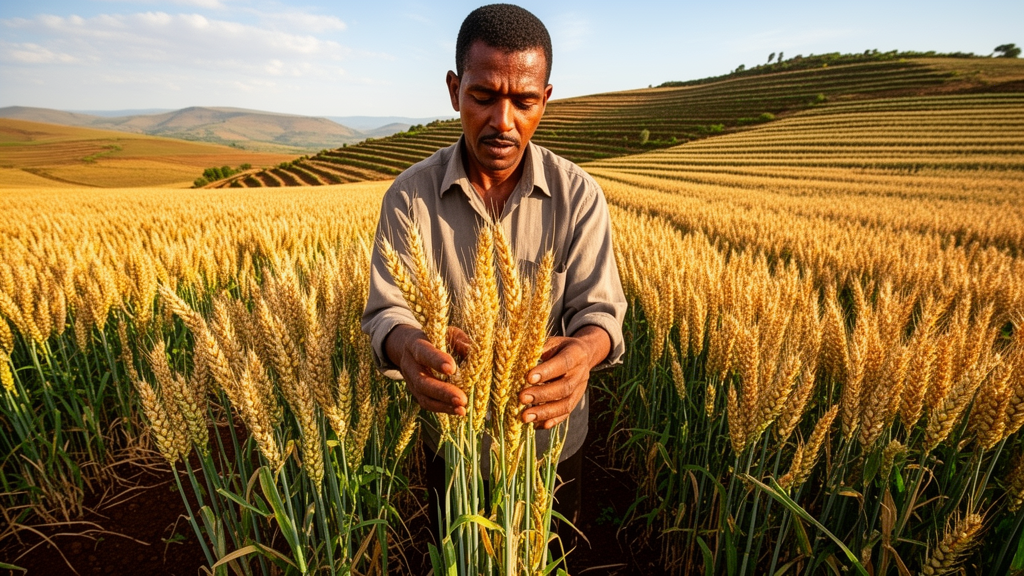
Smallholder farmers in Duna District of Central Ethiopia achieved an estimated average yield increase of 5.59 quintals per hectare after adopting improved bread wheat varieties, according to an econometric analysis that accounted for observed farm and household characteristics. The research evaluated productivity differences across rain-fed agricultural holdings where bread wheat serves as a staple food and vital cash crop. Using statistical matching techniques designed to balance disparities between adopting and non-adopting growers, the researchers identified substantial productivity advantages linked to modern wheat cultivars under local agroecological conditions. The measured difference between matched groups corresponded to an 18.4 percent yield increase relative to non-adopting control farms, or a 15.5 percent gain relative to the matched adopters’ average production level.
Bread wheat remains central to domestic food production in Ethiopia, which stands as the largest producer of the crop in Sub-Saharan Africa and accounts for roughly two-thirds of the sub-region’s aggregate output. Across the country, wheat cultivation occupies between 1.9 million and 2.5 million hectares, generating an annual harvest of approximately 5.5 million to 7 million tons depending on seasonal conditions and reporting sources. Despite this substantial footprint, national productivity has historically lagged behind the crop’s genetic potential due to low adoption rates of modern high-yielding varieties, reliance on traditional farming practices, and persistent institutional barriers. While recent expansions in irrigated production have narrowed domestic supply deficits in specific years, national reliance on imports has persisted, prompting district-level investigations into the practical determinants and productivity consequences of adopting improved seed.
To investigate these dynamics at the local administrative scale, investigators conducted a cross-sectional quantitative study in Duna District, located within the Hadiya Zone approximately 275 kilometers south of Addis Ababa. Geographically, Duna District is characterized by elevations ranging from 2001 to 3000 meters above sea level and a mean annual temperature of roughly 18 degrees Celsius, with peak monthly averages reaching 16.5 degrees Celsius in December. The district’s agroecology is heavily dominated by highland conditions, with 85 percent classified as dega, 10 percent as midland or woina-dega, and 5 percent as lowland or kola. The study area was purposively selected due to its favorable soil fertility, suitable climatic conditions for wheat cultivation, and comparatively reliable access to improved seed relative to neighboring administrative districts.
The research design implemented a multistage sampling protocol to assemble an empirical cross-sectional dataset of 264 farm households. Following the purposive selection of Duna District, three rural kebeles—specifically Le Kufana, Bure Bulishana, and Ha Letebo—were randomly selected from the district’s thirty constituent administrative units to capture representative agroecological variation. Enumerators used official agricultural extension registries to establish comprehensive sampling frames of local wheat producers, stratifying farm households into adopters and non-adopters of improved bread wheat. Within each kebele, households were selected through proportional random sampling, yielding a final analytical sample of 119 adopting households, representing 45.1 percent of the total sample, alongside 145 non-adopting control households. Overall sample size determination was guided by Cochran’s sampling formula based on an assumed adoption rate of 45 percent and a 6 percent margin of error.
Adoption was formally defined as the continuous cultivation of one or more improved bread wheat varieties for a minimum of three consecutive production seasons. This temporal threshold reflects agronomic evidence that productivity improvements and managerial familiarity typically require three to four consecutive growing cycles to stabilize under rain-fed smallholder conditions. Household wheat yield served as the primary outcome variable and was calculated as total harvested wheat production divided by the cultivated land area for the most recent completed agricultural season. Primary data collection was carried out by trained enumerators administering structured questionnaires covering socioeconomic attributes, landholding sizes, livestock ownership, institutional connections, and input utilization, complemented by published institutional and regional secondary data.
Descriptive analyses of continuous explanatory variables revealed notable structural differences between the two surveyed farming groups. Adopters operated significantly larger farms, managing an average landholding of 1.79 hectares with a standard deviation of 0.29, compared to an average of 1.29 hectares with a standard deviation of 0.28 among non-adopters, a disparity statistically significant at the 1 percent level. Adopters also possessed greater livestock assets, averaging 4.78 tropical livestock units compared to 4.31 units among non-adopters. Household heads among adopters had completed an average of 5.7 formal school grades, whereas non-adopters averaged 4.84 grades. Conversely, the two groups showed no statistically significant differences in family size, which averaged 3.44 members for adopters and 3.58 members for non-adopters, or in walking distance to agricultural markets, which averaged 7.69 kilometers and 6.96 kilometers respectively.
Bivariate categorical comparisons similarly demonstrated pronounced differences in institutional engagement and gender demographics across adoption statuses. Male-headed households constituted 78 percent of the overall sample and accounted for 90.75 percent of all adopters, compared to 67.5 percent of non-adopters. Regular contact with agricultural extension agents was reported by 90.7 percent of adopting farmers, whereas only 40 percent of non-adopters reported such contact. Participation in practical agricultural training programs reached 94.1 percent among adopters compared to 33.7 percent among non-adopters, and cooperative membership stood at 80.6 percent for adopters versus 49.6 percent for non-adopters. Formal credit access was reported by 94.1 percent of adopters and 36.5 percent of non-adopters in the bivariate summary, though multivariate modeling demonstrated a contrasting conditional relationship once other covariates were simultaneously held constant.
To evaluate the independent determinants of technology uptake, the authors estimated a binary logit econometric model comprising twelve explanatory variables. Eight predictors showed statistically significant associations with adoption: household head sex, education, farm size, livestock assets, extension contact, training participation, and cooperative membership all exhibited positive associations. Specifically, holding other variables constant, male headship was associated with a 7.96 percentage point increase in adoption probability, each additional hectare of land was associated with a 28.97 percentage point increase, and participation in specialized training corresponded to a 17.98 percentage point higher adoption probability. In contrast, access to formal credit displayed a statistically significant negative association in the multivariate model, reducing adoption probability by 12.73 percentage points, an unexpected finding likely reflecting unmeasured loan purposes, targeting criteria, or local borrowing dynamics.
To rigorously assess yield impacts in the absence of experimental randomization, the researchers deployed propensity score matching using an Epanechnikov kernel algorithm with a bandwidth of 0.01. Across the common support region spanning propensity scores from 0.0543 to 0.9854, matching substantially eliminated observable pre-treatment imbalances between adopters and non-adopters. An initial naive comparison of raw yields yielded a modest, statistically insignificant difference of 1.149 quintals per hectare between the two groups. Following kernel matching, the estimated average treatment effect on the treated revealed that adopting households produced an average of 36.00 quintals per hectare compared to 30.41 quintals per hectare for matched control households, confirming a statistically significant conditional yield premium of 5.59 quintals per hectare.
The study authors emphasize that because propensity score matching conditions solely on observable variables, the resulting yield estimates must be interpreted as conditional associations rather than unqualified causal outcomes. A Rosenbaum bounds sensitivity analysis was undertaken to examine how potential unobserved confounding could alter the statistical significance of the estimated treatment effect. Furthermore, the empirical findings reflect cross-sectional survey data derived from three kebeles within a single purposively chosen district and rely on farmer-reported yield metrics without independent physical crop-cutting validation. Consequently, the authors caution that extrapolating these yield gains or deriving broader conclusions regarding rural food security and poverty reduction requires additional multi-regional evidence and broader livelihood indicators.
Subject of Research: Impact of improved bread wheat variety adoption on smallholder agricultural yields in Central Ethiopia
Article Title: Effects of adopting improved bread wheat varieties on smallholder farmers’ yields: a case study of Duna District, Central Ethiopia
Article References: Shikur, S., Melese, M., Mathewos, T., Desta, A., & Urugo, M. M. (2026). Effects of adopting improved bread wheat varieties on smallholder farmers’ yields: a case study of Duna District, Central Ethiopia. Discover Agriculture, 4(1), Article 334. https://doi.org/10.1007/s44279-026-00807-w
Image Credits: AI Generated
DOI: 10.1007/s44279-026-00807-w
Keywords: bread wheat, Triticum aestivum, smallholder agriculture, Central Ethiopia, Duna District, Hadiya Zone, agricultural technology adoption, crop yield, propensity score matching, average treatment effect on the treated, binary logit model, agricultural extension, cooperative membership, landholding size, livestock holdings, farmer training
News Source: Alan Morgan. (November 12, 2026). Improved Bread Wheat Varieties Boost Smallholder Yields in Central Ethiopian Case Study. Scienmag.