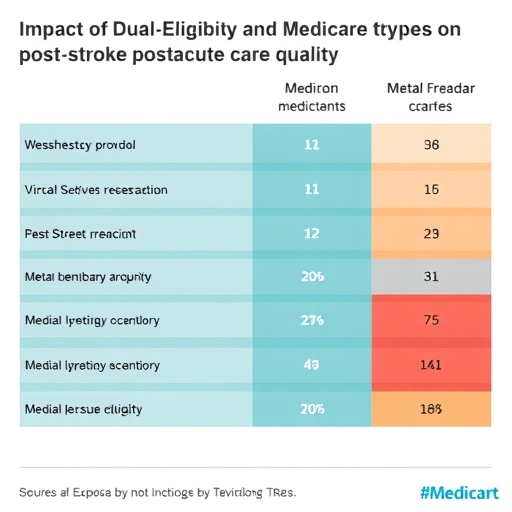
In a groundbreaking cohort study published in the prestigious JAMA Network Open, researchers reveal a striking disparity in access to high-quality postacute care among stroke patients enrolled in Medicare Advantage and those eligible for both Medicare and Medicaid, often termed dual-eligible individuals. This study meticulously analyzed longitudinal patient data to uncover systemic inequities that profoundly impact recovery trajectories in some of the most vulnerable populations within the US healthcare system.
Stroke, a leading cause of long-term disability worldwide, necessitates specialized postacute care to optimize functional recovery and minimize subsequent complications. Skilled nursing facilities (SNFs) and home health agencies (HHAs) serve as pivotal components of this continuum, providing rehabilitative and supportive services critical for patient outcomes. The study’s findings indicate that patients who are dual-eligible or enrolled in Medicare Advantage are significantly less likely to receive postacute care from providers recognized for delivering high-value services, thus raising concerns about the accessibility and quality of care dictated by insurance paradigms.
Utilizing advanced analytical methods tailored to cohort study design, the research scrutinized patient-level health data spanning multiple healthcare settings, controlling for confounding factors such as socioeconomic status, severity of stroke, and comorbidities. This comprehensive approach allowed for an incisive assessment of care patterns, highlighting structural barriers that disproportionally affect high-need, high-risk patients in the era of value-based care. Such disparities underscore the critical need for policy interventions explicitly targeting equitable resource allocation.
The Medicare Advantage program, designed as an alternative to traditional Medicare by integrating private insurance components, aims to enhance efficiency and care coordination. However, this study’s findings challenge assumptions that such integration uniformly benefits all patient groups. Instead, they illustrate that enrollment in Medicare Advantage may inadvertently limit access to premier postacute care providers, possibly due to network restrictions and reimbursement models that prioritize cost-containment over quality.
Similarly, dual-eligible beneficiaries, who often face complex health and social challenges, find themselves at a systemic disadvantage. Their reduced utilization of top-tier SNFs and HHAs could reflect both supply-side limitations—such as provider hesitancy to accept dual-eligible patients due to reimbursement rates—and demand-side factors, including socioeconomic barriers that complicate navigation of healthcare options.
This study’s implications extend beyond clinical practice into the realm of health policy and economics. With healthcare systems increasingly transitioning toward value-based frameworks, ensuring equitable access to high-quality postacute care is paramount for improving overall health outcomes and reducing disparities. Policymakers must consider revising Medicare Advantage plan structures and Medicaid integration strategies to remove bureaucratic and financial obstacles that hinder access.
Moreover, the research highlights the necessity of incorporating social determinants of health into care planning and resource distribution. Recognizing the intertwined nature of economic, social, and medical needs allows for more targeted interventions that support vulnerable patients during critical recovery phases following stroke.
The methodology of this cohort study is particularly notable for its robust observational design, leveraging large datasets to track patient trajectories over time. Such longitudinal analysis is instrumental in distinguishing causal relationships amidst complex healthcare dynamics, thereby providing actionable insights into service utilization patterns and quality disparities.
Technical scrutiny of data revealed that high-quality skilled nursing facilities and home health agencies were defined using standardized metrics based on validated quality assessments. These metrics encompass patient outcomes, readmission rates, staff proficiency, and adherence to evidence-based rehabilitation protocols, ensuring that “high-quality” designation reflects meaningful clinical performance rather than mere volume or availability.
This research aligns with emerging literature emphasizing the critical role of postacute care quality in shaping long-term outcomes after acute vascular events. It contributes to a growing consensus that mitigating disparities in access requires systemic overhaul rather than isolated clinical interventions, underscoring the complexity of health equity in an integrated care ecosystem.
The study’s multidisciplinary team, melding expertise in epidemiology, health services research, and health economics, exemplifies the collaborative effort necessary to tackle challenging public health issues. Their findings serve as a clarion call for ongoing vigilance and innovation to bridge gaps in care for populations traditionally marginalized by market-driven healthcare models.
In summary, this pivotal cohort study elucidates a disturbing trend whereby the very populations with the greatest need for rehabilitative services—Medicare Advantage enrollees and dual-eligible stroke survivors—receive comparatively inferior access to top-tier postacute care providers. Addressing this inequity is not only a moral imperative but also a strategic necessity to improve population health outcomes in the shifting landscape of value-based healthcare delivery.
For clinicians, policymakers, and health systems alike, the message is unequivocal: achieving truly equitable stroke recovery hinges on dismantling structural barriers within insurance frameworks and care networks. Only through deliberate reforms informed by rigorous research can the promise of high-value, patient-centered postacute care be fulfilled for all segments of the aging and vulnerable populations.
Subject of Research: Postacute care disparities in stroke patients enrolled in Medicare Advantage and dual-eligible healthcare plans.
Article Title: Not specified in the provided content.
News Publication Date: Not specified in the provided content.
Web References: Not specified in the provided content.
References: (doi:10.1001/jamanetworkopen.2026.0095)
Image Credits: Not specified in the provided content.
Keywords: Cerebrovascular disorders, Health insurance, Health care, Nursing, Medical facilities, Cohort studies.
Tags: disparities in postacute stroke rehabilitationdual eligibility and post-stroke caredual-eligible beneficiaries healthcare accesshealthcare inequities in stroke rehabilitationhome health agency services post-strokeinsurance influence on post-stroke care qualitylongitudinal studies on stroke rehabilitationMedicare Advantage impact on stroke recoveryMedicare and Medicaid stroke care outcomespostacute care quality measurementquality of skilled nursing facilities for strokesocioeconomic factors in stroke recovery