Tsukuba, Japan – Light is essential for most life on Earth, and single-celled or small multicellular organisms were most likely first to develop the ability to respond to light. But now, researchers from Japan have identified interesting behavior in sea urchin larvae that may provide insights into the evolution of light-responsive tissues/organelles in macroscopic animals.
Credit: University of Tsukuba
Tsukuba, Japan – Light is essential for most life on Earth, and single-celled or small multicellular organisms were most likely first to develop the ability to respond to light. But now, researchers from Japan have identified interesting behavior in sea urchin larvae that may provide insights into the evolution of light-responsive tissues/organelles in macroscopic animals.
In a study published this month in PLOS Genetics, researchers from the University of Tsukuba have revealed that sea urchin larvae reverse their swimming direction when exposed to strong photoirradiation (light) because of the impact of light on the neuron pathways that typically make them swim forward.
Light-response systems usually involve a combination of photoreceptors (cells in the retina that respond to light), nervous system components, and organs that respond to nerve impulses. These organs tend to be muscles in most macroscopic animals, and cilia (hair-like structures) play a role in microscopic aquatic organisms. The cilia-based response probably developed first, before being replaced by muscle-based responses during the evolution of deuterostomes, or more complex animals. However, ciliary responses are so subtle that they are difficult to identify.
“Cilia-based responses to light are poorly understood in deuterostomes, possibly because muscle activities are more obvious than ciliary activity,” explains lead author of the study, Professor Shunsuke Yaguchi. “Sea urchins have free-living planktonic larvae that mainly move using cilia rather than muscles, so they offer a rare opportunity to investigate the presence and mechanisms of cilia-based responses in deuterostomes.”
To do this, the researchers used a strong light source to irradiate larvae from different species of sea urchins in dishes of seawater and observed their behavior using a microscope. Before exposure to the light, the larvae had stayed mainly at the surface of the water.
“The results were intriguing,” says Professor Yaguchi. “The larvae dropped from the surface immediately, and some of them swam backward. We observed similar behavior in several species, suggesting that the response is common among sea urchin groups.”
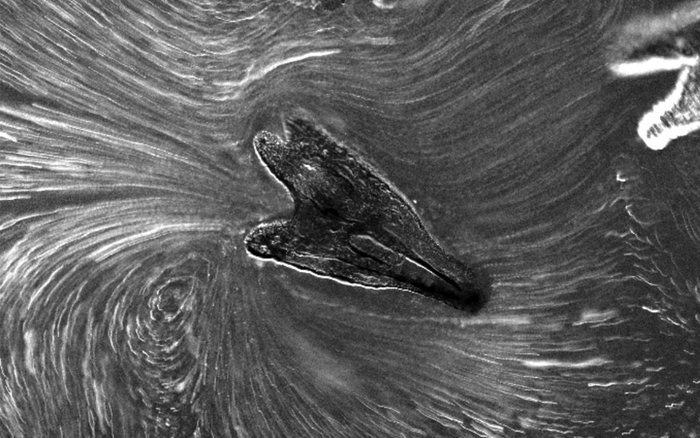
To visualize and quantify the behavior, the researchers added diatoms, or single-celled algae, to the dishes. The movements of these diatoms reflect the water current changes caused by ciliary beating from the larvae, indicating that ciliary responses are present and functional in sea urchins.
Given that cilia are present on tissue cells and facilitate key functions in most organisms, including humans, the identification of this ciliary response in sea urchins may be key in understanding the mechanisms of human behavior or feelings in response to light. Revealing these signaling pathways in sea urchins thus sheds new light on the evolution and diversification of light-response systems.
###
The article, “Planktonic sea urchin larvae change their swimming direction in response to strong photoirradiation,” was published in PLOS Genetics at DOI: 10.1371/journal.pgen.1010033
This work is supported, in part, by JST PRESTO Grant number JPMJPR194C, the Toray Science Foundation and Takeda Science Foundation to S.Y., and JSPS KAKENHI Grant number JP19K16199 to J.Y. H.S. was a JSPS Research Fellow with research grant (DC1: 19J20629).
Journal
PLoS Genetics
DOI
10.1371/journal.pgen.1010033
Article Title
Planktonic sea urchin larvae change their swimming direction in response to strong photoirradiation
Article Publication Date
10-Feb-2022