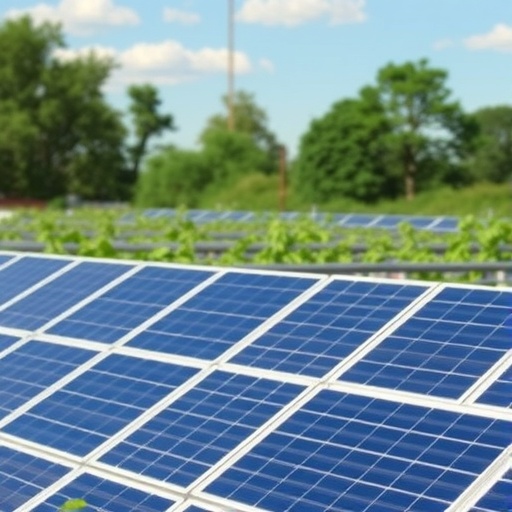
In an era where the dual imperatives of securing food production and expanding renewable energy converge with mounting urgency, scientists are increasingly investigating multifaceted solutions that optimize both. One such promising avenue is agrivoltaics, an innovative approach that physically integrates solar photovoltaic arrays with agricultural crop cultivation on the same land. A recent breakthrough study conducted by researchers from the University of Illinois Urbana-Champaign offers new insight into the complex agricultural and economic trade-offs associated with deploying agrivoltaic systems across diverse climatic zones of the American Midwest.
The research team developed a sophisticated, process-driven model meticulously designed to simulate the biophysical interactions among energy production, soil-plant dynamics, and water cycles under an agrivoltaic system scenario. This model was rigorously validated against empirical data and published in a peer-reviewed modeling journal, confirming its robustness for forecasting agrivoltaics’ multifaceted impacts. By coupling this biophysical model with an integrated economic assessment, the researchers quantified the annual net profitability per acre encompassing both crop yields and energy generation. Their analysis juxtaposed agrivoltaics with conventional standalone solar installations and traditional agriculture to assess relative benefits.
Utilizing 15-year simulation datasets, the study explored a wide range of climate conditions and configurations, specifically modeling a solar panel coverage density of roughly one-third of the farmland surface. The results illuminated the decisive role that regional climate aridity gradients play in mediating agrivoltaics’ effectiveness. In the more humid eastern Midwest, solar panel shading on crops substantially inhibited photosynthetic activity, culminating in a 24% average yield reduction for maize and a 16% decline for soybeans. This translated to suppressed farmer revenues, highlighting the detriments of indiscriminate agrivoltaic deployment in moisture-abundant zones.
Conversely, in the semi-arid western Midwest, where drought stress is a frequent limitation to crop productivity, shading from solar panels mitigated excessive evapotranspiration and water stress. Remarkably, maize yield losses were considerably less severe, and soybean production exhibited a modest yet meaningful increase of 6%. This nuanced divergence underscores that agrivoltaic systems can offer tangible agronomic and economic advantages when thoughtfully adapted to local agroecological conditions rather than applied uniformly.
The multidisciplinary research team involved experts spanning crop sciences, natural resources, environmental sciences, and agricultural economics. Their collective expertise enabled the construction of an integrated modeling framework that unites food production dynamics with energy generation economics and environmental feedback loops. This holistic approach represents a pioneering analytical tool to interrogate the highly interconnected food-energy-economic nexus critical for sustainable land use planning.
Beyond academic implications, the findings carry substantial policy relevance. The study identified “win-win” scenarios where soybean-dominant agrivoltaic systems in semi-arid regions yield concurrent economic benefits for farmers and solar energy developers alike. However, they also flagged significant challenges: the heightened installation costs of elevated photovoltaic panel configurations needed to accommodate row crop cultivation constrain profitability, especially compared to traditional large-scale solar fields. Policy incentives or market mechanisms would therefore be necessary to enhance agrivoltaics’ attractiveness to solar developers.
Multiple market variables modulate agrivoltaics’ financial feasibility, including volatile commodity crop prices, variable land-lease rates, and the evolving patterns of regional climate and weather extremes. The model’s sensitivity to these parameters implies that adaptive management and dynamic policy frameworks will be essential for maximizing agrivoltaics’ sustainable integration into agricultural landscapes. Researchers call for refined regional assessments and context-specific system designs to optimize land use and fulfill dual objectives of food security and green energy production.
The research received funding support from the U.S. Department of Agriculture’s National Institute of Food and Agriculture via the Sustainable Agricultural Systems project, reflecting governmental recognition of agrivoltaics’ potential to strategically co-locate agricultural and photovoltaic systems. This study’s publication in the prestigious Proceedings of the National Academy of Sciences marks a significant milestone in advancing scientific understanding of agrivoltaics as a transformative land-use innovation.
While the underlying physics and ecological biophysical modeling are technical in nature, the practical conclusion is clear: agrivoltaics is not a one-size-fits-all solution. Its success depends on precise alignment with regional climatic conditions, crop types, and economic structures. Humid areas with high soil moisture may experience net losses, whereas semi-arid zones stand to benefit from the synergy created by integrated solar shading and crop production. Future research should refine panel designs and explore agrivoltaic configurations that reduce installation costs and maximize light transmission to crops.
Ultimately, this groundbreaking investigation charts a path toward sustainable energy-agriculture synergies, balancing the competing demands of farm profitability and renewable energy expansion. It provides a robust scientific basis to guide policymakers, investors, and land managers seeking to expand agrivoltaic systems in climate-resilient, economically viable, and environmentally beneficial ways across the diversified Midwest landscape.
Subject of Research:
Agrivoltaics and its biophysical and economic impacts under varying Midwest climate conditions.
Article Title:
“Climate-driven divergence in biophysical and economic impacts of agrivoltaics”
News Publication Date:
March 2, 2026
Web References:
DOI for main study: https://doi.org/10.1073/pnas.2514380123
DOI for modeling foundation: https://doi.org/10.1029/2025MS005092
Image Credits:
Photo courtesy the University of Illinois Institute for Sustainability, Energy, and Environment.
Keywords
Agrivoltaics, Solar Photovoltaics, Crop Yields, Economic Viability, Midwest Agriculture, Climate Adaptation, Biophysical Modeling, Food-Energy Nexus, Renewable Energy Integration, Semi-Arid Regions, Humid Climates, Sustainable Land Use
Tags: agricultural solar energy systemsagrivoltaics economic impact Midwestagrivoltaics environmental benefitsbiophysical modeling agrivoltaicscrop yield solar panel shadingeconomic assessment agrivoltaicsrenewable energy Midwest agriculturesoil-plant dynamics solar farmingsolar panels crop cultivation integrationsustainable farming renewable energyUniversity of Illinois agrivoltaics studywater cycle agrivoltaic systems